
Trump Is Not Doing Russia Any Favors
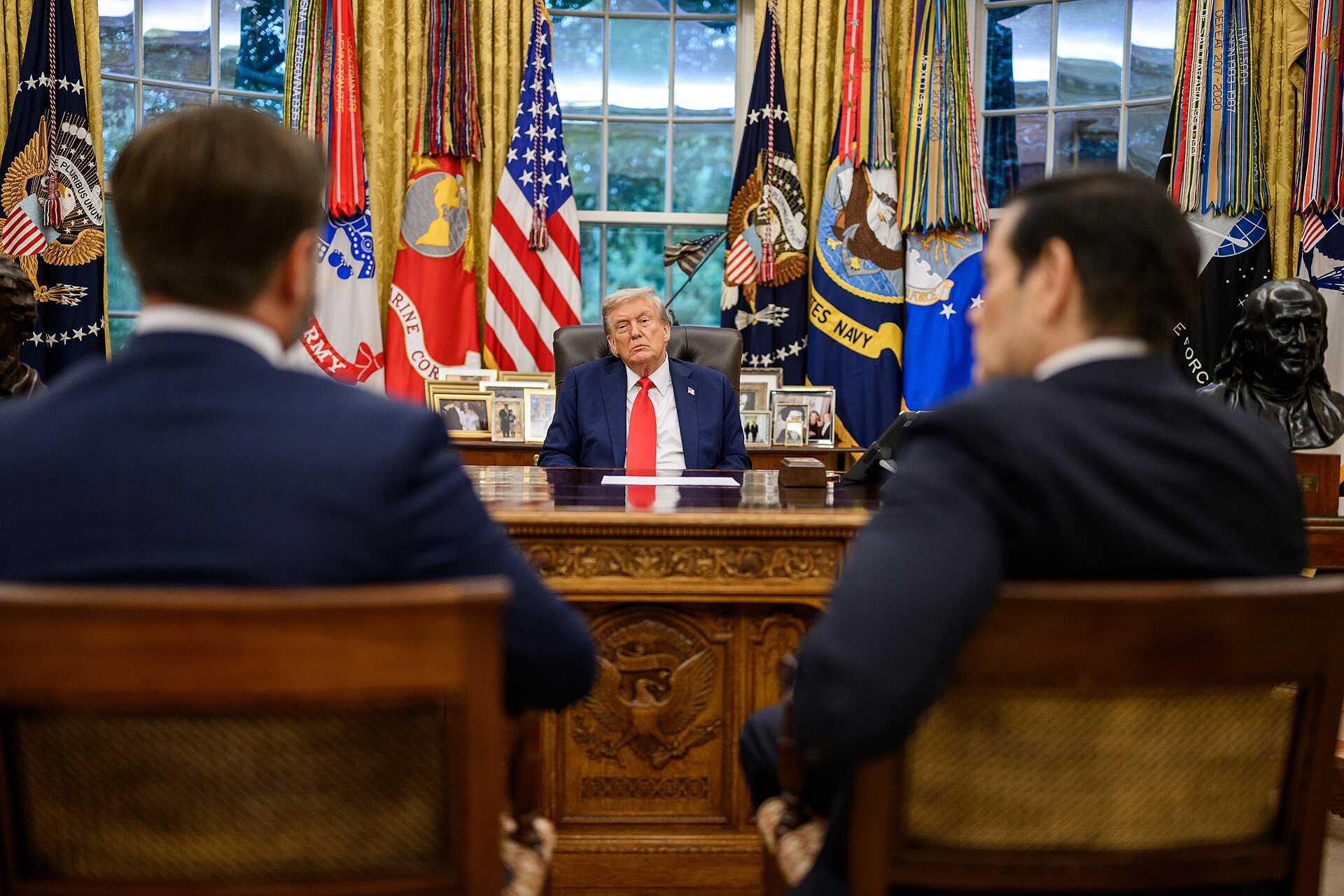
President Donald Trump meets with Secretary of State Marco Rubio and Vice President JD Vance before a call with Russian President Vladimir Putin, Monday, August 18, 2025, in the Oval Office. (Official White House Photo by Daniel Torok)
As Russia’s war of aggression against Ukraine nears its fourth anniversary, Russian President Vladimir Putin has rarely projected greater confidence of success or greater aggression toward civilian targets in Ukraine. His confidence may rest on shifts in U.S. policy away from pressuring Moscow to end the war toward pressuring Kyiv—from the blow-up with President Zelensky in the Oval Office to the recent Trump administration’s proposed peace plan, which incorporates several key Kremlin demands. President Donald Trump’s diplomatic team may entertain concessions to Moscow on Ukraine, but his overall foreign policy is unfolding in ways that militates against Russia’s long-term interests.
Putin anticipated another quick success in Ukraine in 2022 after achieving rapid military success against Georgia in 2008, then annexing Crimea and sparking and supporting a separatist war in Ukraine’s eastern provinces in 2014. His “special military operation” against Ukraine has now exceeded the length of the Soviet Union’s war against Nazi Germany. Ukraine’s successful resistance initially rested on a three-legged stool: the capacity and willpower of Ukraine’s military and society to withstand Russia; U.S. support (mainly military); and European support (military and financial). If Putin hoped that one or more of the three legs would eventually break and enable Russia to prevail, it proved to be more pipe dream than strategy. Increasingly lethal military weapons systems were approved for transfer to Ukraine and the NATO alliance expanded to include Sweden and Finland--more than doubling NATO’s border with Russia. All the while, economic sanctions against Russia steadily expanded and deepened. Then came Donald Trump’s return to the presidency. Overnight, U.S. support for Ukraine diminished. It seemed as if the three legs underpinning Ukraine’s resistance had broken. To Putin, victory likely seemed within reach at last.
Russia greatly intensified its military campaign against Ukraine in 2025. According to the Institute for the Study of War, Russia’s largest missile and drone bombardment against Ukraine prior to 2025 consisted of 210 drones and missiles. In 2025, they launched fifty-two individual strikes of that size or larger, and in total launched over 54,000 drones and over 1,900 missiles against Ukraine. Yet Russia only captured an additional 0.8 percent of Ukraine’s territory over the same period.
The meager territorial gains in 2025 resemble Russia’s tiny incremental gains in 2023 and 2024. Putin’s brutal war has failed to regain control of the over twenty percent of Ukrainian territory that the Russian army briefly held in the months following the full-scale invasion in 2022. Instead, the Russian military is mired in stalemate, with recent declared gains in the Donbass evaporating following Ukrainian counterattacks. The results of Russia’s long years of invasion, particularly the intensification of operations in 2025, demonstrate that its military is more adept at war crimes than at war.
Putin and his team of negotiators arguably had their best successes behind closed doors. At times, they seemed to convince U.S. representatives to back their peace plan, which called for Ukraine to surrender territory that Russia has been unable to capture on the battlefield, among other painful concessions. Moscow’s position, however, had little traction across the entire U.S. government and never received sustained support from the Trump administration. Popular opinion in the United States consistently shows support for Ukraine, not Russia, to prevail in the conflict.
Russian policymakers are under no illusion that President Trump is pro-Russian. Yet they would like to believe that Trump shares their mindset that great powers can dictate outcomes to weaker states. In early in 2025, Kremlin spokesman Dmitry Peskov stated that U.S. foreign policy largely “coincides” with Moscow’s worldview. Nevertheless, the Kremlin has been suspicious of President Trump’s overall intentions from the start of his new term. After all, it was during his first term that the U.S. first provided Ukraine with Javelin anti-tank weapons.
In 2025, Ukraine faced other setbacks that threatened to undermine its security. In March, the Trump administration temporarily paused intelligence sharing with Ukraine, causing painful Ukrainian losses on the battlefield. Then a corruption scandal erupted in November, reaching all the way to Zelensky’s chief of staff. It threatened to damage Ukraine’s legitimacy in the eyes of its own citizens and of supporters around the world. Yet Zelensky has emerged from the scandal undeterred. All the while, Ukraine has continued to rack up unexpected successes against Russia by expanding its tactics to target Russian refineries and Russia’s “shadow fleet” of oil tankers that help Russia to fund the war. Ukraine is also successfully targeting Russian power stations, aiming to disrupt Russia’s war economy and to give its citizens a taste of what their army has inflicted on Ukrainians since 2022.
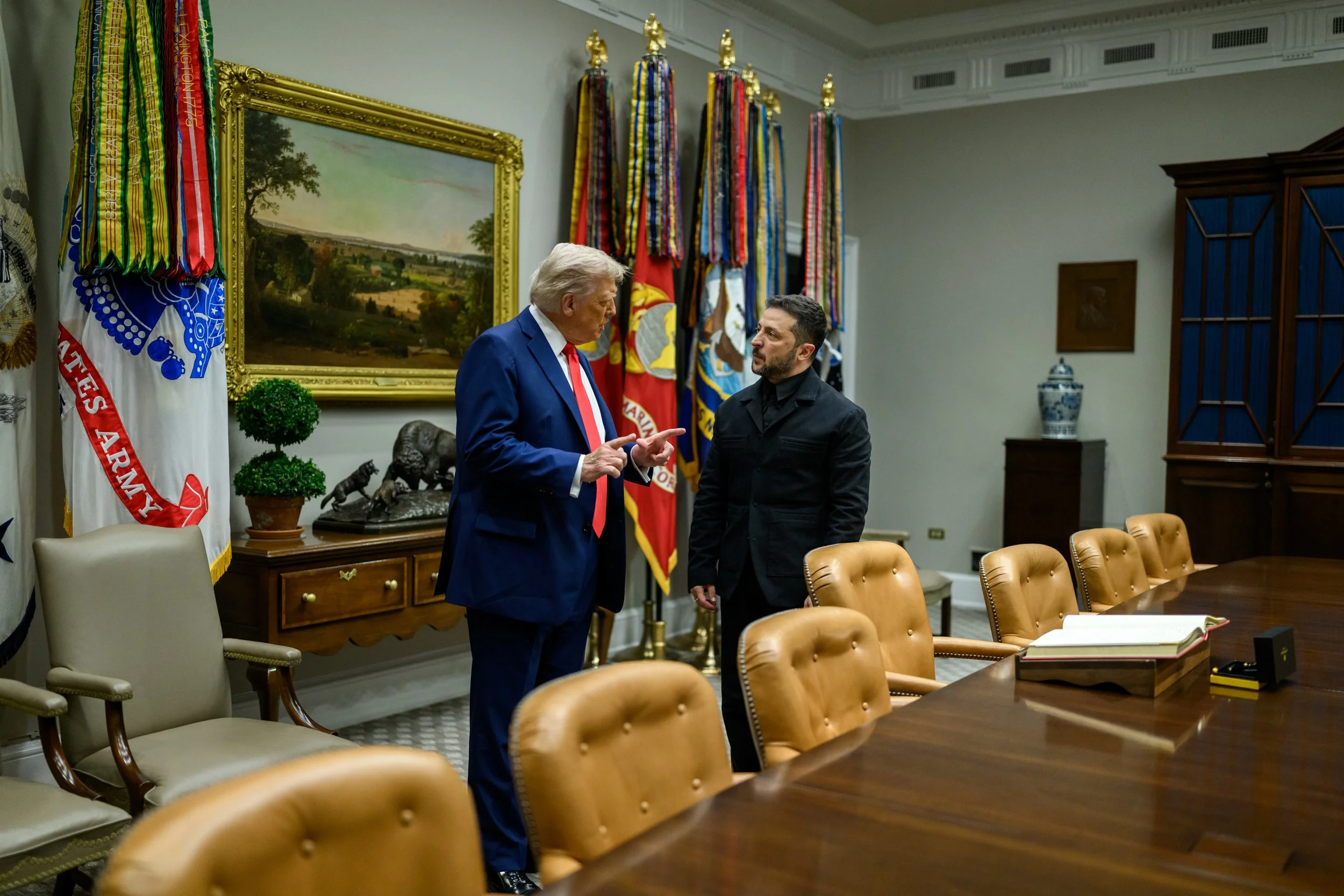
President Volodymyr Zelenskyy of Ukraine signs the guest book in the Roosevelt Room before a meeting with President Donald Trump, Monday, August 18, 2025. (Official White House Photo by Daniel Torok)
Putin surely wished for European consensus to fracture and for some sanctions against Russia to be lifted. In reality, Russia’s heightened aggression and Ukraine’s continued resilience has augmented European support. More promising by far for the Kremlin has been the chaos within the Western alliance. Destabilizing relations between the United States and Europe has been a priority for Moscow dating back to the early days of the Cold War. For that disruption to originate from Washington must have been especially welcome for the Kremlin. Yet the alarm in European capitals over the Trump administration’s rhetoric, especially over repeated threats to take over Greenland, has spurred greater EU defense spending and a more assertive foreign policy in 2025.
Putin does not want the war to end too soon. If he truly believes that NATO is about to crack up or has at least lost cohesion in standing against Russia, then now is the time for Russia to press its advantage with renewed military offensives and with air strikes on Ukrainian infrastructure intended to demoralize its people. The Kremlin is likely to refuse any ceasefire and to insist on maximal terms in negotiations with U.S. representatives, terms it knows Ukraine cannot accept.
As Putin spent 2025 burning through materiel and men to establish more favorable facts on the ground in Ukraine, he was also damaging Russian power projection elsewhere. As he did so, several Trump administration initiatives put Russia’s eroding influence into stark relief. The American capture of Moscow ally Nicolas Maduro from Venezuela is only the most recent example of Russia’s inability to deter or prevent actions against its allies abroad. The rapid overthrow of Bashar Assad in Syria in 2024 had earlier showcased Russia’s inability to protect its client, while Trump’s policy of removing U.S. sanctions and brokering relations with U.S. allies in the region will give Syria’s new government options beyond Russian patronage. Perhaps the most alarming development for the Kremlin, however, was the Trump-brokered peace agreement between Azerbaijan and Armenia in August of 2025, settling a conflict that had festered under Moscow’s watch since the Soviet Union’s fall in 1991. Vice President JD Vance recently concluded a trip to both countries, signing a strategic partnership with Azerbaijan and a deal to replace an aging Soviet reactor in Armenia. He also advanced a transit project that will connect Azerbaijan with its Nakhchivan exclave across Armenia and create an East-West trade and energy corridor bypassing both Russia and Iran.

Secretary of Defense Pete Hegseth, Chairman of the Joint Chiefs of Staff Dan Caine, and Vice President JD Vance look on as European leaders meet with President Donald Trump after his call with Russian President Vladimir Putin, Monday, August 18, 2025, in the Oval Office. (Official White House Photo by Daniel Torok)
The loss of Russian influence in its own so-called “near abroad” and beyond could not be clearer. In 2025, Putin’s government may have gained an additional 0.8 precent of Ukrainian territory, killed hundreds if not thousands of Ukrainian civilians, and repeatedly plunged millions into darkness and freezing cold with its missile and drone strikes, but it is losing power and influence for the Russian state everywhere else.
Putin’s 2025 strategy replicated the main flaw from his 2022 strategy. He again failed to account for Ukrainian resolve and resilience on the battlefield. Russia has a more serious problem. If Trump’s views on great powers are closer to Moscow’s than to most European countries, the U.S. can still act against Russian interests. In 2025, this misunderstanding was on full display, ranging from forceful U.S. diplomacy to continued U.S. intelligence support to guide Ukrainian strikes against Russian targets.
Despite its slow progress, Russia remains the stronger side in the war. Ukraine’s ability to shoot down incoming Russian drone strikes is declining. The Kremlin’s surprising ability to continue to fund the invasion and recruit new soldiers in the face of heavy casualties has shown Russia’s own resilience in prosecuting the war. Putin’s military has recently threatened key advances in several strategic towns. Russia may have endured diplomatic and strategic setbacks during the past four years, but it retained the capacity to escalate the number of drone and missile strikes in 2025 and could escalate again this year. Success for Putin is not out of the question, and he is acting accordingly.
Whereas Putin and the Kremlin leadership may view Trump’s weakening of U.S. support for Ukraine and the Western alliances as godsends, over the long term the Trump administration is not doing the Russian state any favors. With Trump’s return, Putin felt empowered to double and quadruple down on his war of aggression. To what effect? Tens of thousands more Russian casualties, an economy in shambles and reliant on China, and a state with incredibly diminished potential to project hard or soft power for years if not decades to come. Even the gifts that Putin’s team welcomed last year, such as the growing prospects of a rupture in the NATO alliance, have had negative consequences. Trump is handing Russia a more unified Europe that is rebuilding its militaries in response to both Moscow and Washington. Assuming the next U.S. president returns to a more confrontational posture toward Russia, Moscow may find itself confronted only a few years from now by a renewed, and far stronger, alliance on its doorstep, while Russia itself is exhausted by long years of war.
Joseph Dresen served as Senior Program Associate at the Kennan Institute when it was a program of the Wilson Center. He has an extensive background in working with scholars and experts to convey their expertise to public and policy audiences, as well as the administration of academic and other kinds of exchange between the United States and the countries of the former Soviet Union. He has written and given public and private briefings on issues including Russian energy, human rights, and rule-of-law issues.