Cheburashka’s Second Coming
Film trilogy ‘Gena the Crocodile’, ‘Cheburashka’ and ‘Shapoklyak’ based on the stories by Eduard Uspensky.
The story of Cheburashka, a seemingly innocuous cartoon and film character, has much to tell us about today’s Russia and its cultural landscape. A big-eared, big-eyed, clumsy brown creature walking upright on its hind legs first appeared in the 1960s, the invention of Soviet children’s author Eduard Uspensky.
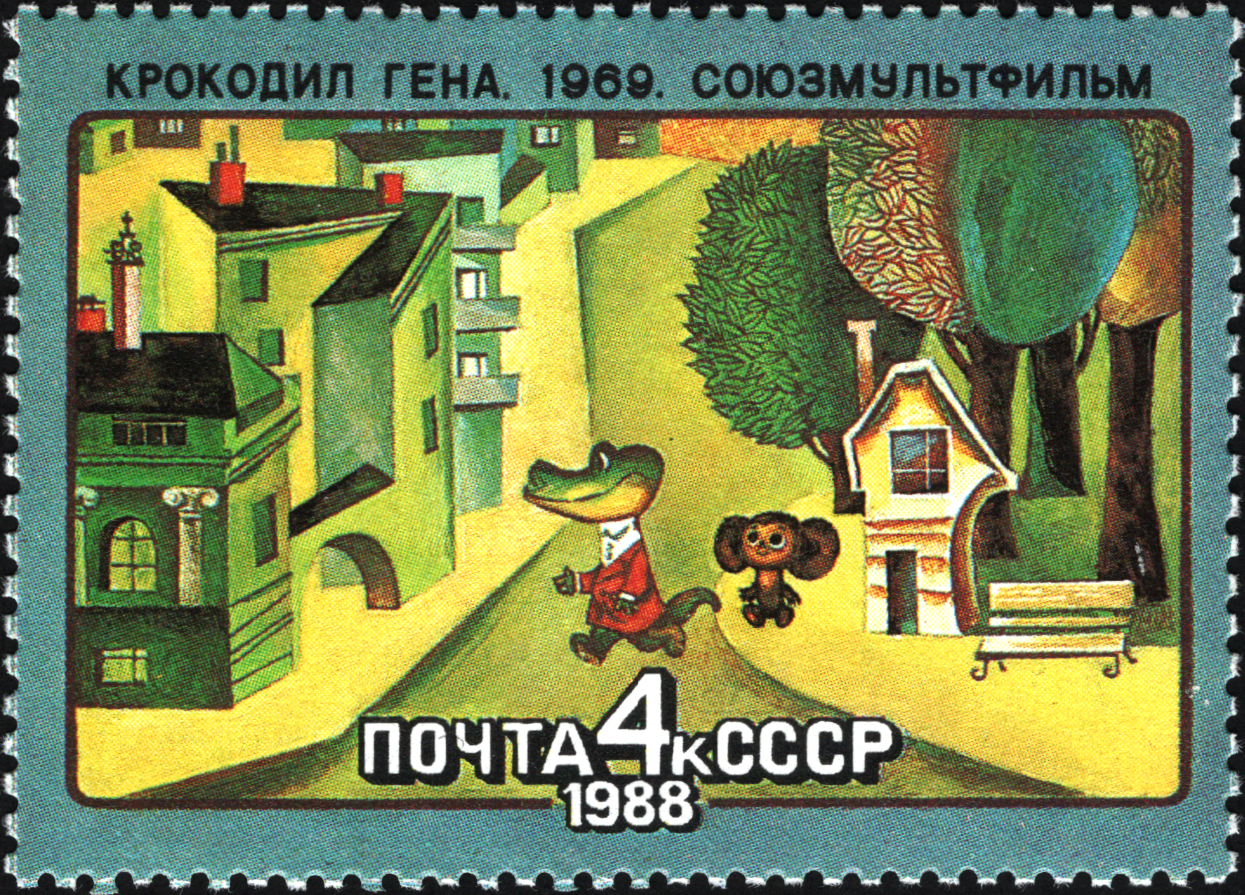
The 1969 stop-motion film Gena the Crocodile turned Cheburashka, an “animal unknown to science,” in the author’s own phrase, into a staple of Soviet mass culture, complete with appearances on official postage stamps.
The recent release of the animated-live-action family film Cheburashka 2 has confirmed its title character’s longevity. The sequel premiered on January 1, 2026, and within days grossed billions of rubles and drew millions of viewers, elevating it to the second highest-grossing post-Soviet Russian film, trailing only the first Cheburashka (2023).
Amid an artistic landscape where many subjects are heavily circumscribed and direct social critique carries real risks, both Cheburashkas have resonated across age groups and regions, not only as a nostalgic revival but as a rare domestically produced film that commands mass attention. In the years before Russia’s full-scale invasion of Ukraine in 2022, Western films, especially Hollywood blockbusters, regularly dominated the Russian box office, often outperforming local productions. After major U.S. studios withdrew from the market Russian films have taken an increasingly large share of cinema revenue.
Cheburashka, Topple in an early English translation, is a strange creature, but in other respects deeply typical. The original Cheburashka books and animated cartoons were examples of how writers, artists, and directors found paths to audiences within a heavily censored cultural environment. Under Soviet rule, children’s books and animation often became a refuge for authors who could not express themselves openly in other media or genres. Ostensibly apolitical and harmless figures – fairy-tale creatures, talking animals, toys that come to life, and generic human types such as parents and children – inhabited a carefully negotiated space of safe expression.
Many artists who later became internationally recognized – among them Ilya Kabakov, Erik Bulatov, and Viktor Pivovarov – started out as children’s book illustrators, a role in which they produced a remarkably rich and enduring body of work. Composers such as Mieczysław (Moisei) Weinberg and Alfred Schnittke wrote extensively for cinema and animated films, genres for which they were known during the Soviet period. Only later would their symphonies and concertos, the deeper works of their output, gain broad recognition. They continue to be performed extensively on the international stage.
The creators of the recent Cheburashka franchise draw on a long-standing tradition of world-building designed to sidestep political red flags and uncomfortable realities. Yet something essential has shifted. For figures such as Bulatov or Schnittke, work in children’s books, animation, or film functioned as a strategy of survival, a way of bypassing censorship while preserving artistic depth. For many of their contemporary successors, the same genres now serve a different purpose: not bypassing censorship, but bypassing reality itself.
As film critic Anton Dolin notes in his book Bad Russians, the latest Cheburashka films construct a benign Russia, a sheltered world designed for leisure and comfort. The main characters live in spaces such as a botanical garden and a zoo, environments created for amusement rather than real life. People work only to help and entertain others: a gardener, an ice-cream vendor, a janitor, countless chocolate sellers.
There are no real problems or obligations here. Even disasters could be a boon: a hurricane brings a rain of sweet oranges. Authority barely exists, conflict is mild and easily resolved, and even tensions between big and small business dissolve under a candy-colored shower at a chocolate festival. In this world, smiles matter more than truth and difficulties are always temporary, if they exist at all. “Even in Eduard Uspensky’s 1966 book, there was a comical and satirical boss-bureaucrat named Ivan Ivanovich. Here, however, there is no authority figure at all, except for the silent police officer on duty who records the destruction in the store,” writes Dolin.
The realities of today’s Russia are harsh for many groups, including writers, directors, composers, and artists. Some are imprisoned, others face prosecution, censorship, or sustained pressure from the state. But leaving the country is far easier than it once was. Some of those who stay are still able to find space for their art. In Russia’s largest cities, especially Moscow, the cultural scene is booming. Small independent theatre troupes stage intellectually demanding productions; poetry readings draw large audiences; independent venues regularly perform contemporary classical music, occasionally even including works by Ukrainian composers such as Valentin Silvestrov. Visual art exhibitions attract substantial crowds, and the contemporary art scene, which thrives in private venues, is active and expanding.
Last December, the ZILART Museum opened in Moscow on the site of the former ZIL industrial zone, once home to a major Soviet automobile manufacturer. The museum was founded by Andrei Molchanov, a major real-estate developer, art collector, and well-connected figure. Molchanov’s stepfather, Yuri Molchanov, worked alongside Vladimir Putin during Putin’s brief stint at Saint Petersburg State University. The works on display include an installation by Grisha Bruskin and an installation by Alexander Brodsky, both internationally recognized Russian conceptual artists. Kabakov or Bulatov would not be able to show their conceptual work in Soviet Moscow.
Explicit anti-war or anti-government statements are, of course, absent. In contemporary art, one can position oneself in so high-minded a way that one floats above the everyday tragedy of war. In mass-market culture, one can sink below it, as in the case of Cheburashka, where reality is softened into harmless fantasy.
Even a whitewashed, idealized Russia constructed for the big screen does not escape criticism from within the country. The far-right political theorist close to some of the top bureaucrats Alexander Dugin told a pro-Kremlin newspaper recently that the historical emergence of Cheburashka coincided with a turn toward bourgeois values and cultural infantilism. “That’s how the USSR collapsed. Cheburashka destroyed it,” Dugin claimed. “We had already forgotten about him. He belonged to the Brezhnev era. But now, with the complete absence of any real ideal capable of mobilizing us, Cheburashka is making his second coming. Everyone giggles and nods, sinking into the slumber of late Soviet degeneration.” Coming from a thinker who demands mobilization and sacrifice, this critique is revealing: even an aggressively depoliticized fantasy world can appear dangerously pacifying, when power itself has run out of convincing ideas.
This is not mere rhetoric. Last week, the State Duma unanimously approved government amendments to the law on culture in the first reading. The changes introduce two new provisions, the most notable of which expands state support for the production and distribution of children’s animated films, raising public funding from 70 percent to full, 100 percent coverage of estimated costs, a model already applied to children’s feature films. At the same time, an order issued by the Ministry of Culture designates the state’s current thematic priorities: historical education; stories about participants in the Great Patriotic War; the traditions of the peoples of Russia; family values; and the promotion of professions. Together, these measures clarify the cultural logic at work. The state is willing fully to underwrite genres and narratives that are politically safe, emotionally soothing, and mobilizable through nostalgia rather than conflict.
When avoidance becomes a choice rather than a necessity, it ceases to be a strategy of survival and becomes a form of conformity. In today’s Russian cultural scene, avoiding the direct expression of political views, including an anti-war position, appears less a matter of coercion than of choice, a conclusion borne out by the examples discussed above. Cheburashka’s second coming marks less a revival than an inversion of Soviet cultural tactics. It signifies comfort without pressure, innocence without irony, and nostalgia without memory.