
The Dangerous Legacy of Alexander Herzen
After Moscow’s “special military operation” in Ukraine began four years ago, negative comments about the nineteenth-century writer and opposition figure Alexander Herzen intensified across Russian social media. Herzen, who famously criticized Russian aggression towards Poland in 1863, was recast as an enemy of his homeland, while his contemporary Mikhail Katkov, a conservative journalist, was resurrected as the patriot who earned the Tsar’s thanks by “tearing the tongue out of The Bell,” Herzen’s signature publication.
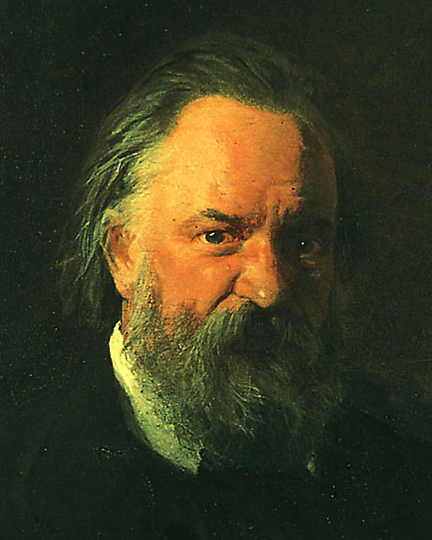
By May 2025, a judicial conference in St. Petersburg had framed Herzen as a figure of foreign interference, foregrounding the enduring political role of a man who died in 1870. He was also labelled a “chronic affliction,” someone who allowed people to think they could love their country (strana) while despising the state (gosudarstvo). Herzen himself used medical metaphors to explain that his generation could not fix all of Russia’s problems. “We are not the doctors, we are the pain, and what will become of our moans and groans we do not know, but the pain has been declared.” In the eyes of official Russia, he is evidently still a pain.
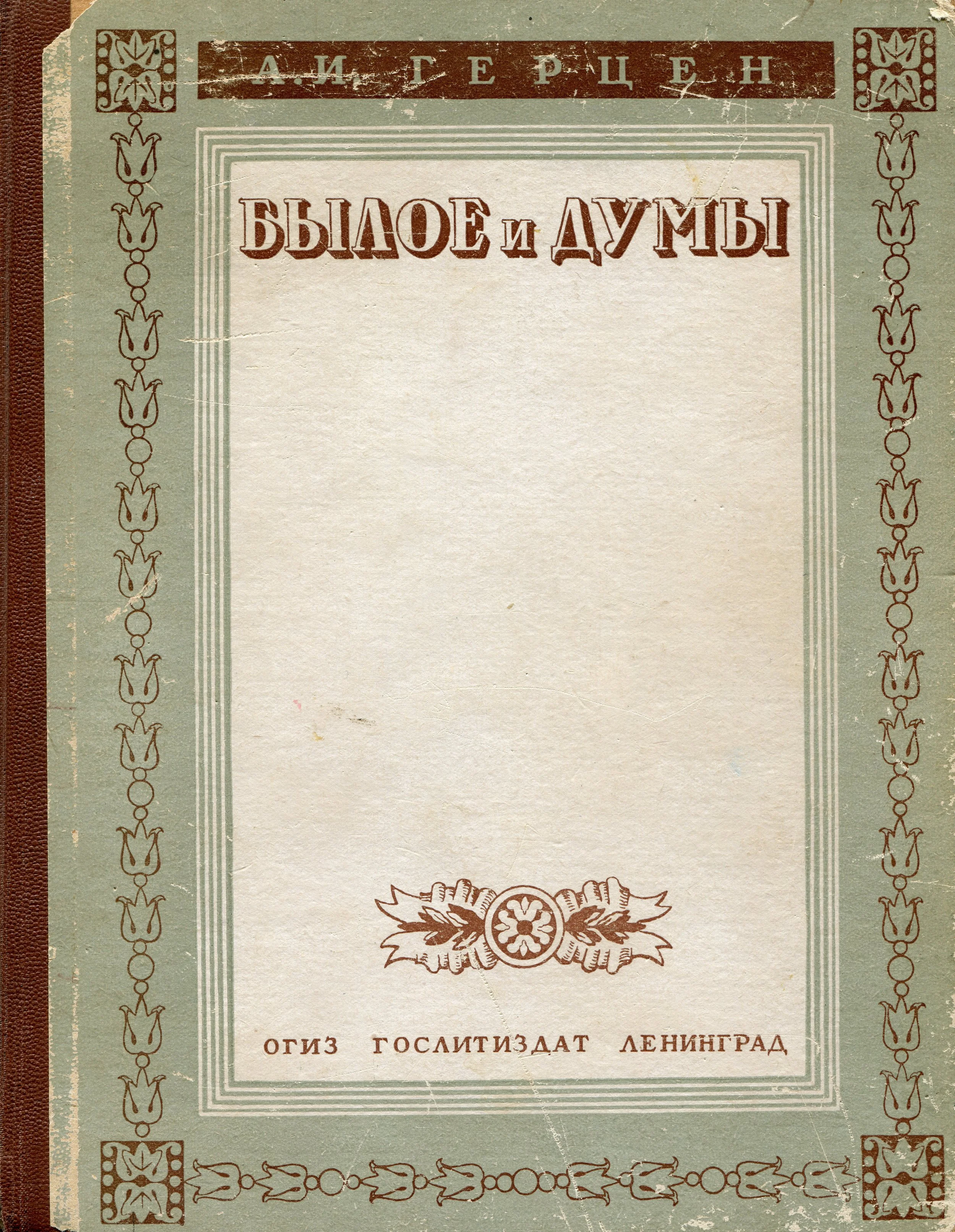
Past and Thoughts by Alexander Herzen
The guide to Herzen has always been Past and Thoughts, but it can obscure other sources for his biography and politics. Isaiah Berlin complained that more of his hero’s prose had to be translated to appreciate this extraordinary life. A Herzen Reader (2012) made available editorials and exposés from The Bell, which – after a clandestine journey from London - regularly showed up on Tsar Alexander II’s dining table, delivering a bracing dose of news about corruption, secret government deliberations, and the oppression of Russians, Poles, and Ukrainians. Further layers of Herzen’s life will be revealed in a new biography (Herzen’s Letters. A Life in Opposition) due out this spring.
Herzen’s personal letters comprise more than a dozen volumes of his collected works, along with “open letters” to friends and foes. Letters make a substantial contribution to his life story, with their range of emotions, their testing of theories in real time, and their details of the age in which he lived and the people around him. In a single message Herzen may ask for updates, argue principles or tactics, describe works in progress, celebrate a victory or mourn a defeat, and wax nostalgic about Moscow. The reader is never in doubt as to the writer’s mood, whether confrontational, inquisitive, or affectionate.
Herzen engaged in spirited debates with many famous intellectuals of the period, including: Vissarion Belinsky, Timofey Granovsky, Ivan Turgenev, Leo Tolstoy, Mikhail Bakunin, Pierre-Joseph Proudhon, and Jules Michelet. For him, “everything is clinched and noted down in letters without rouge or embellishment, and it all stays there and is preserved, like a mollusk enclosed in flint, as though to testify at the Last Judgment.” Less monumental than the memoir, his correspondence records daily skirmishes rather than epic battles, offering a refreshingly honest portrait of how difficult it was to become – and remain - the hero of Past and Thoughts. What follows is just a sampling.
*
Despite the confident tone of essays written in the early 1850s, Herzen’s letters admitted that “I don’t know what lies ahead,” and that his philosophy of history “is not science, but an exposé, a curse on absurd theories and absurd liberal orators.” Since a return to Russia would inevitably involve arrest, he explained that he remained abroad “to be your uncensored voice.” By fall 1852, newly settled in London, Herzen wondered whether to record his life to date, or to avenge himself on his late wife’s lover. He was carried back to his Moscow childhood, “this strange world, patriarchal and Voltairean,” but worried that a memoir would “cover moral defeat with literary success.” He soon resolved to also campaign for the emancipation of the serfs, and, within a few months, the Free Russian Press was up and running. Fifteen years later, weary from attacks on his work as a publisher, he insisted that “this wasn’t a conspiracy, but a printing press.”
Correspondence from Herzen’s final year tracks the genesis of his valedictory “Letters to an Old Friend.” The senseless destruction caused by revolutionaries in 1790s France was meant to be a cautionary tale for Bakunin and his circle. “With coercion one can destroy and clear a place, but nothing more,” and those intent on ridding Russia of tsarist absolutism were themselves absolutists. So powerful was Herzen’s message that, after his death in 1870, Sergei Nechaev, a fake revolutionary but a genuine murderer, threatened retribution against Herzen’s heirs if the essay were ever published.
Whether the subject was Europe in 1848 or Russia in the 1860s, Herzen opposed any nation or group seeing the masses as “cannon fodder.” He supported Alexander II until retrenchment and repression set in and wrote that he would never call for “the axe” while there was a chance to solve Russia’s problems peacefully. Critical of anarchists and bomb-throwing revolutionaries, Herzen saw himself as a metaphor-wielding satirist, who weakened his enemies by making them look ridiculous. As the 1860s advanced, and progressives turned radical, Herzen insisted that accurate information, sound advice, and discussion were prerequisites to successful political action. To liberals, afraid that supporting Poland could endanger their reform-era privileges, he said that Russia still had “a great many policemen, but very few rights.”
*
By calling himself a “Russian socialist” Herzen highlighted the stability and equity of the peasant commune. Correspondence underscores his rejection of political violence, all-embracing ideologies, and “librettos” offering blueprints for the future. Gut feelings (chut’ë) and firm principles helped Herzen choose paths to follow and people to trust, and he saw himself more a bogatyr (a Russian knight), pausing at a crossroads, than a Pugachev, destroying everything in his path. He never made it look easy to forge a new life far from home but was confident that his efforts were honest and worthwhile.
Herzen’s book Letters from France and Italy contains disparaging comments about a French bourgeoisie obsessed with fencing off their property, and a broadened electorate that voted for mediocrities, but it is more accurate to call Herzen a snob than a radical. He was drawn to key historical actors and events, improbably describing himself as a witness (age six months) to the 1812 French occupation of Moscow, when Parisian friends recognized his father Ivan Yakovlev in the street. After that encounter, Napoleon sent Yakovlev to Petersburg with a message for Alexander I. Herzen was close in age to Mikhail Lermontov and Nikolai Gogol, and in ideas and style to Griboyedov, Chaadaev, and aristocratic Decembrists, and illegitimacy mattered less to him than his father’s noble background.
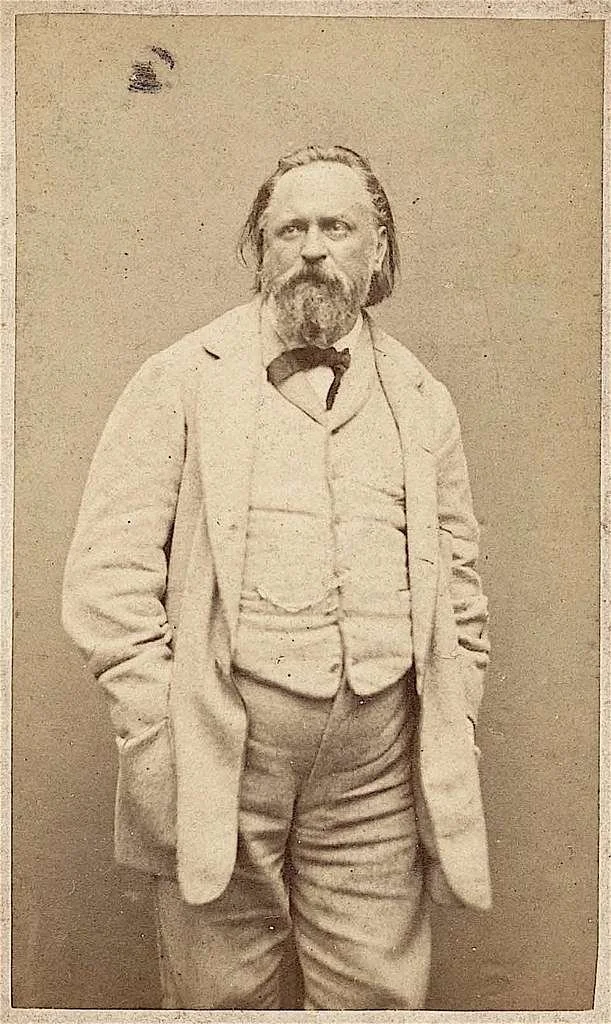

Alexander Herzen c. 1865 - 1870
Herzen inherited a substantial income. Despite the Tsar’s best efforts, was able to transfer most of it abroad, where he carefully managed his capital in order to support family, friends, and the Free Russian Press. Although he often described money as a political weapon, he also had the gentry’s taste for elegance in clothing and living quarters, and insisted that people of advanced views should still read widely, write well, and know how to dance. His definition of nihilism is somewhat idiosyncratic, involving a rejection of prejudices and receptivity to new ideas, while he saw his younger countrymen merely wearing a “nihilist costume,” as they imagined “that socialism consists of people giving them money.” As a correspondent, Herzen was neither a repentant landowner, an ascetic intelligent, nor a superfluous man, and could not be shamed into funding causes for which he lacked sympathy and respect.
*
Petersburg officials, realizing that Herzen’s silence could not be bought, repeatedly attempted to frighten him with spies, slander planted in European papers, and anonymous death threats. As a young man, he had survived arrest, jail, a sham trial, the perfunctory announcement of a “death sentence,” and internal exile, so he was battle-hardened. Not afraid to hold others to his strong moral code, he called liberal support of the government shameful, and conservative journalists’ diatribes against Poland as crossing “a moral boundary, beyond which there is neither insult nor offense.” In the Soviet era, Anna Akhmatova liked to cite his indictment of reactionary Slavophile Ivan Aksakov, who “couldn’t even manage to remain silent” when political prisoners were sentenced to hard labor. Herzen also set standards for the Tsar’s critics: get your facts straight, do not spread misinformation or sacrifice others to poorly planned schemes. He was nostalgic for the old nobility’s sense of personal honor and lamented that his generation of superfluous men were succeeded by an ill-tempered, restless cohort, whose tone “could drive an angel to fight and a saint to curse.”
As his press graduated from pamphlets to almanacs (The Polestar) and a biweekly newspaper (The Bell), Herzen heard that his investigative journalism and irreverent humor worried liberals, who wanted to give reforms a chance, and progressives, who opposed propping up a rotten regime. Herzen had faith in his approach, writing that not everything he aimed for would be accomplished in his lifetime, but “we can see the goal, and we see that fanatics interfere with the matter at hand more than assist it.” He wrote to Ogaryov in 1868 that “the idea will not perish” and told his son that “our opposition can no longer be left out of historical accounts, and it will stir the hearts of the younger generation.” This prediction was validated a century later when Soviet dissidents, opposed to the invasion of Czechoslovakia, resurrected Herzen’s mantra “For Your Freedom and Ours.”
The Bell supported the 1863 Polish fight for freedom, encouraging Russian officers not to follow orders that, if not illegal, were certainly immoral. Herzen was disheartened by support voiced by prominent citizens of Petersburg and Moscow for the slaughter of Poles. He wrote to Ivan Turgenev, who was more concerned with his own freedom to travel than that for the Polish nation’s survival, that only through protest could “the honor of the Russian name” be preserved. The Bell followed Ukraine’s aspirations as well, believing that a reconstituted Poland must not include Ukrainian land. After the death of yet another incarcerated political activist, The Bell asked what it was about Russian prisons that caused healthy young men to die within a few years, and the paper denounced the official lies, hypocrisy, and criminal negligence surrounding such cases. Sadly, these exposés of the Russian penal system are as relevant today as they were a hundred and sixty years ago.
*
Herzen was open about his enduring love for Russia, often recalling the day he departed in January 1847, when he and his family were accompanied to the first posthouse by close friends, many of whom he never saw again. Poignant passages in his letters describe the sheer physicality of his yearning for Moscow, which he had to leave twice, traveling eastward in 1835 for an undetermined period of internal exile, and westward in 1847 for an equally undetermined period of time in Europe. Remembering how his evening guests got bundled up before venturing out into a wintry Moscow night, he wrote that “at times you all stand in front of me with a terrible clarity, and I remember, and remember, and finally am frightened.” When news came of historian Timofey Granovsky’s death, Herzen described how “inside there is pain and an aching feeling, loneliness, and the steppe.” Shortly before his own death in January 1870, he wrote how a Moscow visitor to Paris “filled the entire neighborhood with the fragrance of the Arbat and Prechistenka,” invoking the names of Moscow’s historic streets.
Herzen’s love of Russia was not based on abstractions like velichie (greatness in size and power), but on memories of Moscow University, summers in the countryside, and a circle of friends. Once it was clear that he could not return home, he decided, like some who left after 1917, that he was not in exile, but on a mission, and, during twenty-three years abroad, Herzen became his country’s first modern political émigré. Despite criticism then and now that he used his riches to spread hatred of Russia, Herzen was a hard-working journalist who wanted Europe to respect Russians, and Russians to respect themselves. He once advised his friend Nikolai Ogaryov that “wherever fate has cast you is where you should get down to work,” and saw the peril of the expat life, which combines “the greatest inactivity with tragic interests.” The latest wave of Russians to move abroad can learn from Herzen both the serious costs and the immense value of a life in opposition. It has never been easy, does not guarantee the thanks of a grateful nation, but keeps alive what is truly great and good about Russia.
Kathleen Parthé, Emeritus Professor of Russian at the University of Rochester, is the author of Russia’s Dangerous Texts and editor of A Herzen Reader. A former fellow of the Kennan Institute for Advanced Russian Studies, her latest publications Herzen’s Letters. A Life in Opposition (NIU/Cornell) and a new translation (with Robert N. Harris) of Past and Thoughts (Harvard) will be published in spring 2026.