
The Rise of Mr. Nobody
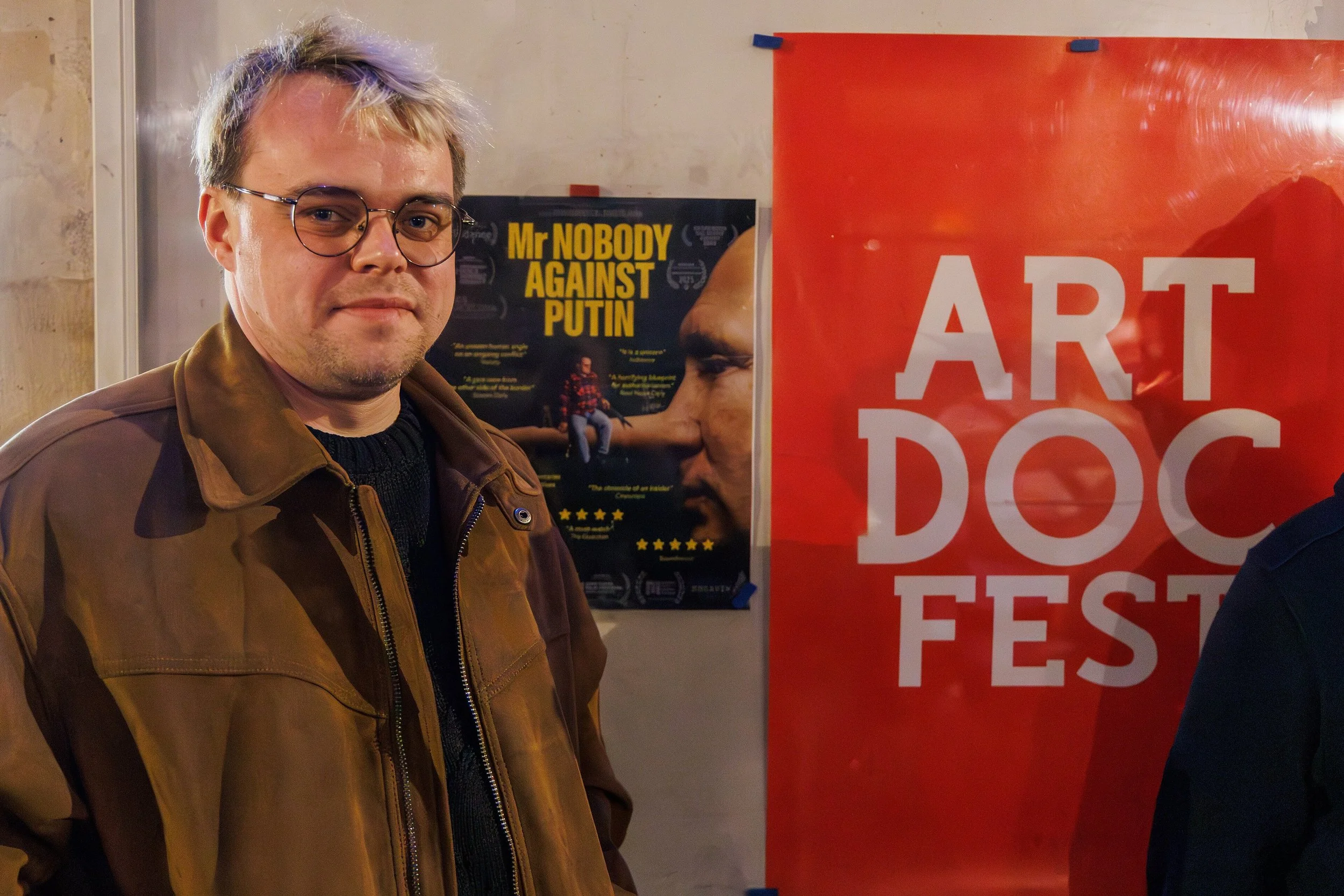
Pavel Talankin at the opening of the ArtDocFest documentary film festival in Paris, November 17, 2025. Photo by Nikita Mouravieff.
Pavel Talankin had a routine job filming school activities in a small town 1,600 kilometers east of Moscow. In 2022, he realized he was documenting something that was not routine at all, the spread of pro-war indoctrination among children. That was a story. He sought collaboration and soon found himself working with an international director based in Europe. Talankin stayed in his town to keep filming and turned official footage into a film. The result: Sundance and an Oscar for Best Documentary Feature.
The narrative was shaped by David Borenstein, an American director based in Denmark. He saw the dramatic potential in a proposal from a schoolteacher in the Russian provinces. Talankin served as cameraman and co-director but above all as the film’s protagonist. Mr. Nobody Against Putin is a film about how this footage came to be made, a film about filmmaking. It is also an antiwar statement about the seeds of war that are being planted in the classroom.
This is the first Oscar in the Best Documentary category awarded to a Russian director since 1942, when the Soviet Union won for Moscow Strikes Back. (The original title was The Defeat of the German Troops near Moscow). At the same time, Mr. Nobody Against Putin is the third documentary directly or indirectly connected to Russia to receive the award since 2022. Navalny won in 2023, and Ukrainian director Mstyslav Chernov’s 20 Days in Mariupol in 2024. Without comparing their artistic merits, it is hard not to see a political gesture in these awards. Mr. Nobody against Putin has sharply divided Russian viewers, provoking criticism not only from pro-Kremlin voices but from parts of the anti-Kremlin opposition as well.
Borenstein and Talankin’s film is unmistakably antiwar. It is not anti-Russian. It communicates affection for the residents of Karabash and even for mobilized Russian soldiers. Just two years earlier, the documentary Russians at War faced near-cancellation for a similar stance. Ukrainian diaspora groups disrupted screenings at European festivals, and the director was accused of working for the Kremlin. Perhaps mindful of that experience, the film includes several awkward, almost comic “antiwar actions” staged by Talankin, such as taping the letter “X” onto the windows of an empty school, a gesture of solidarity with Ukraine.
Many commentators have correctly noted that no such international symbol of support for Ukraine exists. It was likely invented to underline the protagonist’s antiwar stance. Although episodes like this can undermine the film’s credibility for viewers who know its context, the film is addressed primarily to audiences unfamiliar with the Russian context. For a European – and especially an American – audience, any documentary about Russia unfolds in a foreign environment. The film begins with someone who seems to be a provincial eccentric. By its end, he has been transformed into an object of the viewer’s empathy. If that transformation occurs, the filmmakers have succeeded in disenchanting an alien context. If that requires simplifying the story and making it accessible to the uninitiated, there is nothing inherently wrong with that.
What carries Mr. Nobody Against Putin is Talankin himself and his story. A schoolteacher from the backwaters takes on the machinery of state propaganda. He cannot defeat it, as he knows. And yet, honoring the logic of a Hollywood fable, he does. Talankin is part Cinderella, part Harry Potter. Amusingly, he makes the comparison himself in the film, watching schoolchildren march down a corridor and asking, “Is Snape our headmaster now?” Another documentary nominated for an Oscar this year, Our Undesirable Friends, has many references to Harry Potter as well.It is only natural that this character arc culminates in an Oscar acceptance speech. This year, the Oscars were rewarding “Oscar” itself – or rather what it has long stood for. Given that the Academy is largely made up of American filmmakers, the emotional valence behind this choice is easy to understand.
Beyond “Mr. Nobody” becoming an Oscar winner, the film distinguishes itself through its extraordinary access. Russian schools are among the most closed institutions in the country. Documentary filmmakers often say it is harder to get a camera into a school than onto a military base. Talankin’s job was to film inside of a school. His only real constraints were his own conscience and the lawyers advising the project. As a result, the film contains no statements that could endanger its participants in Russia. Explicit antiwar statements or confessions are absent. As for the war itself, the film mostly illustrates the “banality of evil.” When a primary school teacher stumbles over the word “demilitarization,” it is hard to see her as a committed ideologue. What we see instead is a slow landslide of propaganda moving forward until it engulfs an ordinary town.
Remarkably, the film has united pro-war and anti-war critics, those who left Russia and those who stayed.
Pro-Kremlin critics are predictable. They call Talankin a traitor, accuse him of exploiting schoolchildren and smear him with absurd charges. Director Nikita Mikhalkov went so far as to suggest the film followed a CIA playbook, claiming Talankin staged scenes to discredit pro-government narratives.Parts of the antiwar opposition have similar complaints. Some argue he exposed his family and students and then left them to deal with the consequences. (As of this writing, there is no evidence of any repercussions). Others claim that he acted in bad faith. For some critics, the film’s Oscar win becomes proof of Western “double standards”: strict ethics at home, relaxed when it comes to Russian subjects.
Pro-government voices employ the same rhetoric. Why this overlap? For critics inside Russia, the discomfort lies in “airing dirty laundry” and in the film’s implicit message: that the only rational response is to leave the country. For émigré critics, the problem is the oversimplification and artificial anti-war gestures. After years spent articulating a nuanced antiwar position – carefully separating country from state, writing essays and books – they now see an unknown provincial teacher arrive, tell a stark story, and win an Oscar.
Talankin may provoke such a strong reaction among Russian opposition figures for other reasons. One has only to look at the film’s symbolism. One of its recurring themes is treason. The antagonist – Russian President Vladimir Putin – speaks of it directly. Talankin hangs the white-blue-white flag, which is used by parts of the opposition, though not widely accepted, in his classroom. He tries to tear down the official Russian flag and even plays the U.S. national anthem, as if for sound check, over the school loudspeakers before a flag-raising ceremony.
These moments may seem absurd until one recalls that in Russia people are imprisoned for far less. Most of Talankin’s critics, regardless of their politics, were raised in Soviet or Russian schools, where reverence for state symbols was drilled in. Publicly insulting the flag or anthem remains taboo. Pro-war commentators can say this openly; antiwar critics cannot. Instead of accusing Talankin of “treason,” they reach for safer arguments: that he betrayed the children who trusted him, filming them without proper consent. These charges often mask something harder to articulate, without seeming to side with the state they oppose. Many critics project their own doubts and anxieties onto Talankin. After years of pressure – exile, stigmatization as “foreign agents” or worse – even committed opponents of the regime wrestle with doubt. Did they make the right choices at the start of the war? In a polarized society, many have heard accusations of betrayal from relatives or former friends. Seen in this light, the backlash against Talankin resembles a form of self-directed anger, an echo of the very “school trauma” that the film itself evokes.
The film’s title is remarkably apt. “Mr. Nobody” is Talankin himself, a small man challenging an immensely powerful system. But “Nobody” is also the name Odysseus gives the Cyclops Polyphemus in order to save his life. Polyphemus is a cannibal, and in Talankin’s film that role is unmistakably played by Putin. The Russian president appears on screen again and again: announcing the “special military operation,” justifying mobilization, or quoting Bismarck’s line that wars are won by schoolteachers.In Homer’s story, Odysseus calls himself “Nobody” after blinding the Cyclops.
In his manner, Talankin infiltrates the school system and discovers weaknesses in the state’s much-vaunted apparatus of digital control. The biggest weakness turns out to be his own camera, the all-seeing eye through which the state tries to monitor and enforce compliance. By repurposing this footage, he symbolically blinds it, turning propaganda into its inverse, the documentary truth. The Odyssey informs us that Polyphemus eventually takes his revenge. Once he is safe, Odysseus boasts and reveals his real name, prompting the Cyclops to ask his father, Poseidon, to curse his voyage home. One can only hope that Pavel Talankin avoids that fate. Blinded by his own sense of grandeur, Putin is more than capable of making the return journey not just difficult but impossible for the many Russians who since 2022 have left their country.
Konstantin Shavlovsky is a film critic and poet. Previously, he was the editorial director of Seans (Seance) film magazine. In 2017–2022, he was the film section editor at Kommersant Weekend weekly. Shavlovsky has written two books of poetry: Twins in Nettles and What Should Have Been Told From the Very Beginning.