
Non-Political-Yet-Political Theater Comes to Washington
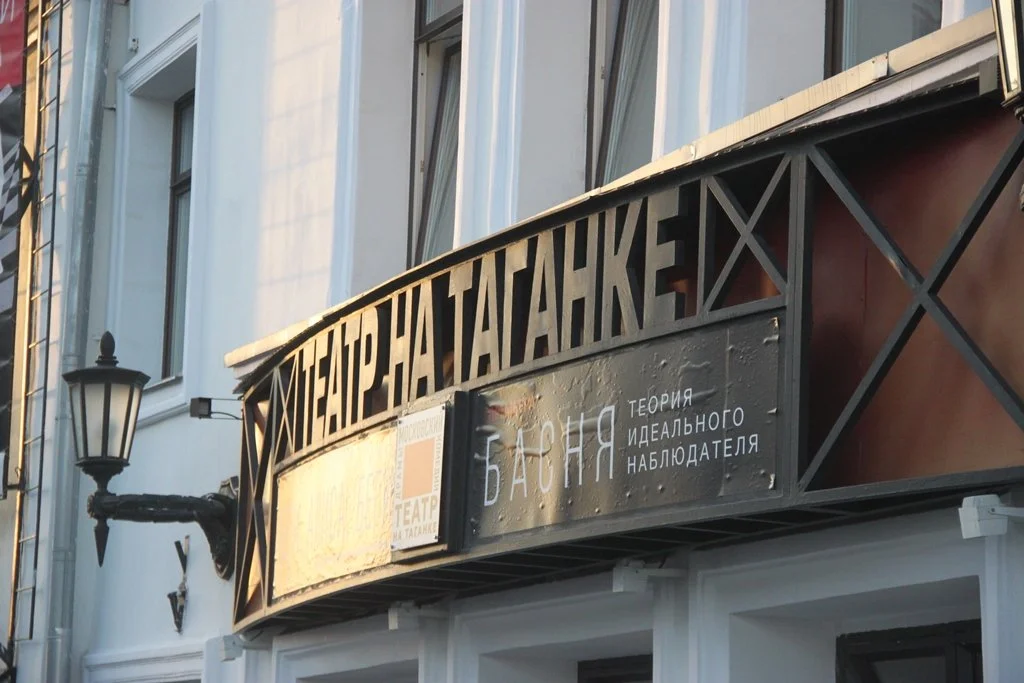
Taganka Theater entrance sign in Moscow, Russia. Photo by Andrey Filippov, August 4, 2018.
A remarkable moment has dawned on Washington stages, as theater artists and their audiences struggle to blend resistance to a hostile federal administration with an artistic imagination that transcends the political. Two noteworthy productions – Inherit the Wind at Arena Stage, and The Crucible at the Washington National Opera – elevate political messages embedded in the original works by given them contemporary readings.
Both works are McCarthy-Era parables, warning of the dangers of an American authoritarianism that is driven by religious zealotry. Jerome Lawrence and Robert E. Lee’s courtroom drama, Inherit the Wind, tells the story of the 1925 Scopes “Monkey Trial,” which concerned the teaching of evolution in Tennessee. In the playwrights’ hands, the media frenzy surrounding the trial becomes a metaphor for the Red Scare taking place when they created their work in 1955.
The action in Arthur Miller’s 1953 play The Crucible is an allegory for the McCarthy-inspired Red Scare. It recounts the panic surrounding the 1692 Salem witch trials. Composer Robert Ward and librettist Bernard Stambler’s interpretation of Miller’s original work as an opera won a Pulitzer Prize in 1962. Their version underscored the threat of tyranny that runs through Miller’s original work.
Both productions make explicit connections among the current period of Trumpian chaos, the era of the McCarthy-inspired Red Scare, and the historic periods when the stories initially transpired. Watching these productions in today’s Washington takes me back to the 1970s and 1980s, when I managed to see powerful non-political-yet-political theater in the Soviet Union.
One evening in December 1981 stands out.
Inquiries among Moscow’s intellectuals, Soviet and foreign, led my Kennan Institute colleague Mark Teeter and me to director Yuri Lyubimov’s Taganka Theater. There we saw his take on Yuri Trifonov’s powerful novel condemning Stalinist repression, The House on the Embankment. The focus of the original (sharpened considerably in the stage version) fell on an aspect of the Stalin years that shamed those who lived through it: the betrayal of innocent souls. The production brilliantly caught the spirit of Stalinism, particularly in the figure of an examiner-prosecutor who takes guilt for granted, seeking only to assign it.
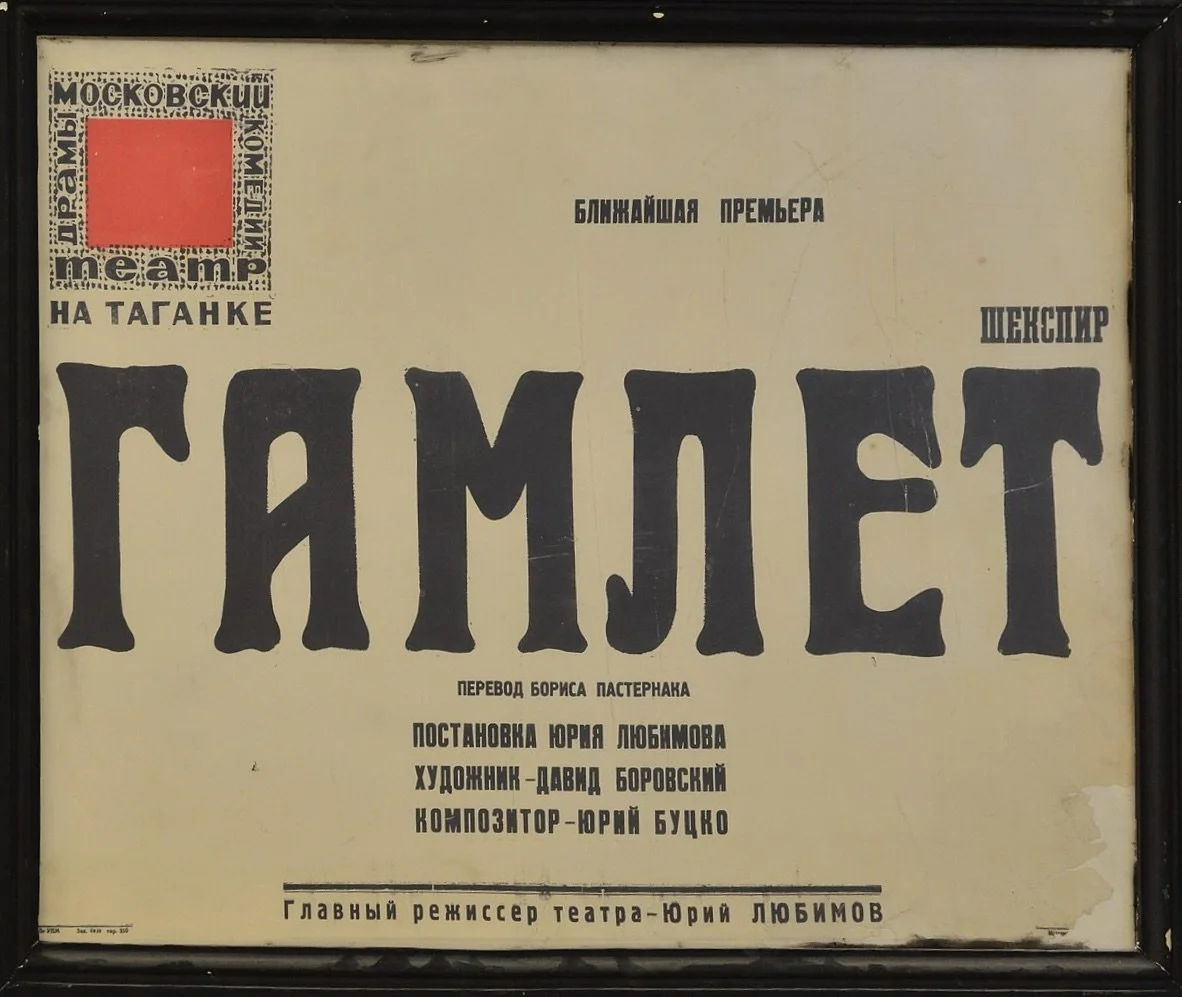
Poster advertising the premiere of Hamlet at the Taganka Theater.
The evening ended with a strong sense of catharsis. Cries of “Thank you!” punctuated the mild applause — the thanks clearly due for broaching in public the anxieties normally shared only in private. The House on the Embankment was painful to watch; and it was painful to watch people watch. When it was over, Mark and I noted that not everyone was applauding.
The production we saw that evening was one among many non-political-yet-political evenings at the Taganka. In late November 1971, somewhere around five hundred Muscovites did everything they could to make it into director Yuri Liubimov’s diminutive experimental theater. That evening’s premiere production offered a moment of warmth during the cultural winter that had descended on Moscow, following the infamous 1966 trial of the writers Andrei Sinyavsky and Yuli Daniel. The audience found that warmth when the Soviet Union’s “Bob Dylan” Vladimir Vysotsky stepped on stage to play Hamlet.
Vysotsky already was well known as an actor and a beloved bard. On cassette tapes passed around until they played no more, he sang underground folk songs in a distinctive growl. He had become a countercultural hero despite -- or, perhaps, because of -- a combination of personal ruin and political restiveness. His funeral during the Moscow Olympics in July 1980 brought out thirty thousand people, mourners to the square outside the theater at a moment when any demonstration of disrespect for the regime could carry severe consequences. His memorial service turned out to be an early manifestation of the generational defiance that would lead to regime’s collapse only a few years later.
Vysotsky and the Taganka’s production turned Hamlet into a story of the lone intellectual rebel fighting the cruel machinery of state. Soviet censors somehow missed the point, lending the production a rare political frisson. Once in repertoire, Shakespeare’s drama became one of many plays that eventually drove Lyubimov out of the country.
Throughout the Soviet Union’s last quarter-century, Moscow and to a lesser extent Leningrad’s stages became a halting sanctuary, so long as the politics did not speak its name. Some productions, such as Hamlet and Houseon the Embankment, did not hide their political message. Others, such as Lyubimov’s production of Mikhail Bulgakov’s long sanctioned novel Master and Margareta, made a statement simply by taking place. In Leningrad, a mid-1970s production of Dickens’s Pickwick Papers contained many subtle political messages to ponder on the Metro home.
The same pattern of presenting non-political-yet-political theater occurred across Communist East Europe. Playwrights, directors, and actors skirted state censors by not mentioning politics explicitly, just as Shakespeare often did when writing under Elizabethan England’s authoritarian regime.
As I ponder the 1970s and 1980s, my mind falls on the sharp debates in overheated graduate seminar rooms over the question of “convergence.” Would the Soviet Union and the United States converge if given enough time? The assumption was always that the Soviet Union would become more like us. Attending the theater in Washington at this moment suggests that such convergence can move in the other direction.
Blair A. Ruble is former Director of the Kennan Institute and currently serves as Secretary of the Kennan Institute board.