
Reflections on Russia’s Nuclear Behavior
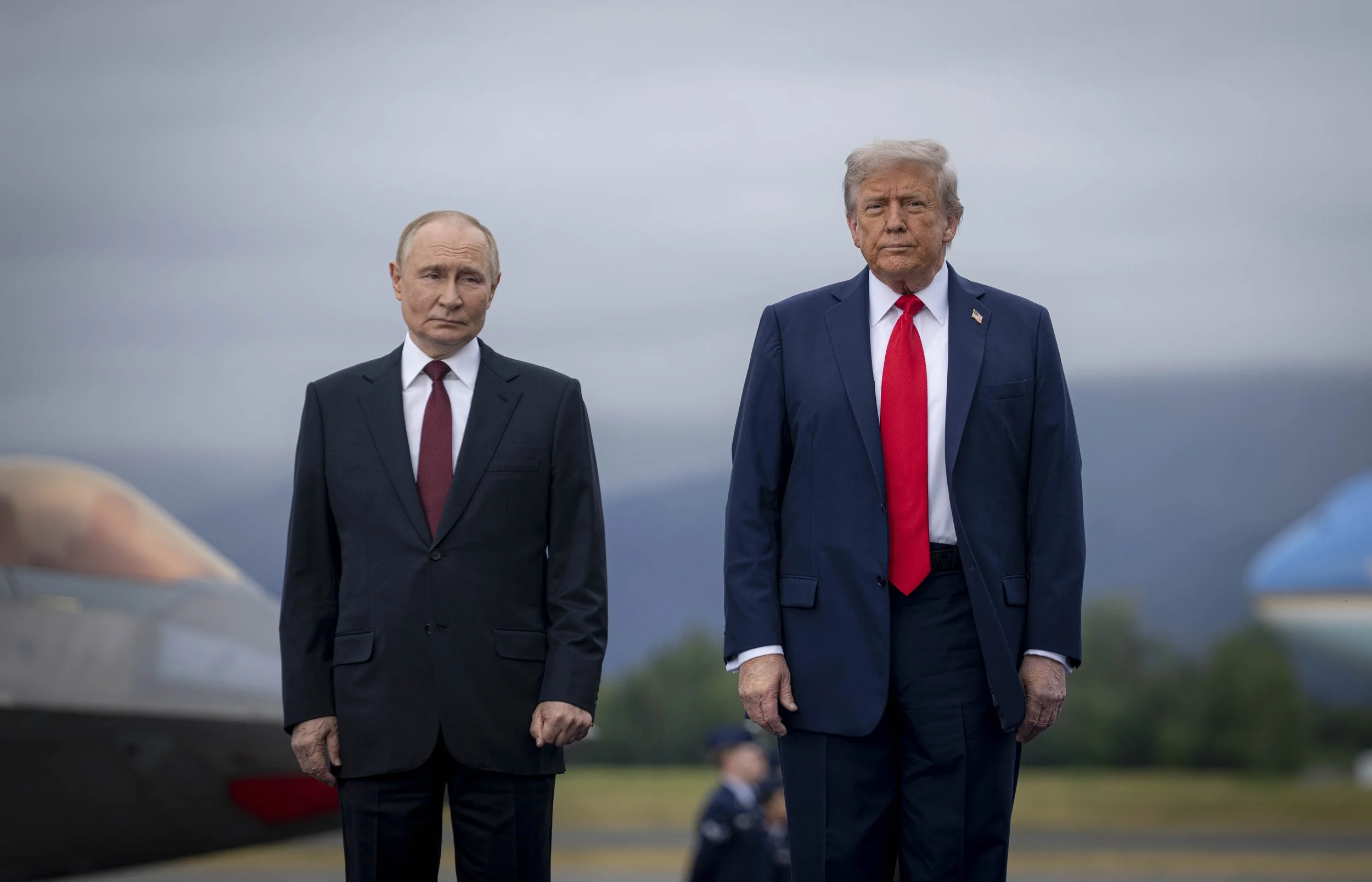
President Donald J. Trump welcomes Russian President Vladimir Putin to Joint Base Elmendorf-Richardson, Anchorage, Alaska on August 15, 2025 (United States Department of Defense photo by Benjamin Applebaum)
Given the failure to renew the 2010 New START Treaty limiting Russian and American nuclear weapons, now is an auspicious time to revisit Russia’s nuclear behavior. Though the Russian and the Chinese stories are distinct, Russia’s nuclear behavior has contributed to the failure to extend the treaty along with China’s unceasing nuclear buildup.
An extensive and insightful literature exists concerning Russian nuclear doctrine and strategy. But assessments of Russian nuclear behavior – what Moscow actually does – are much more sparse. Indeed, we already have evidence (from the past) of actual divergence from proclaimed policy. While Leonid Brezhnev, the Soviet leader, proclaimed a no first use policy for nuclear weapons, the Soviet-led Warsaw Pact doctrine fully embraced the first strike use of nuclear weapons to preempt a Western response to invasion.
Since it attacked Ukraine in 2022, Russian nuclear behavior has had multiple pillars. They are: rhetoric, including official and semi-official threats and the 2024 doctrine; war plans in verified but unclassified versions; procurement and the testing of the new weapons systems deployed since 2022; and exercises. Juxtaposing evidence from all these categories helps to correlate Russian nuclear behavior with doctrine, giving deeper insight into actual policy along with the means with which to formulate and effectively deter Russian aggression.
Russia’s war against Ukraine and its intensifying attacks against Europe represent an obvious failure of conventional deterrence. This affects both Western and Russian policies. While Russia’s ongoing militarization fuels anxiety, Western officials are determined not to be caught short again. Western intelligence agencies argue that Putin is likely preparing for war, not negotiations. Almost every Western intelligence agency, including the CIA, reports a possible future Russian offensive against Europe and one that could further erode conventional and threaten nuclear deterrence within the next five to ten years. Already, Putin has ordered his forces to seize more Ukrainian territory. We must grasp Russian behavior to counter it more capably.
This framework illuminates Russia’s first strike strategy. Printed doctrine notwithstanding, Putin is the ultimate decisionmaker and can override doctrine. Recently evolved doctrine opens the door to a strike. In 2018, Putin said that Russian nuclear policy was to launch on warning of an approaching missile, presumably the launch of one or several nuclear missiles by NATO. This may include conventional NATO launches. As the war against Ukraine shows, however, it does not mean Ukrainian conventional strikes on Russian territory. The 2020 military doctrine added missile attacks from Ukraine, if allied to NATO, against Russia and Belarus. The 2024 Fundamentals of Nuclear Deterrence admitted that Russia conducts nuclear deterrence against purely conventionally armed states, warning that missile defenses in other countries are a risk to Russia. It also cited NATO enlargement to Ukraine and conventional weapons that could be directed against Russia.
Conditions leading to nuclear use include credible warnings. In the words of the 2024 nuclear doctrine: “aggression against the Russian Federation and (or) the Republic of Belarus as participants in the Union State with the employment of conventional weapons, which creates a critical threat to their sovereignty and (or) territorial integrity.” Moscow extended deterrence to Belarus after deploying nuclear weapons there in 2022, undermining the spirit if not the letter of the non-proliferation treaty. These moves reduced restrictions on a nuclear first strike, as many observers contended. These weapons, the Oreshnik (Hazelnut) IRBM, are hypersonic dual-use missiles built to evade defenses. Moreover, they are MIRVed (multiple independently targetable reentry vehicles), possessing multiple independent reentry vehicles. They present serious challenges to defenders.
The Oreshnik is an IRBM (intermediate range ballistic missile), a category of missiles explicitly banned by the INF treaty. Worse, it derives from ICBM (intercontinental ballistic missile), RS-26 Rubezh missile; its reappearance as an IRBM is a blatant violation of the New START Treaty. It violates the latter treaty in many ways. Moscow then tried to reconfigure it as an IRBM, violating the INF treaty. Moscow may have endeavored to conceal the Oreshnik from Western eyes, leading to the cancellation of on-site inspection required under the New START treat. This pattern of violating arms-control treaties is systematic rather than incidental. The bipartisan Congressional Strategic Posture Commission stated that, “Over the past 20 years, Russia has either violated or has failed to comply with nearly every major arms control treaty or agreement to which the United States is or was a party.”
Today, Oreshnik dual-capable intermediate-range ballistic missiles remain in Belarus. They are clearly aimed at destroying Ukraine’s critical infrastructure and intimidating Western audiences by demonstrating Russian power and capacity for escalation. Russian rhetoric to the contrary, training and deployment of this and other new weapons reveal their offensive nature and Russia’s serial violation of major arms-control treaties.
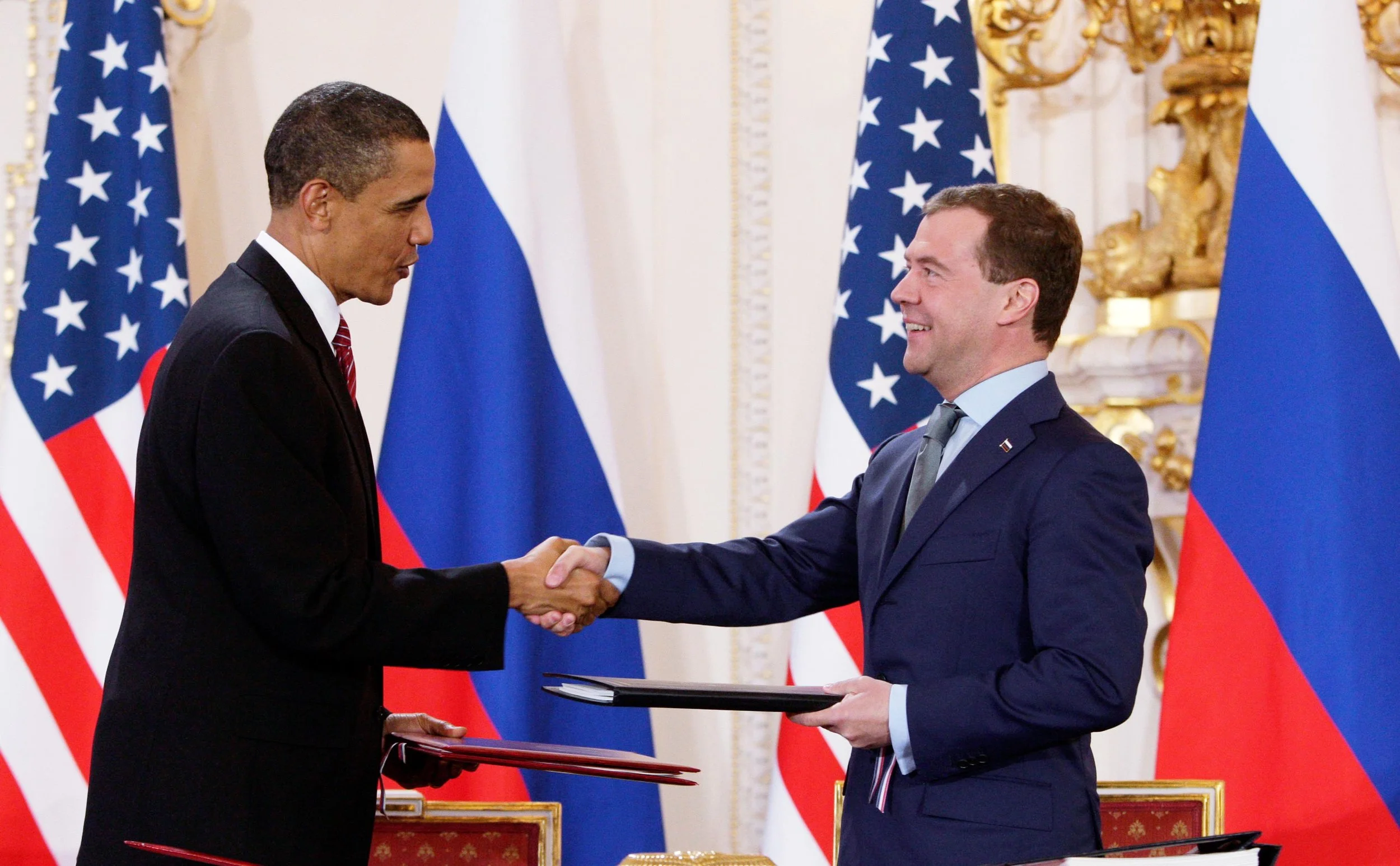
Barack Obama and Dmitry Medvedev after signing the "New START" treaty in Prague on April 8, 2010
Under certain circumstances, Russia will launch a first strike. While Ukrainian conventional strikes on Russian targets have not triggered nuclear retaliation, we could conceivably see a Russian nuclear first strike, if the current war escalated to the point of NATO or larger Ukrainian missile strikes, especially against critical Russian targets. Sergei Karaganov, a known advocate of a nuclear first strike, now states that the prospect of defeat in Ukraine will trigger a nuclear first strike. This is not a new threat. It has been implicit if not explicit in Russian nuclear signaling since 2022. The likelihood of these threats has rightly diminished: the West has crossed many of Russia’s so called red lines without falling into an escalatory spiral with Russia.
Russia can produce 2500 ballistic and/or cruise missiles annually and is now stockpiling them, presumably for use in Ukraine. As the European missile expert Fabian Hoffman writes, “This points to only one conclusion: Russia is stockpiling missile systems for other contingencies, including a potential NATO-Russia confrontation in Europe.” All these missiles that Russia produces are now dual-capable. Since European intelligence and governmental agencies now warn about a Russian-initiated war between 2027 and 2035, we must consider the possibility of nuclear strikes due to European involvement in Ukraine or in a subsequent attack on a NATO ally. This is something that some military-political-intelligence leaders now expect, though we have little reliable information concerning Russian tactical nuclear weapons (TNW). Their number is estimated at between one and two thousand missiles and most seem to belong to the Russian Navy. They could easily be used to strike European targets.
Russian procurement of nuclear weapons continues without reliable verification. The arms control regime collapsed largely due to Russian cheating: the number and mission of weapons cannot be monitored. Russian exercises in mid-2024 confirm that the Navy rehearsed procedures consistent with the use of tactical nuclear weapons (TNW) and Russian doctrine. These exercises involved the use of nuclear capable Kinzhal hypersonic and Iskander missiles that can carry TNW, suggesting a rehearsal of nuclear weapon scenarios involving TNW.
By demonstrating that Russia is capable of deploying almost all of its ships at short notice, including nuclear weapons carriers, the use of which was also simulated, the Ocean maneuvers can be considered an important element of deterrence.
Subsequent naval exercises and revelations from leaked documents point towards a first strike. In June 2024, Russia’s armed forces practiced loading Soviet-era P-270 anti-ship cruise missiles onto a Tarantul-class corvette in Kaliningrad, where NATO officials say it stores an undeclared stockpile of tactical nuclear warheads. Footage of the drills showed the troops of Russia’s 12th GUMO (the department of the Ministry of Defense tasked with oversight of nuclear weapons) moving the missile in the container to a fully nuclear-armed missile, accompanied by a guard force.
For the first time, the Zapad-2025 exercises began not with a conventional threat or attack but with a scenario involving nuclear use of TNW against Europe. Russia has a growing interest and possible readiness to begin a war with Europe with a seemingly limited nuclear strike. When we correlate these exercises with Moscow’s regular exercises of its tactical nuclear weapons (TNW), the first strike and preemptive missions are real threats to the West. Moscow habitually invokes them for reasons that extend beyond intimidation. Evidence from doctrine, testing, procurement and especially exercises point conclusively to a first strike and even a preemptive Russian strategy.
Although Putin proposed retaining the treaty numbers for another year, he did not propose preserving its verification regime. Without a credible verification regime, no arms control treaty is possible, let alone desirable. More recently, on February 23, 2026, he stated that the development of the nuclear triad remains an absolute priority. In light of the ensuing US-Israeli air attack on Iran, the kind of aerospace attack that ranks as the greatest likely military threat to Russia, this deterrent priority is likely to receive still greater emphasis in the foreseeable future, precluding further progress on arms control.
Deterrence is not a luxury that can be postponed. As recent events demonstrate, Western nuclear deterrence works when applied. In 2025 Russian ex-president Medvedev threatened Washington. In reply, Trump announced he was moving two SSBNs closer to Russia, i.e. he exercised genuine deterrence. Yet nuclear threats continue. When Trump stated that he was considering resuming nuclear testing due to the Russo-Chinese nuclear buildups, Putin announced that he tasked his staff for testing options, even though they were already doing so.
Today, both conventional and nuclear deterrence are urgent necessities. These forms of deterrence require greater allied unity across several dimensions. Washington and its allies must accelerate conventional and nuclear procurement.
Enhanced conventional deterrence in Europe means countering Russia’s shadow fleet alongside its non-kinetic challenges in cyber and information warfare. Concurrently, allies must provide Ukraine with the weapons it needs, including intelligence support and expanded defense industrial capacity. In the nuclear domain, numerous bipartisan commissions have advocated for a new generation of nuclear weapons and missile defenses—not least theater nuclear weapons—to counter Russia’s threat of first strikes with tactical or low-yield weapons against Europe and the U.S. homeland. Those recommendations deserve urgent attention.
Mainly because it excludes China, the Trump Administration has rightly decided not to renew the New START Treaty. Beijing is undertaking a breathtaking and unconstrained buildup of its nuclear forces. But even if China is left out of the equation, an enduring arms control treaty relationship with Russia is hard to envision. Moscow has broken every arms control treaty to which it is a party, including conventional arms control, limits on chemical and biological weapons, and the INF and New START treaties. Despite unconfirmed reports that negotiators (not Presidents Putin and Trump) have decided to abide by that treaty’s numbers, such reports are meaningless in the absence of verification protocols in treaties. This is why the Oreshnik story is so pertinent. It suggests a long-term unilateral decision by Moscow, even when both the INF and New Start treaties were in force, to break those treaties regardless of the consequences.
Russia has long since made clear that it believes itself under attack from the West. Its mounting sabotage efforts in Europe, Putin’s orders to his forces to seize more territory, and the militarization of Russia’s economy, politics, and society outline the long-term threats that Europe faces. For too long, Western leaders have refused to face these facts, and many are still in denial. But as Shakespeare’s Henry V stated, “when the blast of war is in your ears imitate the action of the tiger.” Today the West must be this tiger. For the foreseeable future, Russia’s conventional and nuclear threats have foreclosed other options.
Stephen Blank is a senior fellow at the Foreign Policy Research Institute.