Nobody’s Heroes
Russia’s Pavilion and the Art of Conformism
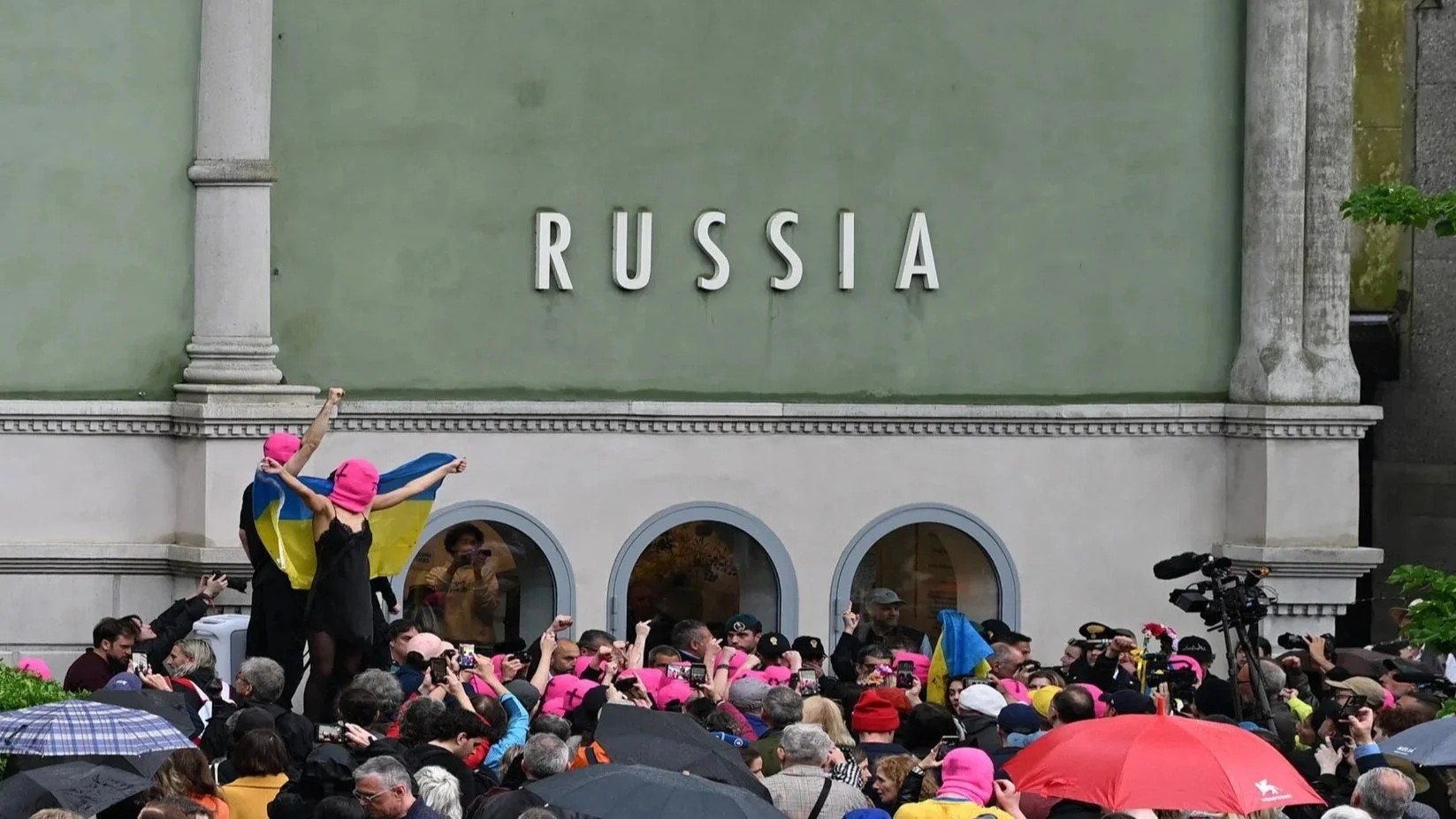
Protestors at the Russian Pavilion during the 2026 Venice Biennale. Photo by Hano, Piet Parkiet (May 6, 2026).
Russia’s pavilion has become one of the many controversies at this year’s Venice Biennale. Following public condemnation, the resignation of the Biennale’s international jury, and a series of acts of protest by anti-war artists, the Russian pavilion now stands closed. Russia is effectively represented only by the building itself, a fitting form of representation if one takes a look at the architect and at his creation’s history.At the Biennale, the pavilion is impossible to miss. It stands along one of the exhibition grounds’ main avenues. It was designed on the eve of the First World War and inaugurated in the spring of 1914 in the presence of Russian royalty, government officials, and international guests. The pavilion housed the avant-garde in the 1920s, Socialist Realism in the 1930s, late Soviet official art in the 1970s, former dissident and underground conceptual art in the 1990s. Now it houses nothing, effectively waiting for what will come at the next historical turn. It is monument to Russia’s ability to absorb political reversals and to its culture of adaptability.
Remarkably, the principal benefactor for the pavilion’s construction was Bohdan Khanenko, a Ukrainian sugar industrialist, imperial official in St. Petersburg, and a major philanthropist and art collector. Together with his wife Varvara, Khanenko assembled one of the most important private art collections in the late Russian Empire. The collection spanning European painting, Byzantine icons, Islamic art is the foundation of the Bohdan and Varvara Khanenko National Museum of Arts in Kyiv. The museum suffered damage during Russian strikes on Kyiv in 2022 but was restored and continues to serve as one of Ukraine’s foremost cultural institutions.
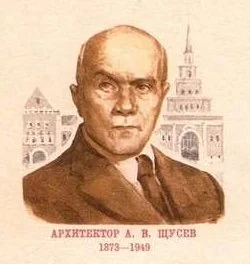
1973 Soviet post card featuring Aleksey Shchusev
The pavilion’s architect, Alexey Shchusev, was one of Russia’s ultimate protean figures, a man who achieved prominence under opposing ideological regimes and amid radically shifting political and stylistic currents. Shchusev built churches under the tsars, drafted Moscow’s first modern urban development plan under the Bolsheviks, designed Lenin’s Mausoleum, took part in the Constructivist avant-garde, and later became one of the leading architects of Stalinist monumentalism.
Few twentieth-century architectural or artistic careers can rival Alexey Shchusev’s ideological and stylistic elasticity. Most architects of his era achieved prominence by adhering to a professed creed – traditionalist, avant-garde, modernist, imperial – but rarely all of them in succession. Shchusev did not merely survive: mere conformism would hardly have made him remarkable. A conformist, he remained highly relevant across radically different political and aesthetic regimes.
His churches were inventive Art Nouveau compositions drawing on late Byzantine and early Russian forms. His urban planning was ambitious and forward-looking. His Constructivist projects were convincing enough to compete with the work of committed avant-gardists. In the 1930s, his later architecture defined Stalin’s monumental visual language.
Shchusev did everything he could to sideline questions about his morals and values. He styled himself the ultimate professional. He won multiple competitions and understood what the client cared for, whether it was the Church, the tsarist state, or the Soviet regime. His work treated style less as doctrine than as vocabulary: adaptable, secondary to structure, function, and public meaning. Shchusev would have read The Language of Post-Modern Architecture, first published thirty years after his death, with genuine curiosity.
Russia’s cultural and political landscape is filled with similarly adaptable figures. There were writers who began as experimental, counter-culture literary figures in the decades before the 1930s only to become pillars of Soviet official culture under Stalin. Alexei Tolstoy, once an émigré novelist with modernist sensibilities, returned to the Soviet Union to reinvent himself as one of the regime’s most celebrated literary figures and an architect of Soviet historical mythmaking. The lyrics of Russia’s national anthem, in its Stalinist, post-Stalinist, and Putin-era incarnations, were written by one and the same poet, Sergey Mikhalkov.
There were numerous artists who started out experimenting with cubism, expressionism, and the formal innovations of Kazimir Malevich or Vladimir Tatlin only to adapt themselves later to the demands of Stalinist socialist realism. Yuri Pimenov began with expressionistic canvases indebted to German modernism before reinventing himself as a lyrical painter of Soviet everyday life. Aleksandr Deyneka moved from avant-garde experimentation to heroic depictions of socialist modernity; Mussolini praised his Stalin-era work. Isaak Brodsky, who had absorbed influences from European modern painting before the 1917 revolution, became one of the canonical portraitists of Lenin and Stalin.
There are architects who once designed Soviet public buildings and later turned to churches, in a kind of “reverse Shchusev.” Mikhail Posokhin would be a prominent example of this. There are film directors who were experimental and forward-looking in the late Soviet period only to reinvent themselves decades later as pro-Kremlin conservatives.
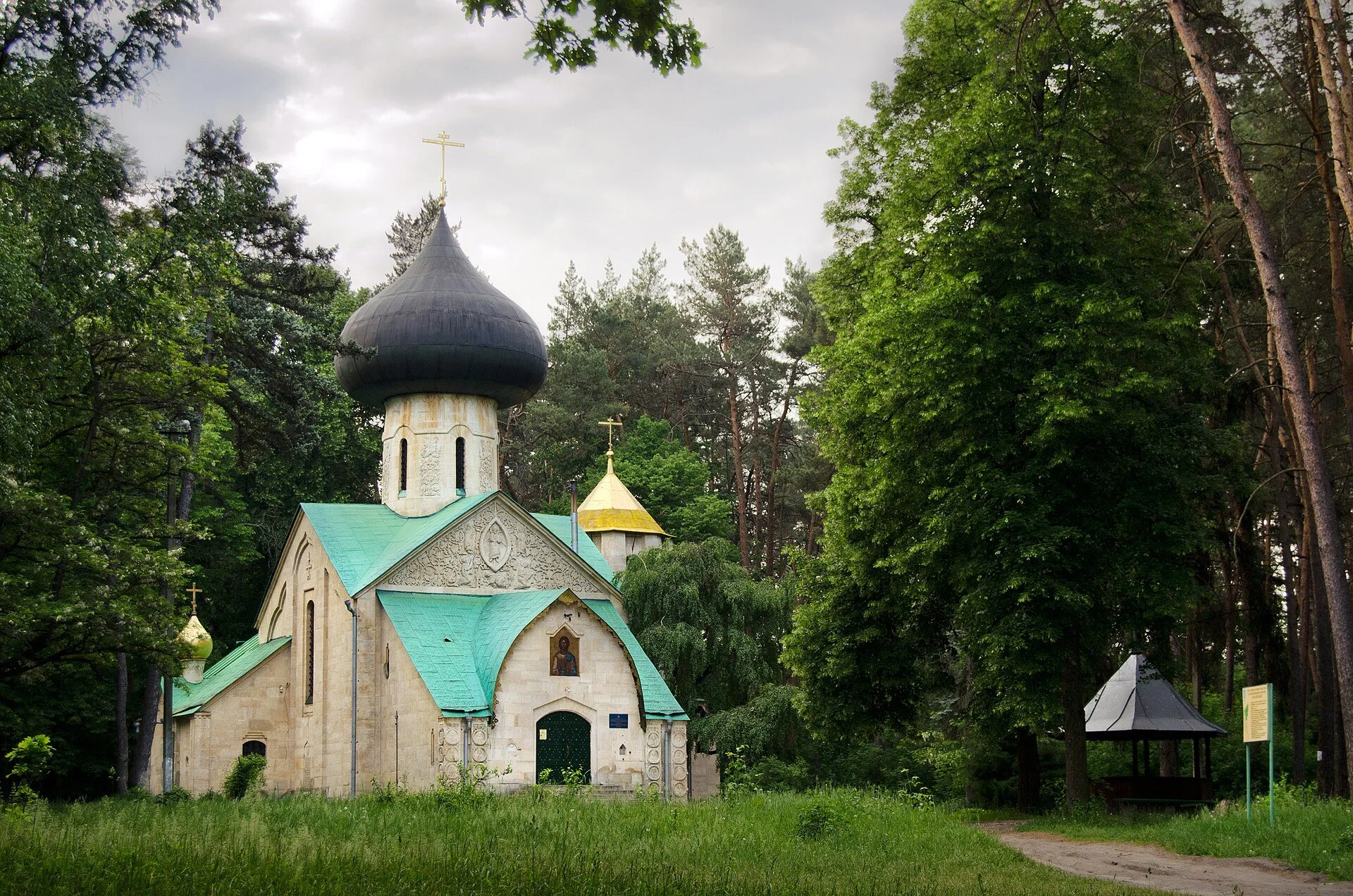
Church of the Transfiguration of the Savior, designed by Alexey Shchusev, built between 1911 and 1913. Photo by Sergey Ryzhkov, May 20, 2013.
And then there is the entire corps of Russia’s upper bureaucracy. Vladimir Putin is an intensely conservative boss who prefers to keep senior figures in place unless they discredit themselves or somehow manage to escape. But an exit is a rare and dangerous undertaking in contemporary Russia. This is why many of the officials now overseeing Russia’s wartime economy, censorship apparatus, and geopolitical confrontation with the West are often the same people who were once building commercial and other ties to the West. Some spoke the language of market reform and globalization in the 1990s. Others promoted integration with Europe, modernization, efficiency, and institutional development.
For an outside observer, it is hard to fathom figures of this kind. They are widely seen as accomplices to Putin’s aggressive and illegal war against Ukraine, even when they have no direct personal involvement in acts of violence, military decision making or procurement. From a distance, they collapse into a single image of accommodation and compromise.
A closer look, which few are inclined to take, reveals dozens of shades of conformism. Many of these officials might be exonerated in a hypothetical post-Putin tribunal on the grounds that they were administering technical or infrastructural systems. That at least is how many of them understand their own role, an impression that emerges from conversations I have had over the years with people in and around the government.
Like Alexey Shchusev, they would prefer moral questions to be treated as irrelevant to their work. Yet very likely such questions will continue to be asked, and these questions notwithstanding many of them, the younger officials and those below the highest ranks, will likely serve as administrators in a post-Putin government. All those Kremlin-friendly directors, architects, actors, journalists will one day turn to different themes. They will try to put their Putin-era work behind them. They will also enjoy numerical superiority over those who emigrated or preserved their moral distance by other means.
Figures of this kind are rarely celebrated. They are most often despised or mocked. But what if an entire culture is shaped by adaptive figures rather than by unambiguous heroes? The spotlight often falls on the writers and artists who became Russia’s moral and cultural ambassadors to the world, from Alexander Herzen and Sergei Rachmaninoff to Vladimir Nabokov, Ilya Kabakov, and Vladimir Sorokin; but these figures are notable precisely because they are so exceptional.Adaptability and the repertoire of survival techniques it has produced are the rule. Then there are those unable or unwilling to leave, those who are opposed to the war, those who are pained by their country’s actions in Ukraine. Most are unseen and unheard. Some keep silent out of fear, others out of exhaustion, professional obligation, family ties, or simple uncertainty about what meaningful resistance would even look like under current conditions. They also belong to this landscape of adaptation, though history may judge them differently.
Few monuments will be erected in their honor. Nobody will think of them as heroes. Yet one such monument already exists, Shchusev’s pavilion at the Venice biennale. The meaningless installation inside the building, space posing as art, is inaccessible. While its doors are sealed, the architecture itself remains. Its façade, which combines mock seventeenth-century Russian motifs with Art Nouveau shapes, houses nothing. It will be there after Putin, a truthful Russian exhibit, honoring adaptability, ideological reversals and the practiced ability to wriggle free from the past.
Maxim Trudolyubov edits The Russia File, the Kennan Institute’s publication, and writes on Russian politics, society, and institutions.