
Letter from Kyiv
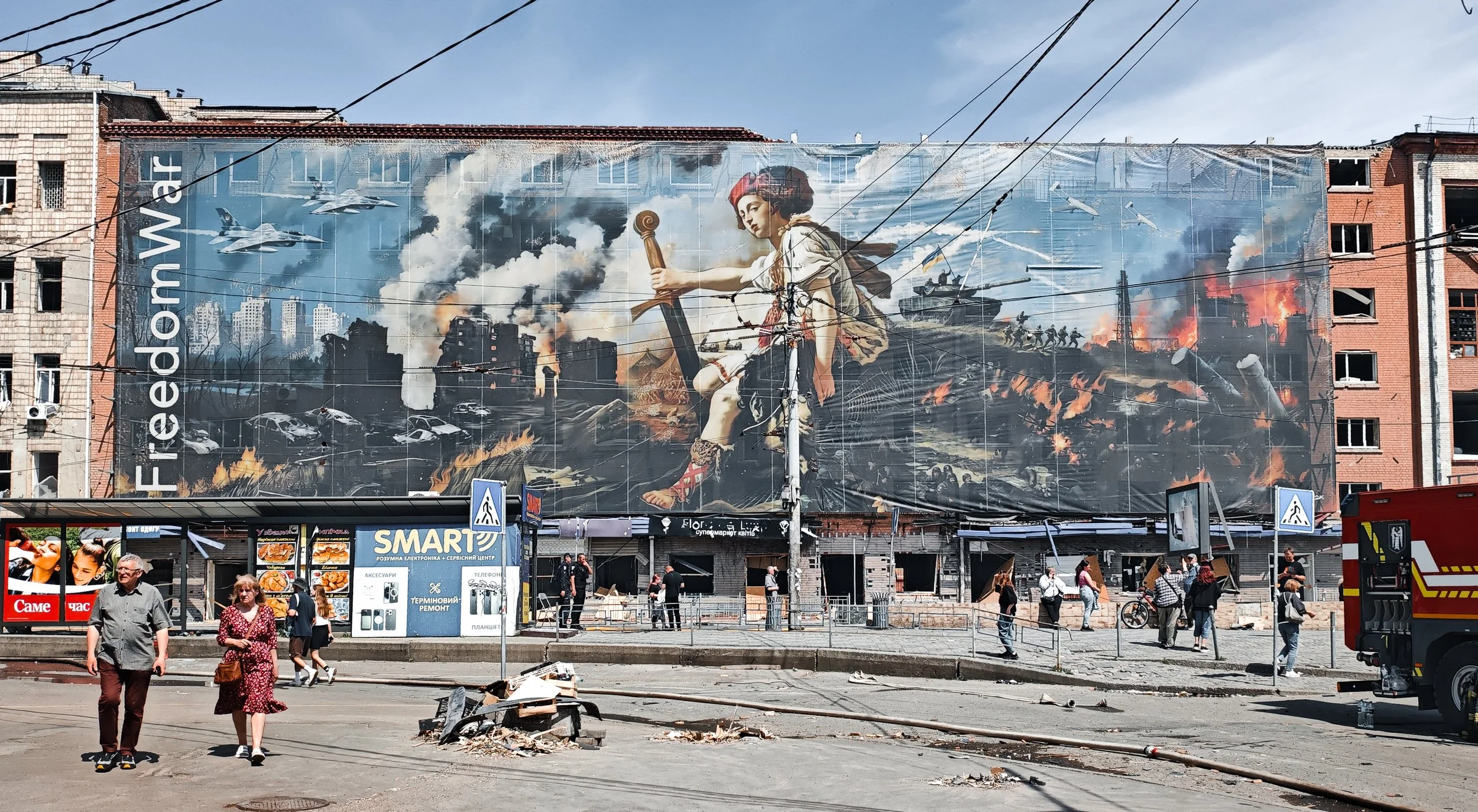
A banner depicting the battle between David and Goliath remains intact following Russia’s May 24th bombardment of Kyiv.
Courtesy of Gennadiy Kurochka, Andriy Plakhonin; #FreedomWar Project.
In Kyiv, an invisible competition for the country’s future shape is percolating. More a tectonic than a political competition, it is proceeding slowly and at times painfully.
Even when people in Kyiv think they are talking about something else, they are talking about the new society that is coming into being.
The President of Ukraine, following the usual process, has recently approved a number of changes to Ukrainian law. Among them is the requirement that male public servants under sixty have served in the military. The law will take effect after the end of martial law, which is to say after the war. Working as a schoolteacher, a municipal engineer, or a senior manager in military technology enables a “delay” in military service which is probably the most important privilege in today’s Ukraine. In the future, you will not be able to work in many areas of public service if today you are male professional between, say, thirty and forty years of age without military training.
The Ukrainian law regulating “public service” does not apply to the President, members of the Cabinet of Ministers and their deputies, members of parliament, the heads of the number of public agencies, ombudsmen and ombudswomen, and several other positions, including military servants ironically.
The new law applies to public servants at ministries, diplomatic institutions, the office of the Cabinet of Ministers, local administrations and some others. Some might think that these positions are so attractive that people might opt for military service now, when such service needed most, bypassing legal delays and illegal methods of avoiding military service. The new norm suggests a long line of people seeking government jobs and waiting to claim their share of money and status; but this is not the case. The money and status at issue is doubtful, depending as they do on certain variables: starting position, youth, ambition and family status.
How attractive these government positions are is unclear. There are many of them, but few are well paid. The less well paid they are, the more these jobs are held by women. Given the war’s effect on Ukraine’s population, there will be even more women taking these jobs in the future. Yet martial law has its limits for women in public service. Just this May, the Cabinet of Ministers loosened restrictions on going abroad for the middle and lower ranks of female public servants. After February 24, 2022, many women had to choose between leaving the country to protect their children and losing their jobs. For most mothers, it would be hard to describe public service as a dream job.
The bill sheds an interesting light on Ukrainian politicians and on political wannabes. For years, and especially after 2022, the Ukrainian army has enjoyed a high level of trust. Former Commander of the Ukrainian Armed Forces, General Zaluzhny happened to lose his position because of his popularity; surveys had started to show him as a rival to Zelensky. These days, Zaluzhny is Ukraine’s Ambassador to the United Kingdom and is persistently said to be readying himself for a political career, something that he keeps denying. Whether his ambitions are serious or exaggerated or whether his ambassadorial exile is a self-fulfilling prophecy is hard to say.
Trust converts into political capital. Even when those in the military have little desire to work in government, this bill is a welcoming gesture. In the first years of the war, there was a widespread sentiment that “the boys will come back and get things in order.” As more information about frontline hardships and strategic misjudgments became available, this sentiment started to break down. The change was not driven by the media. Everyday back-and-forth between civilians and their friends and family at the front darkened the mood. Indefinite terms of service – some troops have been on the frontline for years – have been dubbed a “one-way ticket,” and that does not help.
Surveys show that more than ninety percent of Ukrainians still respect and trust the armed forces and veterans. At the same time, the perspective of many Ukrainians has become more nuanced. For those in the military, many of whom feel trapped in permanent service, it is easy to take offense. They complain about a deficit of respect and understanding, especially from those far from the frontlines, where the pleasures of daily life can obscure the wages of war.
But is this deficit real? Have Ukrainians really forgotten about their army or lost their respect for it? Or has someone persuaded the army that there is a problem with respect?
In the competition for a hazy postwar political future, I detect the sharp edges of ambition and vanity. Political entrepreneurs search for approval among the soldiers. “Look, we love you, unlike those nasty people over there!” When normal political life sooner or later returns, the headhunting for prominent veterans will commence. We saw this after the fighting in 2014 and 2015, and it makes sense to invest early. Some politicians in uniform are already shoring up their political future. You can see that at almost every metro station in Kyiv and in the recruitment ads on city streets.
As I write, people are protesting the new Civil Code – in Lviv today, yesterday in Kyiv. The parliament (Verkhovna Rada) passed a draft on April 28, though that is not where this story begins. It all started back in January, when a previous version of the bill passed the parliament, making headlines. Among its many innovations was a provision allowing fourteen-years old girls to marry in case of pregnancy, if a court permits. (Normally, a court may allow a marriage after the age of sixteen under special circumstances, although the legal marriage age in Ukraine is eighteen.) The provision about fourteen-year-old girls was a scandal. Commentators in the media and online condemned it as an attempt to normalize patriarchy or even to legalize pedophilia. After all, teenage pregnancy is uncommon in Ukraine.
The new Civic Code is said to be the legacy project of Ruslan Stefanchuk, the speaker of the parliament. Though he was the formal sponsor of the bill, Stefanchuk quickly retreated and vowed to remove the outrageous provision, which he claimed had been misunderstood; and so it had been. Nevertheless, it left a bad impression.
The new Civic Code runs to seven hundred pages and has up to two thousand articles. It seems to cover all aspects of private life: birth, death, marriage, reproductive rights (including reproductive technologies and biological materials), inheritance and private property. Unlike corporate law, which bores most people, private law is something on which everyone has an opinion, at least everyone who votes.
On January 26, Ukrainian NGOs published a public call to withdraw and re-write the draft. The notorious marriage age article was just one of many problems. In short, a draft meant to liberalize the outdated Civil Code had only made it worse. The “corrected” May draft went even further, as with the absurd norm that a man may demand his ex-wife use her maidan name if her behavior offends him. For a country known for its independent and assertive women, women who for over a century have had access to higher education and the right to vote, it sounds like a joke. The Handmaid’s Tale memes ensued immediately.

Kyiv Skyline by Jude Schroder
The proposals violate Ukraine’s commitments to the European Union, which are also known as roadmaps. To start the negotiation process and eventually to join the EU, Ukraine must change several of its legislative norms. A year ago, the Ukrainian government had agreed to a list of such changes. The Cabinet of Ministers had signed a Rule of Law Roadmap for Ukraine, but it is parliament that must change the legislation, including the Civil Code.
One of the Roadmap’s paragraph states that Ukraine must adopt a law defining registered partnerships (including same-sex civil unions) and their property rights. The new Civil Code was supposed to meet this requirement, which it did not do. In the “Family Law” chapter, the words “a union of a man and a woman” are used wherever possible to prohibit same-sex couples, the opposite of what had been promised to the EU. The Civil Code also goes against Ukrainian precedent. On February 25, the Supreme Court of Ukraine had recognized the same-sex couple as a family. The Supreme Court was upholding the June 2025 decision by a district court in Kyiv.
More than 160 authors had worked on the draft of the Civil Code. Some were experts and some were members of parliament. I was able to speak to the member of parliament in charge of the “Family Law” section. When I asked about its many references to “a man and a woman,” he referred to the Ukrainian Constitution. “We cannot change the Constitution during martial law,” he said. I suggested that omitting the particularities would be in harmony with the Constitution. He was sure the parliament’s legal committee would not allow the change, an explanation I took with a grain of salt.
What had been exposed in January 2026 and what is being exposed for the second time is that the parliament majority either ignores or qualifies promises made by the Ukrainian government. Some of the draft opponents compared this situation to Georgia, where the decline of civic freedoms and pro-European aspirations started with an attack on civil partnerships. Paradoxically, the war amplified the voice of LGBT people in Ukraine. Many volunteered and now serve in the army, and some have come out as soldiers who are LGBT.
The speaker of the parliament comes from President Volodymyr Zelensky’s “Servant of the People” party, the majority party in parliament. Party membership does not translate into loyalty. The parliament chose to cater to the most conservative segments of Ukrainian society or to the groups which claim to represent them. (Seven years ago, addressing young urban voters, Zelensky and his “Servant of the People” party made political headway by mocking the previous President’s conservatism.) When one reads the news from the frontline or checks the Air Raids app on one’s smartphone, parliamentary elections might feel far away. Yet as the new Civil Code story suggests, many political figures are thinking ahead. At this point, their target audience is probably not the voters themselves but the people and groups that will emerge as power brokers in the future.
Not necessarily a bad thing, this could even be interpreted as a sign of optimism, but the current political elite’s vision of the future seems to be diverging from Ukrainians’ post-2014 hopes. Before the 2022 invasion, Ukrainians, especially younger Ukrainians, were growing closer and closer to their European counterparts. Even if Russia’s invasion has held the country back in some respects, Ukrainians do not aspire to live in a nationalist Sparta. On this the survey data is crystal clear: most Ukrainians want accession to the EU and to NATO. Tested by the pressures of war, this vision of the future is very unlikely to lose its currency.
Oksana Forostyna is Opinion Editor at Ukraina Moderna and an author. A former executive editor for Krytyka Journal, she contributes to Liberties, The European Review of Books, Krytyka, and Babel.