
The Battle for Memory
New Monuments Are Being Erected and Old Ones Destroyed in Ukraine’s Occupied Territories
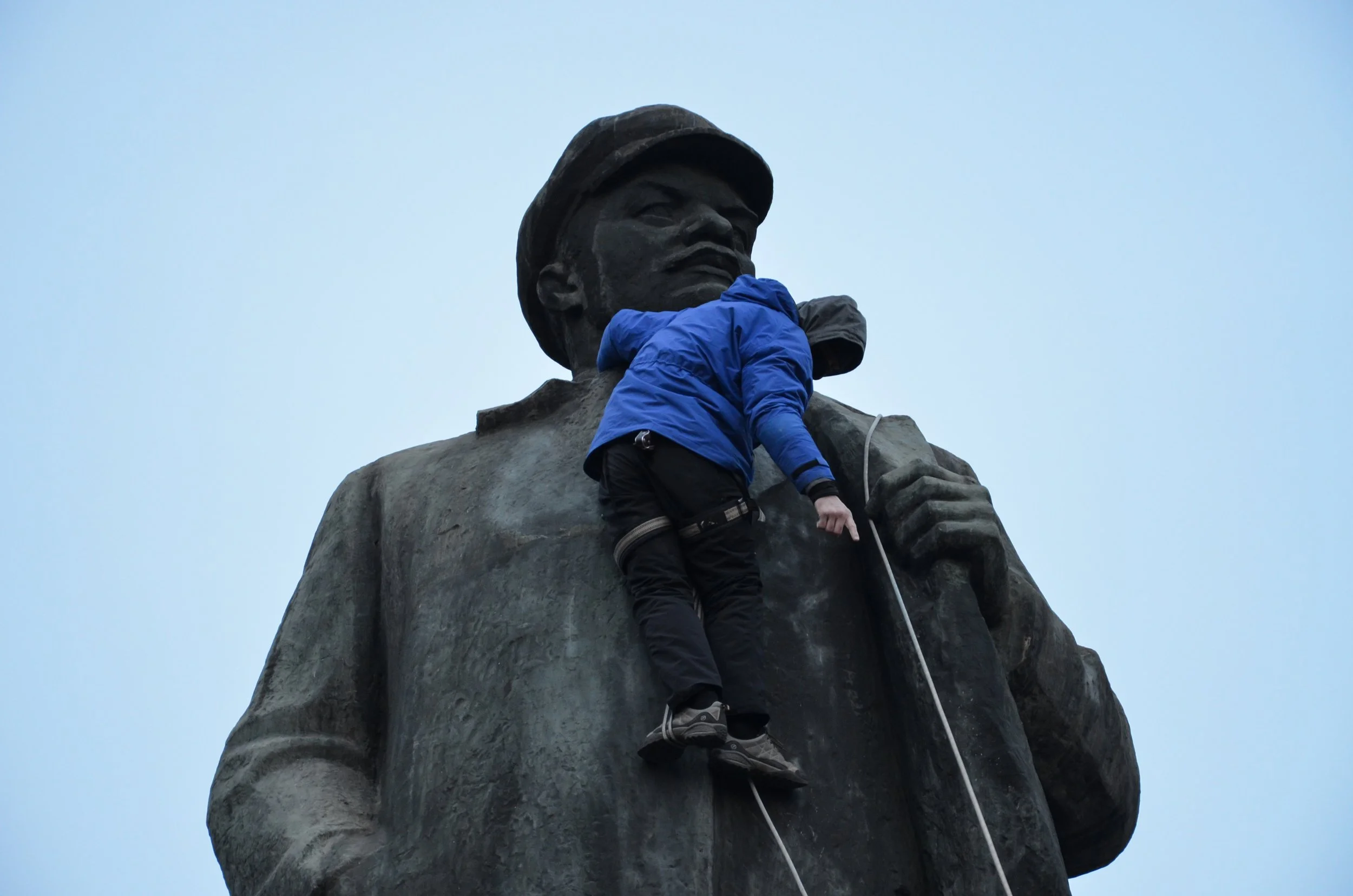
Toppling of the Lenin Monument on Freedom Square in Kherson, February 2014. Photo by Ivan Antypenko.
Along with Russian tanks and military forces, new monuments began appearing in the Ukrainian cities and towns that fell under occupation after Russia’s invasion in February 2022. To fit the ideology of the new authorities, some existing monuments were destroyed or altered. The Reckoning Project — a global team of journalists and lawyers documenting, publicizing and building cases for war crimes— has interviewed witnesses. They have described the physical erasure of memory accompanying the imposition of Russian historical ideology in their communities.
For security reasons, names and identifying details have been altered or withheld.
On the first day of the full-scale invasion, Russian forces occupied a small town on the left bank of the Kherson region, where Hanna was living. The town remains under Russian control. Hanna recounts that Russian soldiers took her, her family, and fellow villagers to the local police station in early September 2022. There they were interrogated and coerced into cooperation, and they were forced to work without payment.
They were brought to a local World War II memorial, a typical Soviet-era monument consisting of a sculpted soldier and a memorial plaque; it had been installed in the 1970s. It once featured a Soviet flag and an “eternal flame,” symbolizing perpetual remembrance. After Ukraine became independent, the Soviet emblem was replaced with the Ukrainian trident and the gas supply was shut off.
Hanna says the flame was relit in 2022, when detainees were forced to remake the monument. “We were forced to clean the area around the monument. The men were made to remove the emblem, and the occupiers bought paint in three colors (of the Russian flag) and the men painted it,” Hanna recalls.
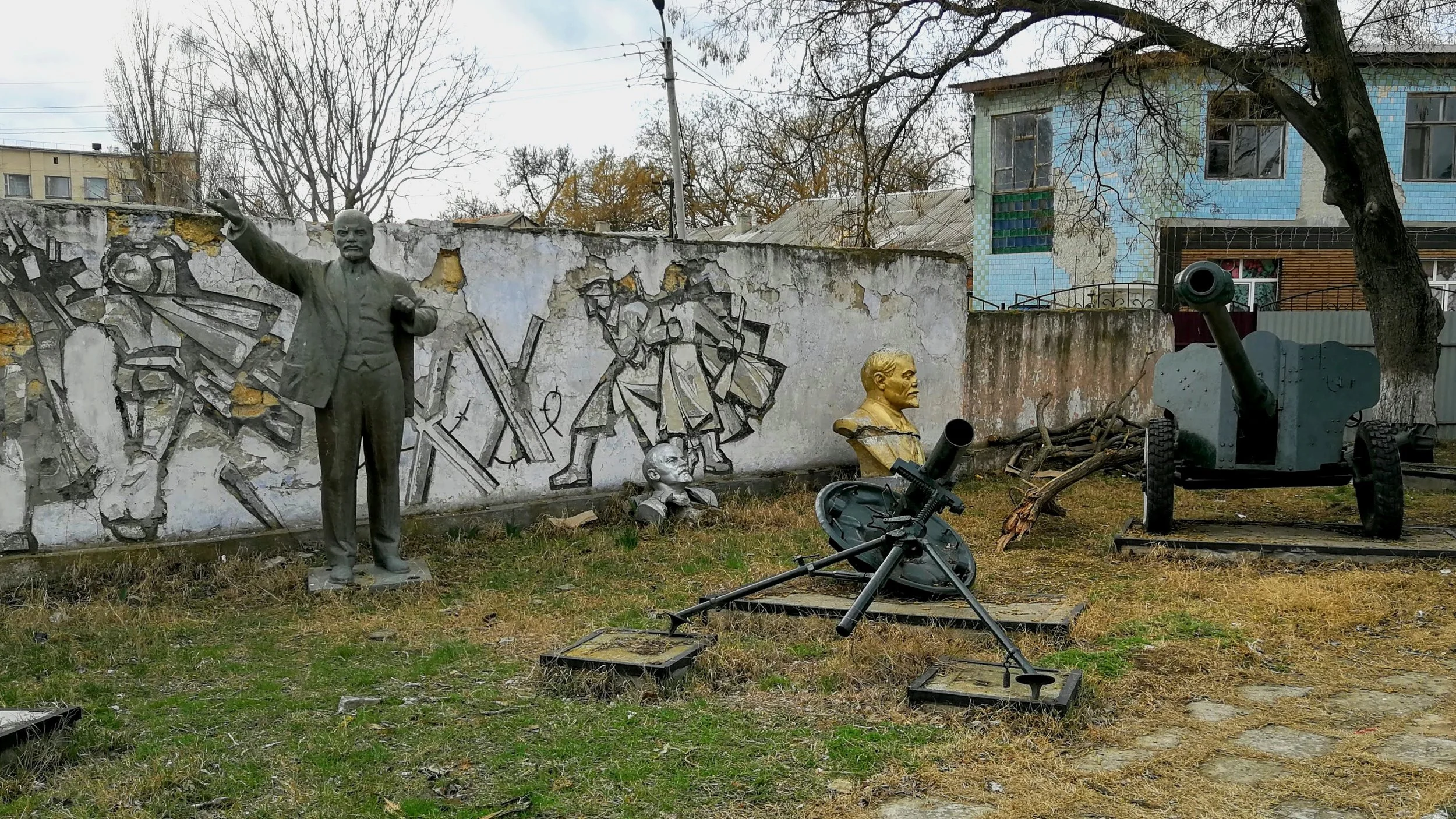
Monument to Vladimir Lenin, Bolhrad, Odesa region, 2019. Photo by Michael Shtekel, The Reckoning Project.
Ukrainians living in the Soviet Union suffered catastrophic losses under German occupation and on the battlefields of the World War II. Historians have established that about eight million Ukrainians died, the majority of which were civilians. Already weakened by the Holodomor, the man-made famine of 1932–33 that killed at least 3.9 million Ukrainians, Ukrainians contributed massively to the defeat of Nazism. Around six million Ukrainians served in the Red Army.
Ukraine continues to honor its many World War II victims. Unlike in Soviet times, when May 9 marked victory over Nazi Germany, since 2015 Ukraine commemorates May 8 as the Day of Remembrance and Victory over Nazism, along with most European countries.
“We remember that war is a catastrophe, a tragedy, millions of dead and broken bodies and souls. We also understand that glorifying and romanticizing war leads to new conflicts,” states the Ukrainian Institute of National Memory, in a rebuke to the way the the Russian Government commemorates World War II.
In Ukraine, this shift became more prominent after the 2013 Revolution of Dignity,mass protests against the government’s abrupt rejection of an Association Agreement with the European Union. The Revolution was followed by decommunization laws, which led to the dismantling of Soviet monuments and the renaming of locations tied to the Soviet past.
The Russian Government has taken a different path. Since the 2000s — especially after the 2008 invasion of Georgia and 2014 annexation of Crimea — official commemoration of World War II has emphasized displays of military power. Victory Day parades have become increasingly militarized, and movements like the “Immortal Regiment,” marches in which citizens carry portraits of relatives who fought in World War II, have been institutionalized.
The Kremlin has used World War II memory to justify its war against Ukraine, portraying Ukrainians as ‘Nazis’ and framing the current war as a continuation of the fight against Nazism. In 2025, on the 80th anniversary of the war’s end, Vladimir Putin declared it the “Year of the Defender of the Fatherland,” explicitly linking World War II victory to “our heroes and participants in the special military operation today [and to] remembrance of the feats of all our ancestors who fought for the Motherland in different historical periods.”
Witnesses interviewed by The Reckoning Project say that Russian forces misunderstand Ukraine’s approach to World War II memory. They are surprised that Ukrainians commemorate the war at all. Ihor, who left an occupied village in Zaporizhzhia region, recalls Russians being surprised that locals cared for a Second World War monument. “The school always took care of it. Before May 9, we cleaned it ourselves. Russians didn’t, but they watched and asked why we did it. For them, it was strange.”
Victoria from the Kherson region says an occupying official vowed that Russia would restore Victory Day celebrations and Soviet monuments, what the Ukrainian government had supposedly taken away. Locals disagreed, noting they had never stopped commemorating the past. “So we told him: ‘What do you mean? Who is forcing us? You can see for yourself — we remember this. It’s not like we’re destroying anything,’” she told the researcher.
She recalls how locals quietly honored May 8, laying flowers at a memorial despite their fear. The next day, they watched from hiding in the bushes as Russian forces and some locals celebrated May 9. “They set up a field kitchen, and Russian soldiers were handing out porridge. People went to the monument and laid flowers. Then there were flags — of the Soviet Union, red flags, and of course Russian flags,” Victoria recounts. “And loud music was playing — Russian military songs, the kind heard during and after the war, all on military themes.”
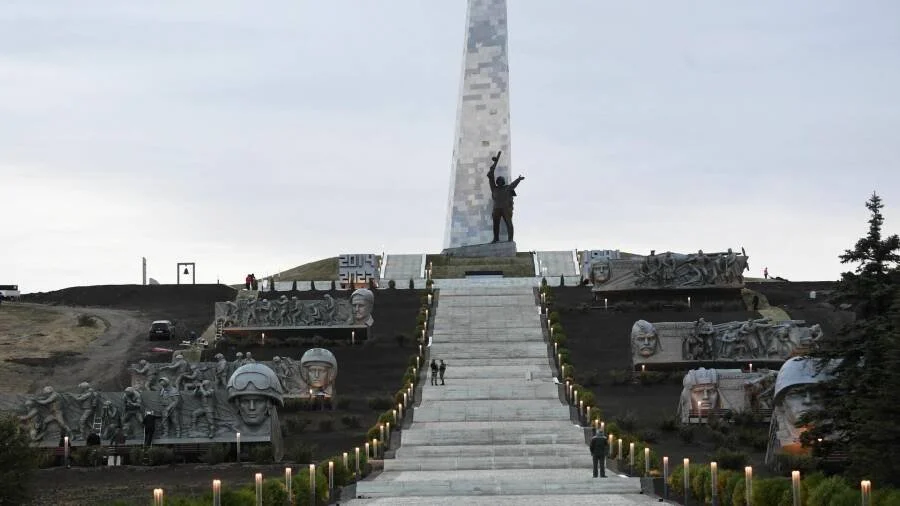
Saur-Mohyla, June 9, 2023. Source: Istoriya.RF, Russian Military Historical Society.
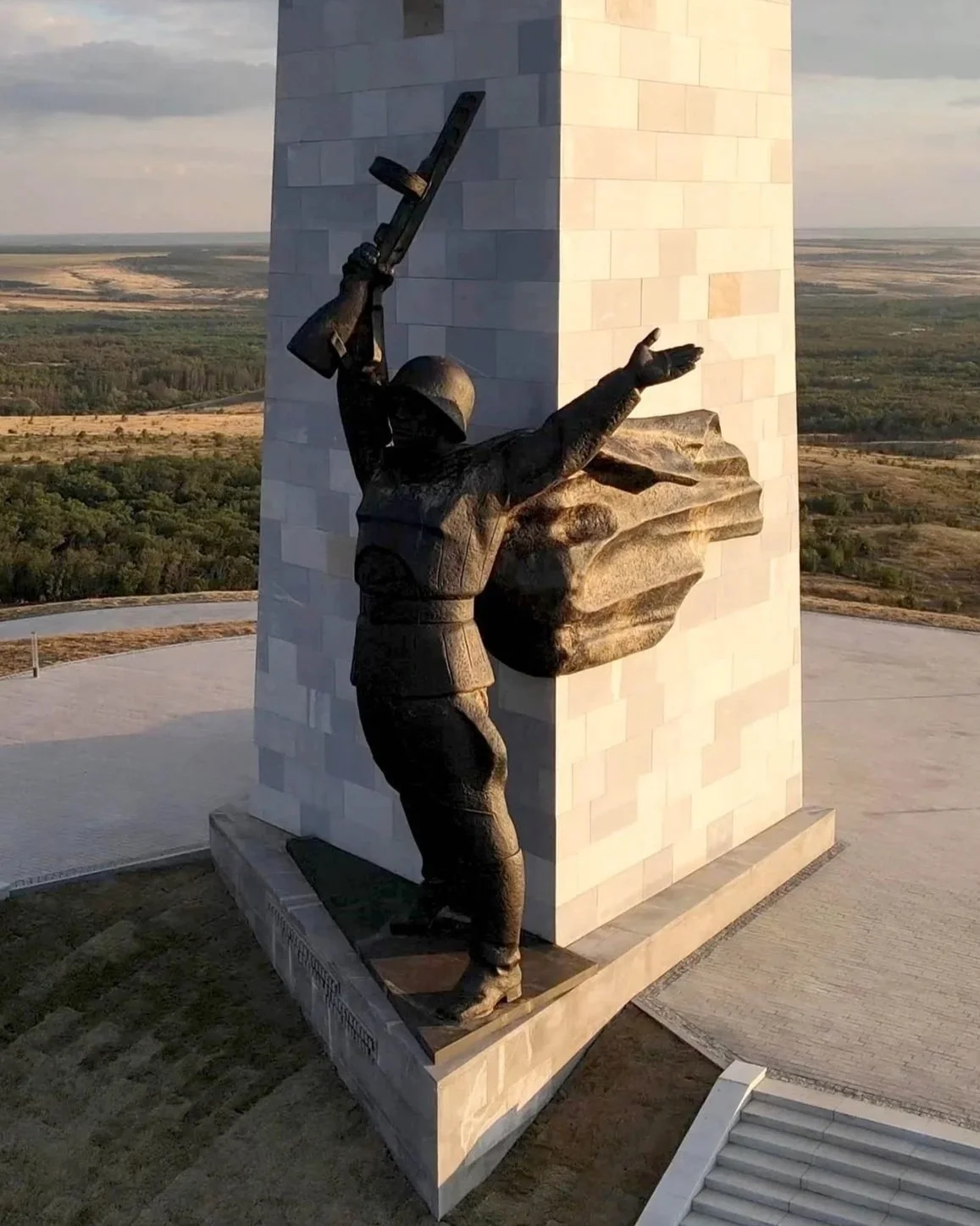
Photos of monuments used to illustrate a guidebook for Russian schoolchildren. Source: Federal State Budgetary Educational Institution of Additional Education and Culture “Center for Comprehensive Development of Children ‘Progress’” of the Russian Federation.
Russian occupation authorities are actively building new monuments. The Ukrainian outlet Texty found that since the full-scale invasion, 124 new monuments have been erected, most of them dedicated to World War II or to the invasion of Ukraine. They often merge World War II memory with current Russian military actions.
In September 2022, Putin took part remotely in the reopening of the Savur-Mohyla memorial in Donetsk region. Originally built in the 1960s, it had been damaged by fighting. It was then modified to include imagery of the so-called Donetsk People`s Republic (DPR) militants. New monuments that honor fighters of the self-proclaimed DPR/LPR, and at least thirteen new Lenin statues have been installed.
Before independence, there were over 5,500 Lenin monuments in Ukraine. Many had been dismantled after 1991, especially during decommunization. Victoria says that in her town the Lenin statue had been removed and replaced with a memorial to soldiers from the 2014–2022 war. She told the researcher that occupying forces destroyed the memorial and placed Lenin’s head from the original Soviet-era statue back on the pedestal.
Occupation authorities have also installed monuments to Russian historical figures unrelated to Ukraine —a statue of 18th-century Russian admiral Fyodor Ushakov, for example, in Kalanchak in Kherson oblast.
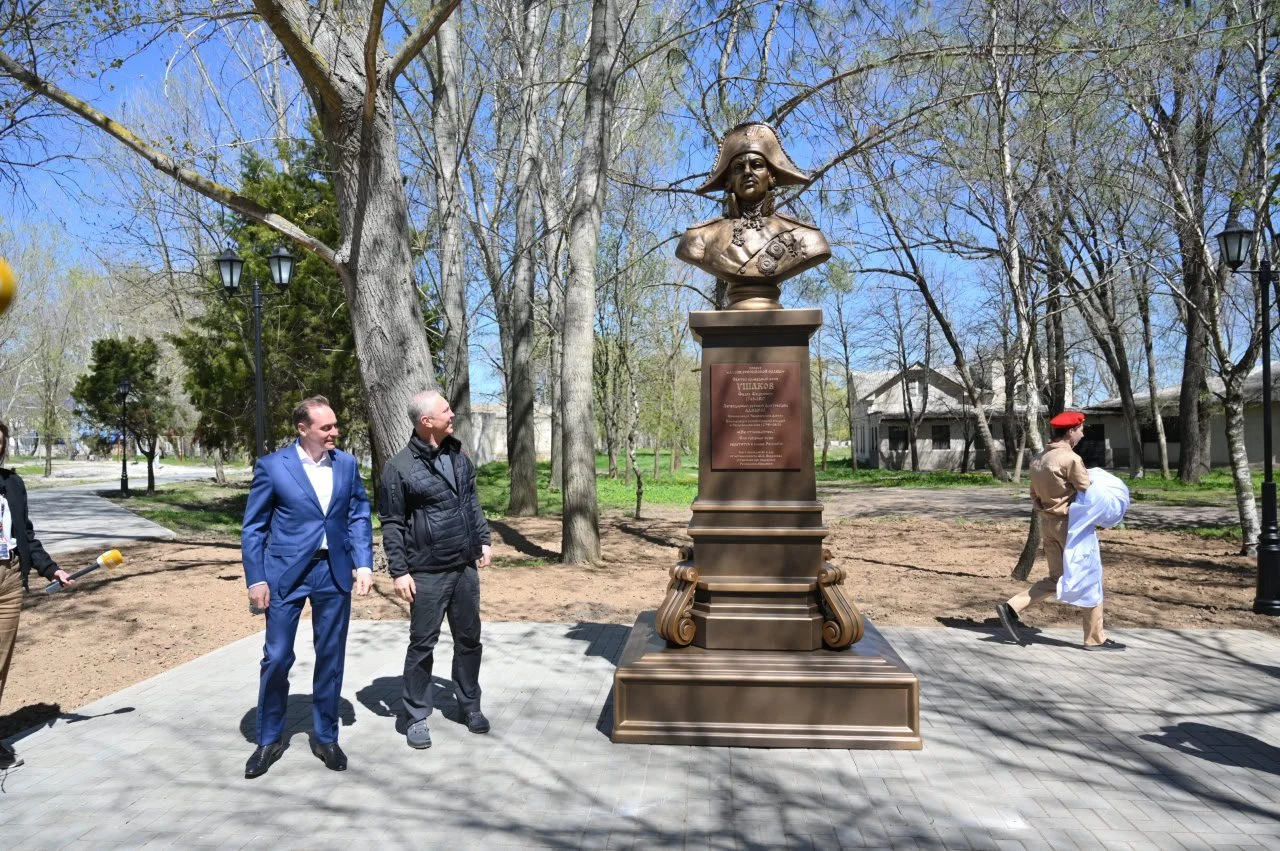
Unveiling of a monument to Ushakov in occupied Kalanchak, Kherson Oblast. Source: Telegram channel of the occupying administration of the Kalanchak District.
In the occupied territories, Ukrainian monuments are being destroyed. According to UNESCO (April 2026), 526 cultural sites in Ukraine (including but not only in the occupied territories) have been damaged or destroyed. Ukrainian authorities estimate that 1,333 cultural heritage sites and 2,185 cultural infrastructure facilities have been damaged or destroyed as of January 2025, noting their limited access to occupied areas.
Reports indicate active demolition of monuments to Holodomor victims in the occupied territories. Occupation authorities justify their actions as fighting “disinformation.” The Russian government denies that the famine was intentional and downplays its scale.
Monuments to other victims of Stalinism, participants of the 2014-2022 defense of Ukraine, and Ukrainian cultural figures have also been removed, including statues of Ukrainian nineteenth-century poet Taras Shevchenko, political and military leader of early seventeenth-century Petro Konashevych-Sahaidachny, and contemporary opera singer Vasyl Slipak, who was killed in combat in 2016 after joining Ukraine`s armed forces.
One witness described how a memorial to Ukrainian soldiers (2014-2022) was destroyed and replaced with a “tricolor heart” in her town. Another said locals hid a memorial plaque to a soldier killed in the 2014 Ilovaisk battle. Street names and other toponyms are being changed to reflect Russian and Soviet figures, alongside broader efforts to control media and to Russify education.
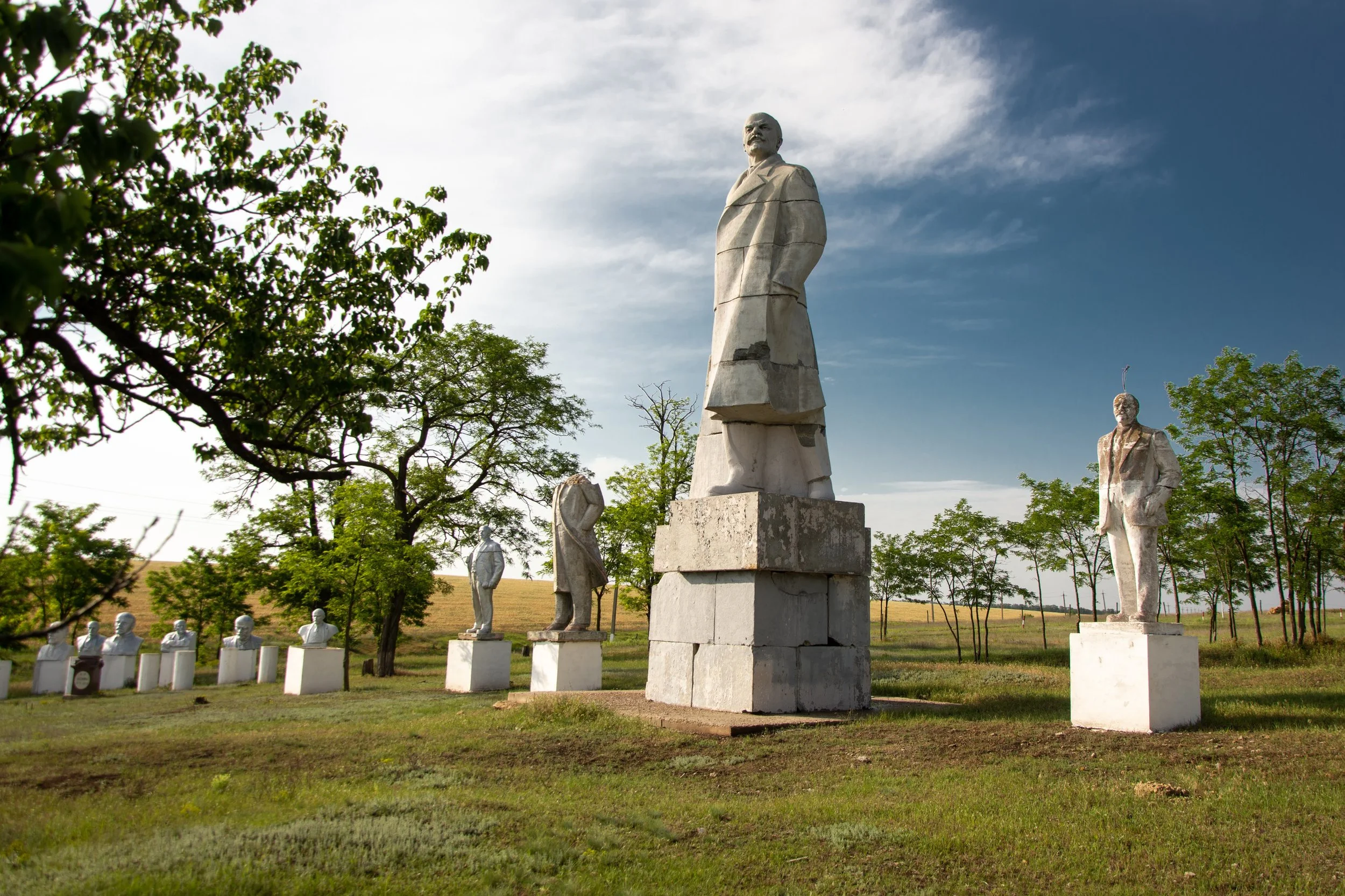
Monuments and busts of Vladimir Lenin, Museum of the Totalitarian System of the USSR and Socialist Realism Monuments, Frumushika-Nova, Odesa region, 2020. Photo by Michael Shtekel, The Reckoning Project.
Russia’s reshaping of the physical landscape in the occupied territories serves several interlinked goals. One is to reenforce its narrative of a shared Ukrainian-Russian past and of the two people as “one,” as claimed by Vladimir Putin. Other goals are: to erase Ukrainian identity by removing monuments to national cultural and political figures; to present itself as a defender rather than a destroyer by restoring Soviet-era and especially World War II memorials; to legitimize its claim that these territories are inherently “Russian” through the installation of monuments to Russian historical figures; and to cultivate loyalty, patriotism and a pro-Russian identity.
Monuments, which are expensive to erect, express physical reality in ways that can feel more real and convincing than information conveyed online or through the media. They carry a sense of permanence, signaling to the occupied population that Russia together with its vision of the past, present and future is there to stay.
Tatiana Vorozhko is a Contributing Editor at The Reckoning Project
Lesya Pyniak is a Project Researcher at The Reckoning Project