
Letter from Kyiv
On June 15, we reached an official milestone. The European Union opened the first cluster—“Fundamentals” in its parlance—of accession negotiations with Ukraine and Moldova. For Ukraine, this is the last mile on the long road initially and dramatically chosen on November 21, 2013. This was when protests first materialized against the decision of Victor Yanukovych, Ukraine’s president, to turn away from EU integration. As we know, he was being blackmailed by Russia, and some consider this the first day of the Russo-Ukrainian war. Since that moment, the pitch of violence has only risen: the persecution of pro-European protesters in 2013; the annexation of Crimea and the war in the eastern regions in 2014; and then the full-scale invasion in 2022, by which time Russia was waging war against all Ukrainians.
Our June 2026 milestone was big enough to elicit Russia’s congratulations. In the night came a missile attack. Deliberately or not, a series of important cultural venues suffered damage. One was the Dormition Cathedral at Kyiv’s Pechersk Monastery, a UNESCO World Heritage Site and holy place for Ukraine’s Orthodox Christians. The nearby Book Museum was also hit. So too was the Art Arsenal building just across the street, Kyiv’s biggest exhibition venue and home to Book Arsenal, an annual book fair. Two weeks before, under the very roof that was now burning, thousands of readers had mingled, bought books, sipped coffee and listened to writers, poets, intellectuals and veterans. For Ukrainian and foreign literati had been meeting up annually at Book Arsenal.
A week before Book Arsenal, on May 24, we endured one of the worst attacks since the start of the invasion. Russia used ninety missiles and roughly six hundred drones of different kinds, weapons that cost hundreds of million dollars. Three people died; dozens were injured. (As the attacks on Kyiv get worse, international coverage appears to diminish.) That night, the shopping mall and the market near the Lukyanivska metro station had been destroyed by a missile, as were many other locations. Because of the smoke, people who had found shelter in the metro had to be evacuated to the next station. The banner with Domenico Fetti’s David and Goliath in the header of my previous letter (from May 27, 2026) somehow survived the massive fire. It can still be seen just in front of the burned down mall.
Not for the first time since the invasion has this particular neighborhood—between two well-known Kyiv locations, the Maidan Square, the central place for the 2013-2014 revolution, and Babyn Yar, a Holocaust memorial— been at the epicenter of attack. Some locals have had to replace their windows for the fifth time. One of the reasons is the topography. Lukyanivka, the name for the metro and for the area, is on the one of Kyiv’s many hills. The other reason is a former military factory. Though it is not functional, Russia has found reason to hit the ruin over and over again.
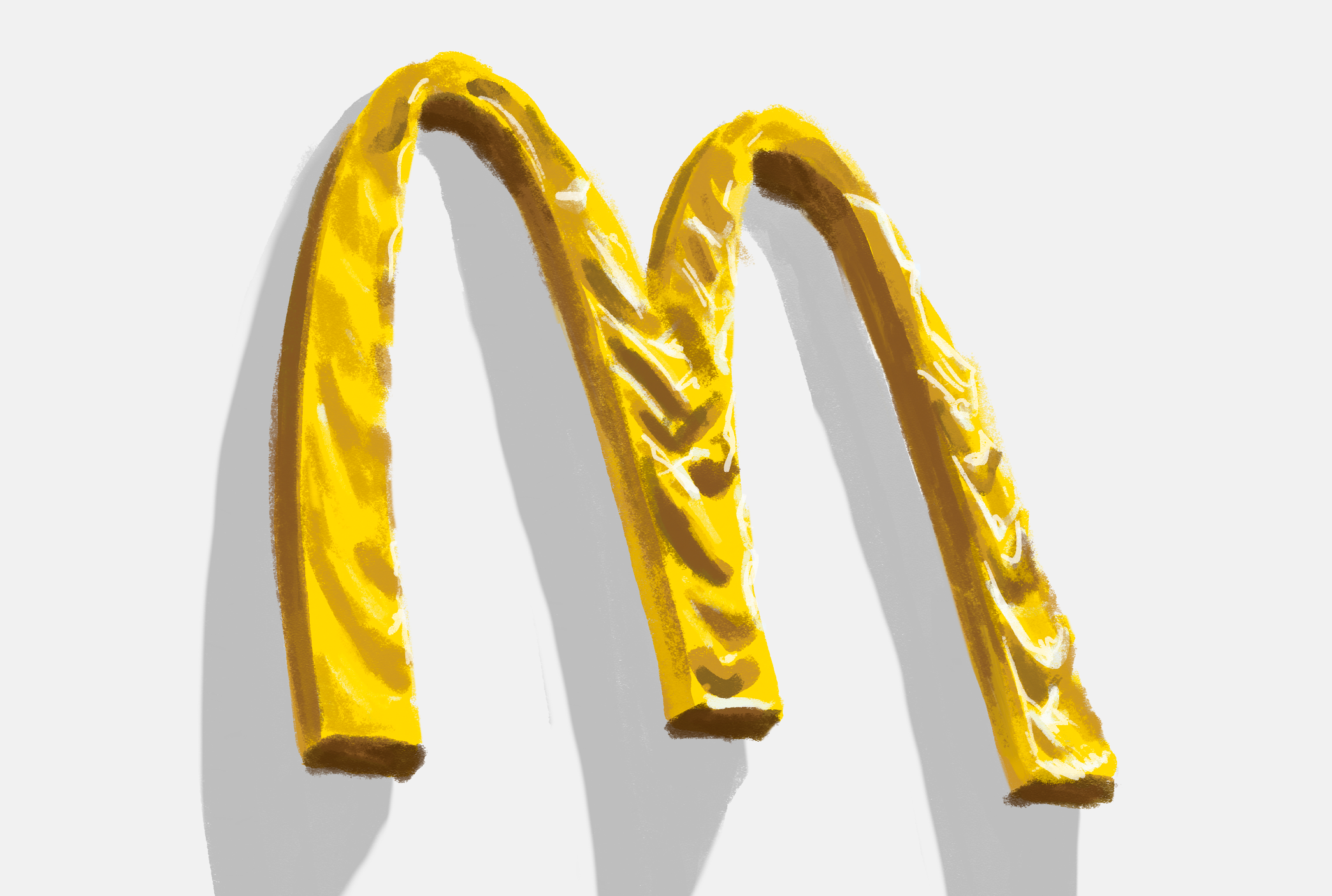
Next door to the metro station stands the oldest McDonald’s in Ukraine. The restaurant has had to change its windows several times as well. On May 24, the bright yellow “M” had melted in the heat of fire. Photos of this disfigured letter went viral.
There are more than 120 McDonald’s in Ukraine. One of them is the second most visited McDonald’s in the world. The one on Lukyanivka opened in 1997 – also on May 24. In 2026, the fire following the bombing took some time to put out, and the restaurant re-opened three days after it had been struck. A joke in Kyiv is that in the event of a nuclear attack they would need a week to reopen.
While new McDonald’s have appeared in Ukraine over the years, the yellow “M” has at times symbolized the evils of the West, a satanic moniker in the eyes of anti-globalists and anti-Western zealots the world over. To be honest, I’m not myself fond of McDonald’s (except for their coffee). It’s a shame, I think, that a chain with mediocre cuisine must shoulder such a heavy symbolic burden, but looking at enemies of what McDonald’s represents, you have to love it.
When McDonald’s was back in business in September 2022, half a year after the start of the full-scale invasion, the delivery services were out of couriers in twenty minutes. People stood in long lines. Ukrainians are foodies, and the city had countless better alternatives. The demand was driven by nostalgia and by the sentiment of defiance, defiance of the war. Having access to a McDonald’s is normal.
The year of McDonald’s opening in 1997 had been a time of gradual economic recovery after years of inflation and misery. During the recent Madrid Summit, Ukraine and NATO signed a Charter on a Distinctive Partnership; they also established a NATO-Ukraine Commission. The European Convention on Human Rights has been ratified by Ukraine’s parliament. The return of McDonald’s in September 2022 was another sign that Ukraine can win the war, a newly discovered Big Mac Index.
On the night Lukyanivka was attacked, we got almost no sleep. Our home is a couple of miles away, and our own neighborhood has suffered too. Nevertheless, in the morning our friend texted to confirm the plan we had before, an immersive Van Gogh exhibition at 10 AM. “Fuck them! We go!” So much for my hope of escaping an immerse exhibition: ninety missiles are no excuse. We went with our little kids, though our friend’s husband couldn’t join. As an officer serving in Kyiv, he had gone to his base to fix its broken windows with plywood. At 11AM, the venue was full of people. (My conclusion: sleep deprivation mixes poorly with VR headsets and immersive exhibitions.)
I then went back to our neighborhood for a coffee with my old friend and his fiancé; he is my daughter’s godfather. Their wedding was a week away. This area is one of Kyiv’s two major hipsterlands, and that day they both bore the marks of the recent attack. Just a few blocks from us, the Chornobyl Museum had been destroyed. A few feet from the ruin, the coffeeshop owner served espressos through a broken window.
Wartime Kyiv is sometimes criticized for its hedonism. Fancy restaurants, people nicely dressed, dance parties and clubs, book fairs, and matcha lattes on every corner: all that can seems surreal in a country riven by war. Yet even in Kyiv you can only party to a certain degree. Night curfews empty the streets for the mobile units protecting the city from Russian drones.
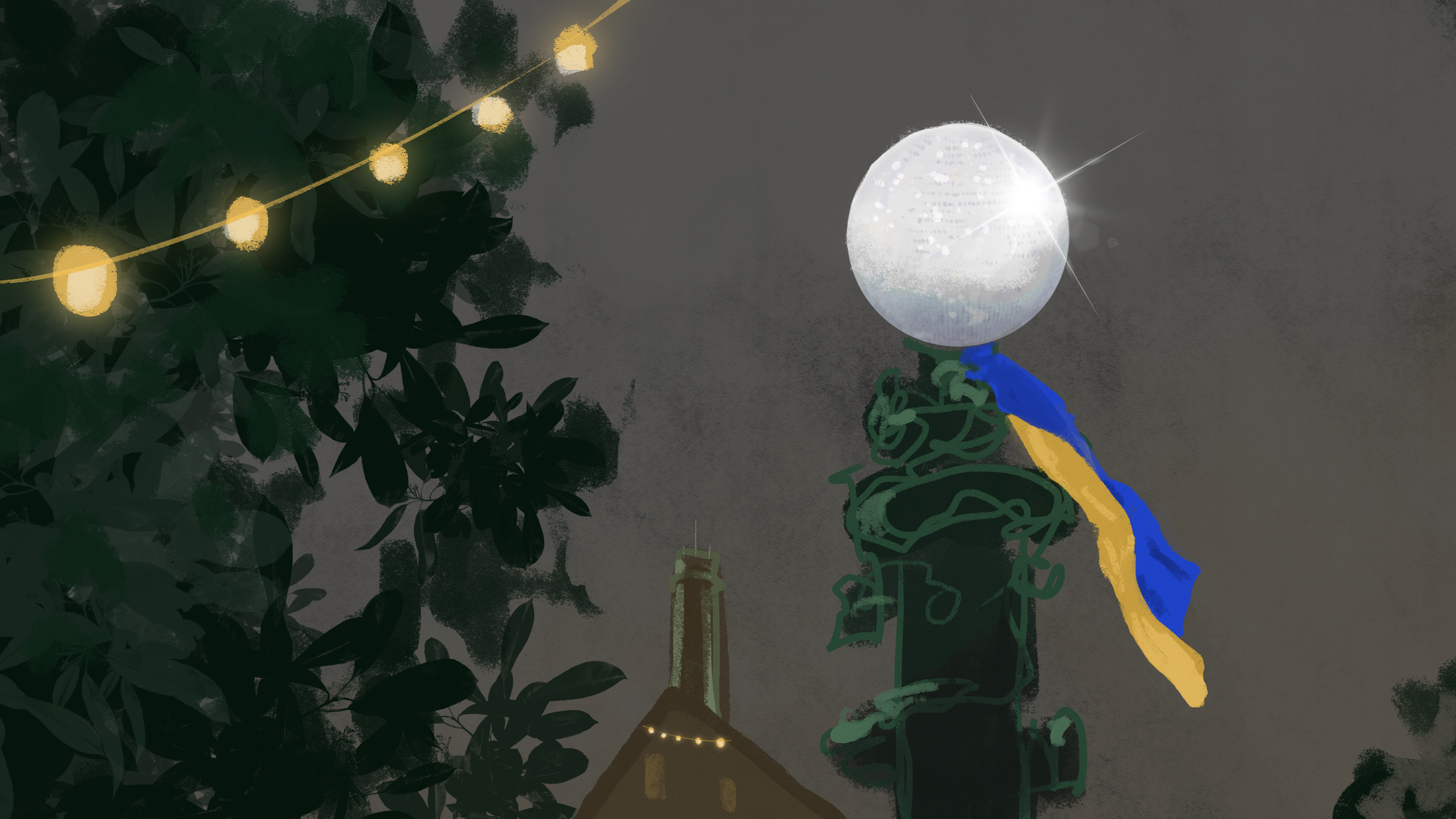
“…surrounded by the trees, was a pillar with projectors on it. At the pillar’s top was the blue-and-yellow Ukrainian flag and a disco-ball.”
The next Sunday, my friend celebrated his wedding in one of the oldest hipster dance clubs in Kyiv. Ravers had gentrified an abandoned small factory, which had survived attacks from the radical right (the place is LGBT-friendly), police raids, covid and the full-scale invasion. The place evokes an island of pre-war freedom amid the cruelties of war. My friend, the groom, has been serving since the invasion’s first day; he is now based in Kyiv. He and his colleagues (who also serve) were in their civilian clothes. You couldn’t tell them apart from the DJ, though the father of the bride was in military dress. The guests took photos on the terraces covering a green hill hidden beneath its May greenery. In the center, surrounded by the trees, was a pillar with projectors on it. At the pillar’s top was the blue-and-yellow Ukrainian flag and a disco-ball.
That’s what keeps the country sane. The cafes, the exhibitions, the matcha, the hangover McMenus and the Sunday brunches after deadly attacks — the modest trappings of civilization. We need our flag, and we need a disco-ball. Without either one, the hardships of the last years would make no sense.
Anyone in Ukraine can tell you that this is a war for survival, and so it is. The attacks on Kyiv gain in intensity, while Ukrainian attacks on Russian oil refineries gain in success. In the background is another battle, the battle for Ukraine’s soul and for its European future. The criticism of Kyiv surreal normality is just a minor example of moral narcissism which already started to plague the country. Excelling on the battlefield and becoming a regional leader in military technology is inspiring, especially after there have been so many disappointments – first and foremost, faltering support in 2022 when Ukraine could have pivoted and counter-attacked Russia. Because of its military prowess and because of daily-life hardship and martial law, Ukraine’s current advances may invite a less pro-Western, more Euroskeptic and more resentful spirit.
Ukraine’s first set of accession negotiations (out of six) covers the EU’s founding principles, the rule of law, fundamental rights, the functioning of democratic institutions and the reform of public administration. In some of these, Ukraine lags behind neighboring Moldova. Both countries have been striving to meet the EU criteria and in particular to align local legislation with European models also known as acquis communautaire. Until recently, the accession process of these two countries had been in synch.
Despite the optimistic rhetoric, this process isn’t going so smoothly for Ukraine. Volodymyr Zelensky has said that “we want 2027 [to be the year of access],” which, putting it mildly, is unrealistic. Meanwhile, according to Ukrainian experts, the country ranks fifteenth out of a hundred in implementing the so-called “Kachka-Kos plan,” a list of reforms that the Ukrainian government agreed to fulfill in December 2025. This agenda is focused mostly on rule-of-law and anti-corruption legislation. Even with the president’s impatience, with Ukrainians’ practically univocal support for European integration and with the government’s efforts, Ukrainian political actors still need to be nudged by the EU to make reforms.
There are cautionary examples outside of Ukraine. The most worrisome is Serbia, which started negotiations with the EU in 2014, and got nowhere. Not coincidentally, Serbia has often been moving away from democracy over the past decade. Serbian nationalists and their appetite for greatness have deprived the country of its European future. Ukrainians do not fall for “greatness,” but we have a new buzzword, subjectnist, meaning subjectivity as well as agency. Good concepts and fine words can be overused and then misused. In our current context, subjectnist can stand for arrogance. My concern is that “subjectivity,” a word that initially came from the vocabulary of Ukrainian liberals, has been turned at times into a cognate for nationalistic pride. This would be a shame. “Greatness” is not yet on the table, but I will stay watchful.
Being normal under absolutely abnormal circumstances is something more noble than greatness. A few days ago, I toasted to that with my McDonald’s coffee at Lukyanivka. Its yellow “M” is new and once again shiny.
Oksana Forostyna is Opinion Editor at Ukraina Moderna and an author. A former executive editor for Krytyka Journal, she contributes to Liberties, The European Review of Books, Krytyka, and Babel.
Illustrations by Kennan Institute Creative Director Jude Schroder. McDonald’s “M” illustration based on photo by Olesia Petryk.