
From Self-Censorship to Exposé
A Commissioned Docudrama about Sergei Eisenstein’s Ivan Grozny
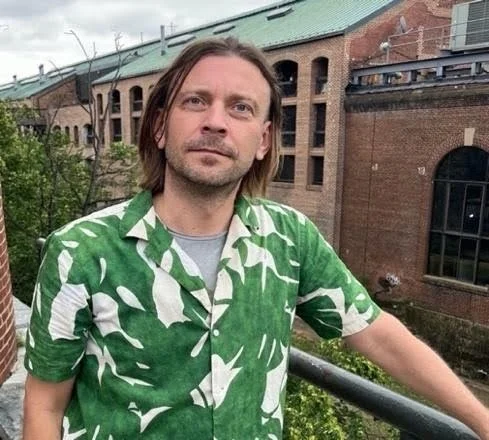
Durnenkov pictured by Blue Bottle coffee shop, near the towpath in Georgetown, May 2024. Photo from the author’s archive.
Born in 1976, Mikhail Durnenkov is one of the founders of the New Drama (Novaia Drama) playwriting and directing movement in Russia. He participated in the Teatr.doc company in Moscow, and served for many years as the Artistic Director of the Liubimovka Festival, a leading independent forum of new Russian-language playwriting. He has written fifty plays, which have all been produced in either Russia, Europe, or the United States. The War Has Not Yet Started (2016) was performed at Middlebury College in 2025 and at the University of Maryland in 2024. Utopia (2009) was performed at Yale University in 2025.
New Drama began about a decade after the fall of Soviet Union. It used the stage to speak directly about social issues, which state-sponsored media in Russia would not cover. One of the movement’s main formal qualities of the movement was its reliance on docudrama. Through workshops hosted by Royal Court Theatre in 1999, docudrama was developed in the basement of an apartment, which became Teatr.doc in 2002. To make a docudrama, the playwright interviews marginalized social groups and different ethnic groups. The subsequent questions and responses become the crux of the plays. New Drama continues in the increasingly censorious Russia of today, bringing the voices of the dispossessed to audience members.
Mikhail Durnenkov has published multiple plays in the docudrama genre. Durnenkov’s oeuvre, which is mostly fictional, often depicts the real-world conditions of post-Soviet life. Blue Machinist, which Durnenkov wrote in 2007 and which premiered at Teatr.doc in 2007, is illustrative of his style. The play satirizes the Soviet factory novel, while focusing on the real lives of blue-collar workers. The Blue Machinist depicts factory workers during work, though mostly on their lunch and smoking breaks. This kind of storytelling casts a bright light on everyday life.
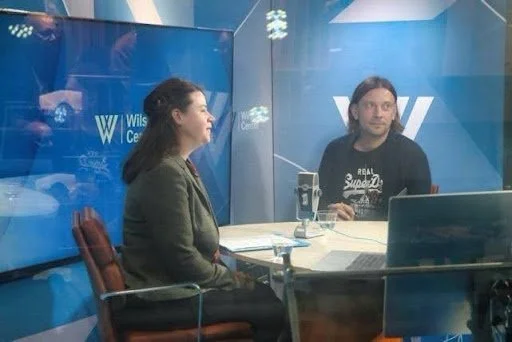
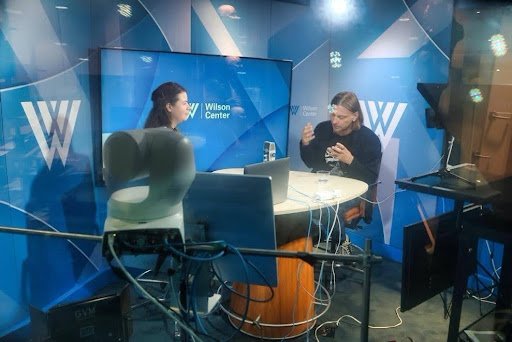
Full interview between the author and M. Durnenkov recorded in June 2024.
The powerful dialogue of Blue Machinist compensates for the characters’ lack of action and ability to carry the plot forward. Factory workers write and declaim haiku poetry. Machinist hokkus are similar to traditional ancient Japanese, poetry because the poet (in this case the factory worker) exercises self-restraint and gives weight to every word. Durnenkov, who highlights verbal montage as opposed to image montage, is familiar with Eisenstein’s theory of montage. Eisenstein’s montage had used a psychological effect known known today as associationism. In his time, Eisenstein referred to it as “image sensual thinking,” by which the camera shows one object and then juxtaposes it with a filmed shot of another object; the viewer’s own mind synthesizes the two filmed objects into a concept, and Eisenstein believed that this process had a greater impact on the audience’s imagination than any camera’s portrayal of a natural event. The audience of Durnenkov’s play, hearing the slang and the declaimed haiku, grasps a social message. This is the need to appreciate and sympathize with the extreme manual labor of Machinists.
Given the post-2022 climate in Russia, Durnenkov opted for exile in Finland. There he decided to create a mostly-documentary play about Sergei Eisenstein, who navigated censorship and artistic creativity under the most difficult of circumstances. Joseph Stalin commissioned Eisenstein’s last film project, Ivan Grozny or Ivan the Terrible, in January of 1941. Eisenstein agreed to do this project for Stalin, but he promised himself not to betray his own artistic will, for instance, by romanticizing the tyrant “just” out of fear of Stalin. The artist’s struggle to balance the demands of art with the demands of power is the subject of Durnenkov’s play.
Part I of Eisenstein’s Ivan Grozny was released in 1945. It received the Stalin Prize, a prestigious award in the Soviet Union (1941–1954) for outstanding contributions in arts, literature, and science, later replaced by the Lenin Prize. It was awarded to individuals or collectives for achievements promoting Soviet ideology and industrialization. Durnenkov’s play is based on archival documents from the film director’s journal with some inventions by Durnenkov: the presence of Eisenstein’s wife Pera and the presence of an NKVD scout, Savelyi Kondrashev. The playwright weaves the presence of an invented spy named Man Without A Face into the plot, a presence (in the play) during Eisenstein’s filming process in Almaty (which was then called Alma-Ata).
In Part I of Eisenstein’s film, Ivan IV is crowned as the first tsar of Russia. The boyars (nobility) and the Archbishop Pimen plot against Ivan, leaving hidden poison near the tsarina, Anastasia, which Ivan invertantly gives to her. In 1564, Ivan abdicates and leaves Moscow for the town of Aleksandrova Sloboda. When hundreds of common people come to him, he decides to return, saying that he will rule with absolute power and by the will of the people. Stalin regarded the first part of the film as an allegory for his own rule.
In Part II, which was completed in 1946, Ivan has returned to Moscow to begin a series of attacks on his enemies there, while at the same time the boyars plot to assassinate him. Stalin detested the portrait in the second film and promptly banned it. While Eisenstein intended Ivan the Terrible to be a three-part film and had begun filming for Part III, he abandoned production of Part III after the ban of Part II. Eisenstein died in 1948, leaving the film incomplete.
Archive material indicates that Eisenstein was walking a razor-sharp line. He had been commissioned to depict Ivan Grozny accurately, but he could not make it appear that Stalin was a double of Ivan the Terrible. This tension comes to the surface in four dialogues that Eisenstein has with different characters, including Savelyi, Pera, Zoya, and himself.
EISENSTEIN. The film Ivan the Terrible will consist of three pictures. In the first I will lay the spring of history, and bend it to the limit ... In the second - it will straighten and... hit properly! And in the third, it’ll blow everything to pieces. So that everyone will realize that this story is a verdict on the system.
SAVELYI. Why put yourself and the people you work with at risk?
EISENSTEIN. I will answer you in the words of the historian Karamzin: “The life of a tyrant is a calamity for mankind, but his history is always useful for sovereigns and nations: to instill disgust for evil is to instill love for virtue - and it is glorious for the time when a writer armed with the truth can, in the rule of an autocracy, put such a ruler to shame, so that there will be no more like him from now on!”
[…]
SAVELIY. Aren’t you scared?
EISENSTEIN. Scary, of course. I’m used to a rational approach to everything I do, and it’s obvious to me that my idea looks like suicide. At best, I won’t be allowed to make any more films. But I'm willing to try.
SAVELYI. My question wasn't about that.
EISENSTEIN. Am I afraid that you will denounce me?
SAVELYI. Yeah.
EISENSTEIN. Remember I told you that I see the evil in you fighting the good? My role is to be an artist. And if I betray the artist that lives in me, if I do something I don't believe in, my inner creator dies.
While writing, Durnenkov consulted the Eisenstein biographer Naum Kleiman. Did Eisenstein want to deceive Stalin? he asked. Eisenstein’s research for the film, which he began in 1941, included reading historical documents by Heinrich von Staden and Andrei Kurbsky, who both wrote historical accounts of Grozny in the 1500s. He also read original correspondence between Ivan Grozny and Kurbsky. Stalin wanted the film to depict Grozny as a great ruler Eisenstein did not shy away from this goal, but Eisenstein could not simply capitulate to a falsely positive depiction of Grozny. Eisenstein wrote a hundred notebooks with ideas for the film, notebooks Durnenkov has read. Durnenkov was struck by Eisenstein’s grip on his artistic will. In Durnenkov’s play, Eisenstein remains true to his creative will despite censorship and self-doubt, which his wife helps him overcome.
PERA. I'm asking you how I can make a film in which I have to go against historical truth and spend my talent to whitewash a murderous tsar.
PERA. How? The way you usually do it, with your head and your talent. Fall in love with this film and it will all work out for you. […] Just don't cheat on yourself.
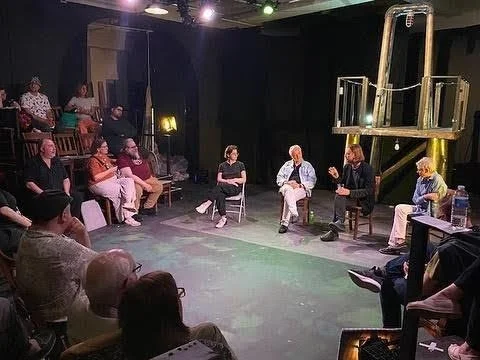
(In a jean jacket, center) Yuri Kordonsky (Yale University), who directed the play-reading of Eisenstein at Spooky Action Theatre. M. Durnenkov is seated to the right of him.
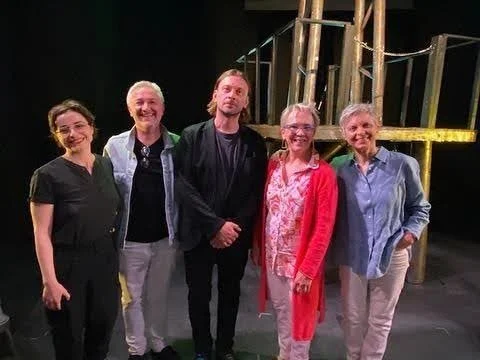
After the play-reading with Spooky Action Theatre manager, Elizabeth Dinkova, who is pictured to the leftofKordonsky.
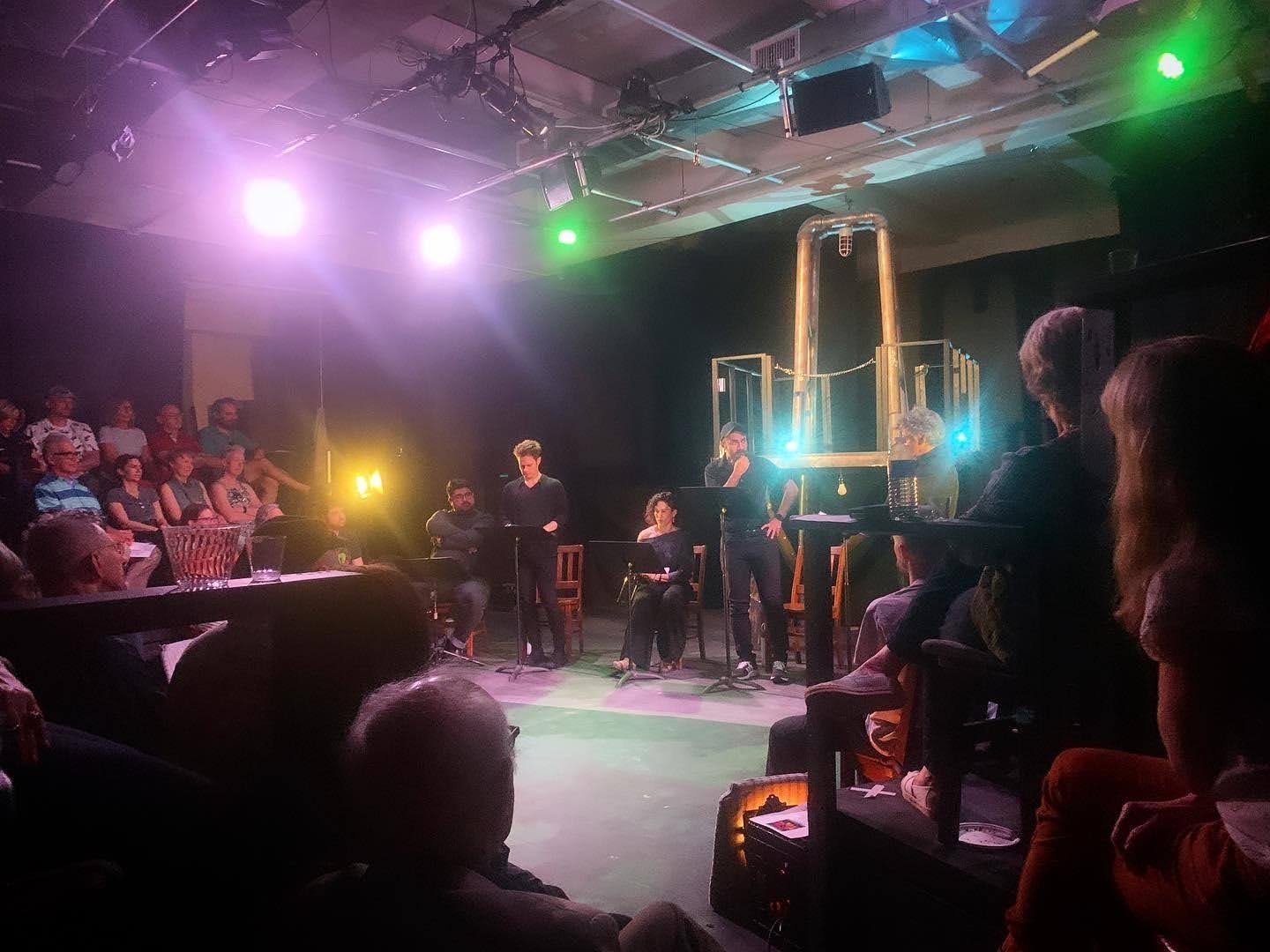
Play-reading of Eisenstein at Spooky Action Theatre, April 28, 2024.
At one point in Durnenkov’s play, a NKVD scout explains that “Comrade Stalin has no other artist who can make him stronger on the screen than in life.” Ultimately, Eisenstein’s film, like Durnenkov’s play, never depicts Stalin as a revered czar. Durnenkov’s play channels a tension Eisenstein’s body and mind that went on for years. Throughout the stalled and resumed filming process in the 1940s, Eisenstein walked a dangerous tightrope.
Durnenkov’s play explores Eisenstein’s inner life and his reckoning with his own artistic ambitions. By the end of the play, poetic justice wins, but it costs Eisenstein his life. Eisenstein had a heart attack and died before completing the third part of Ivan Grozny. In late February of 2022, Durnenkov agonized about whether or not to leave. He finally decided to listen to the voice inside him that felt he could not be a writer in wartime Russia. He does not regret his choice, even though exile is often difficult. Some of his artist friends who stayed in Russia after 2022 have had to face the challenges that Eisenstein had once faced. That could have been Durnenkov’s fate as well.
During the Q-&-A with the audience, a regular component in docudrama productions, at the play’s premier at Spooky Action Theatre, film scholar Liz Papazian spoke about tyranny. The play reminds the audience, she observed, that at the time of high Stalinism in the 1930s and 1940s speaking the truth feels like a jolt. The play mixes pessimism and optimism, Papazian’s view. Pessimism is reflected in the constant fear of Stalin’s opinion, a constant that led to Eisenstein’s heart attack. Poetic justice is the optimistic aspect of the play. Eisenstein achieved it, although at enormous cost.
In April 2025, Durnenkov’s Eisenstein was performed at the Festival of Young Drama in Teatr.doc. Ira Volkova directed the production that opened in a packed theatre, to an audience of 250 people. Underground art in twenty-first century Russia finds a sanctuary in Teatr.doc’s basement theater, a place of free speech during the staging. When the play is over, the footlights go up and the actors slip into unscripted conversation with the audience.
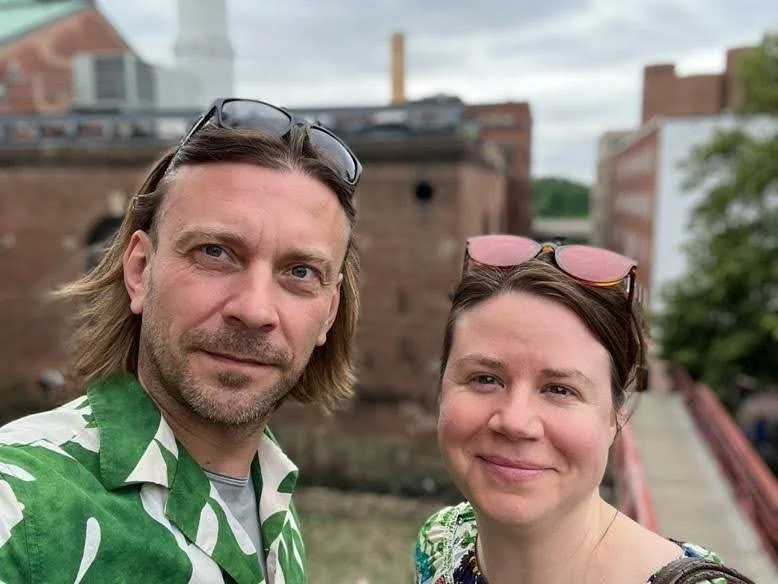
Durnenkov pictured in a selfie with Elena Susanna Weygandt, May, 2024, Georgetown, District of Columbia.
Elena Susanna Weygandt holds a PhD from Princeton's Department of Slavic Languages and Literatures and works at the intersection of literary theory, film studies, and gender and performance studies. She has written several publications on these topics, including her recent book “From Metaphor to Direct Speech: Contemporary Russophone Drama and Performance Theory (2025).”