
Chechnya: Laboratory of Authoritarian Identity Engineering
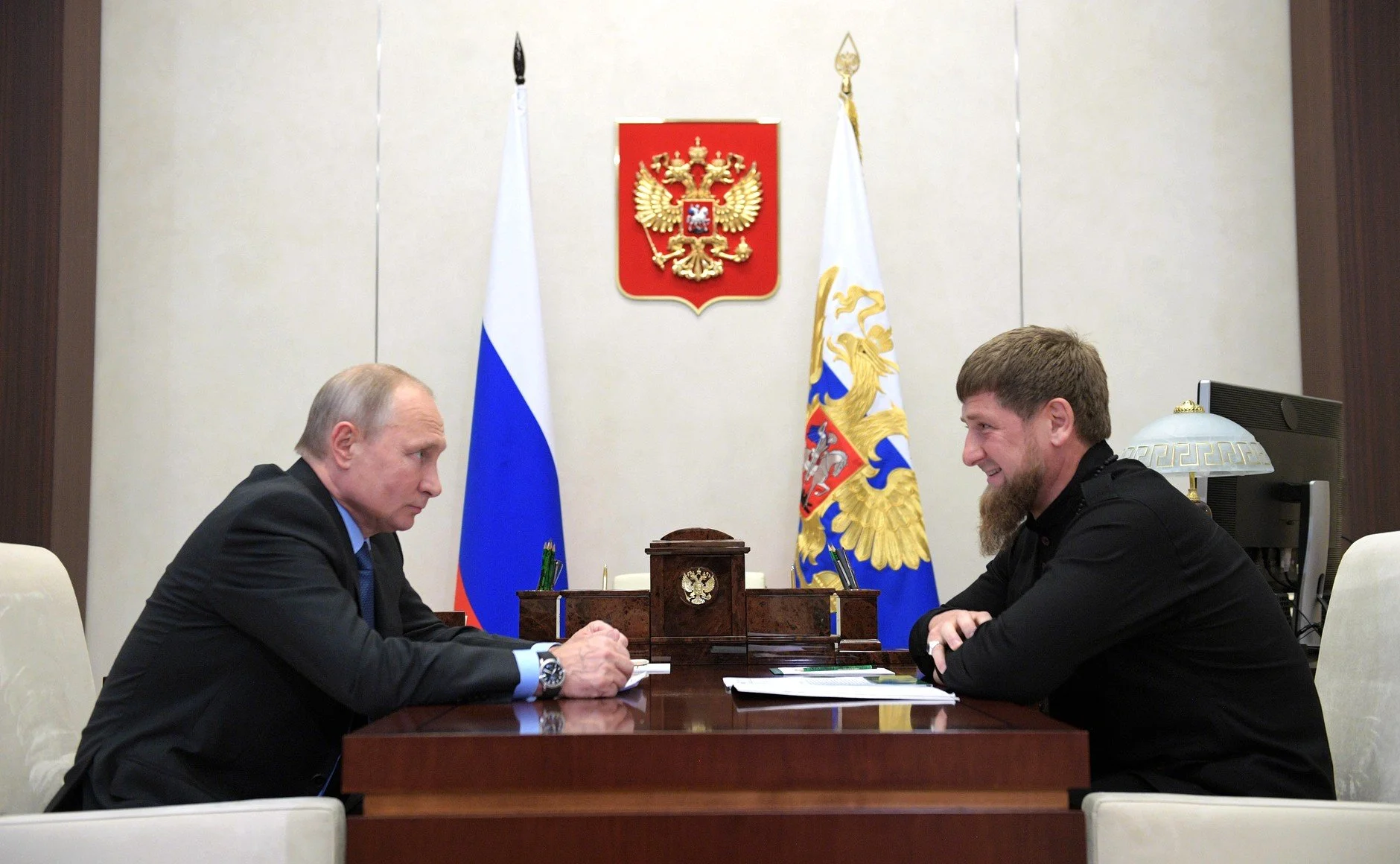
"Vladimir Putin with Ramzan Kadyrov" in June 2018, by www.kremlin.ru, licensed under CC BY 4.0.
In the aftermath of two devastating wars, Chechnya’s leadership under Ramzan Kadyrov has pursued a deliberate campaign of constructing a “new Chechen identity.” It blends ethnocultural distinctiveness with loyalty to the Russian state and operates through a dense web of institutions. Religion, education, gender norms, and memory politics are all aimed at reshaping Chechens’ understanding of themselves and of their place within Russia.
As Kadyrov increasingly installs close relatives in key political positions, preparing perhaps for a future power transfer, the question of whether his carefully engineered Chechen identity can outlive its architect becomes more pressing.
Chechnya offers a particularly clear case of authoritarian identity-engineering. Clan structures, Islam, customary law, and codes of honor are mobilized but selectively reinterpreted to serve contemporary state-building goals. This essay examines the institutional tools behind this identity project, contrasting Chechnya’s model with the Kremlin’s more expansive effort to forge a unified Russian civic identity.
*
Chechen identity rests on a rich traditional foundation. Historically, Chechen self-understanding rested on three pillars: the clan-based teip (genus, tribe) system, the corpus of adat (customary law), and a distinct Islamic tradition centered on Sufi brotherhoods. The teip system, encompassing over a hundred patrilineal clans, structured solidarity and conflict mediation, often outweighing formal state institutions. Adat governed everyday life through councils of elders, while Sufi Islam blended religious practice with local custom and provided spiritual and organizational cohesion, particularly during periods of resistance to imperial rule.
These institutions were reinforced by a strong moral code (nokhchalla), emphasizing honor, hospitality, respect for elders, and proper conduct as well as by a powerful historical memory. Repeated conflicts with outside powers and with the Russian empire, from the nineteenth-century Caucasian wars to Stalin’s 1944 deportation, fostered a collective narrative of suffering and resilience, marked by a deep sense of injustice and enduring mistrust of state authority.
By the late Soviet period and during the early post-Soviet years, Chechen identity had become a complex mosaic. Clan solidarities, customary norms, a strict honor code, and a powerful memory of resistance all persisted. At the same time, there was no single, fixed tradition: urbanization, Soviet modernization, secular education, and a brief period of de facto independence after 1991 produced competing visions of what it meant to be Chechen.
The wars of 1994–96 and 1999–2009 reinforced and transformed these patterns, reconfiguring gender roles, religious practice, and attitudes toward Russia. Today’s authorities seek to construct an official identity against this contradictory inheritance. They do not start from a blank slate; nor do they simply restore “authentic” forms. They selectively preserve, adapt, or suppress elements according to their compatibility with a loyal and governable Chechen identity.
*
A set of official policy documents adopted by the republic’s leadership illuminate the ideological architecture of Chechnya’s new identity. Central among them is the Concept of State and National Policy of the Chechen Republic, which defines Chechens as a distinctive titular nation whose history and moral values evolved in interaction “with the Russian and other peoples.” The document emphasizes interethnic harmony and the long-standing “friendship of nations,” framing Chechen identity not as an alternative to the Russian state but as one of its constituent elements.
Related texts, including the Chechen Code of Conduct, portray Chechens as inherently tolerant, hospitable, law-abiding, and respectful of other cultures and religions, while explicitly rejecting chauvinism and xenophobia. Together, these formulations function both as internal behavioral norms and as external signals: Chechnya, once associated with separatism and war, is recast as a loyal, orderly, and multi-ethnic republic within the Russian Federation.
Ramzan Kadyrov has repeatedly argued that a “true” Chechen should take pride in ethnic and religious belonging while remaining unconditionally loyal to the Russian state and its president. Official discourse often places Chechens within the broader notion of the “Russian world,” portraying Kadyrov as Putin’s “foot soldier.” Loyalty to Moscow is thus elevated from a pragmatic requirement to a normative one: to be a good Chechen is to be a good Russian citizen.
Education and youth policy translate this doctrine into practice. The Unified Concept of Spiritual and Moral Education and Development of the Younger Generation mandates moral and patriotic instruction across schools and universities, while the Code of Conduct for Chechen Youth explicitly links individual behavior to collective identity. Together, these measures promote a state-approved image of the “decent Chechen” and make conformity to it a public expectation.
*
Religious institutions play a central role in Chechnya’s identity project. The authorities promote Sunni Islam in its Sufi form as the “authentic” core of Chechen culture and as a bulwark against extremism. Local Sufi traditions are framed as indigenous and loyal, as alien to “Wahhabism” and radicalism, while Salafi currents are stigmatized as foreign and radical.
The Spiritual Board of Muslims of the Chechen Republic, closely aligned with Kadyrov, functions as a quasi-state institution, enforcing moral norms through public campaigns and social pressure. Informal sanctions, such as community boycotts of weddings or funerals, revive traditional mechanisms of control – redirected to serve the regime.
Religious authority is tightly regulated. Imams and teachers require official approval, and religious education is embedded in schools as moral and civic instruction. In practice, full social acceptance increasingly presupposes adherence to state-sanctioned Islam alongside political loyalty to the Russian Federation.
If mosques provide moral anchoring, schools serve as the main channel for transmitting the new identity. Under the Unified Concept of Spiritual and Moral Education, educational institutions are treated as instruments of patriotic and spiritual socialization, organizing clubs, contests, festivals, and commemorations tied to officially approved culture and history. Students celebrate the Prophet Muhammad’s birthday, the officially defined Day of Peace in the Chechen Republic, and the birthday of Akhmad Kadyrov.
History education has been carefully reworked to reinforce loyalty. Textbooks emphasize unity with the state, present World War II as a moment of shared sacrifice, frame the 1944 deportation as the result of Stalin’s personal arbitrary rule, rather than the empire’s systemic crime, and depict the post-Soviet wars as the legitimate authorities’ fights against “international terrorism.” Through this selective narrative, today’s leadership and its alliance with Moscow are presented as the natural outcome of history rather than a rupture with earlier aspirations.
*
Regulation of gender relations and family life is another core element of Chechnya’s identity policy. Since the late 2000s, the authorities have promoted conservative norms as markers of “authentic” Chechen culture. Dress codes require women in public institutions to wear headscarves and modest clothing, while men are encouraged to adopt traditional or Islamic attire at official events, turning visible piety into a public sign of belonging.
Leadership also promotes early marriage and high fertility as social ideals, celebrating large families and framing women primarily as mothers and guardians of honor. Activities seen as incompatible with this model are discouraged or policed, with informal “morality patrols” and public shaming reinforcing state norms through community pressure.
Family policy has been reshaped along similar lines. Chechnya has closed orphanages and nursing homes, arguing that state care for children without parents or for the elderly contradicts Chechen custom. Official discourse insists that extended families are responsible for all dependents, invoking ideals of clan solidarity while shifting social obligations from the state to kinship networks closely tied to Kadyrov’s patronage system.
Most controversially, the authorities have revived a form of collective responsibility. Human-rights groups and independent media have documented cases in which relatives of alleged insurgents were punished through house burnings, expulsions, or public shaming. Kadyrov has openly defended such measures as a means of enforcing internal discipline. In this way, an adat-inspired notion of collective accountability is repurposed as an instrument of authoritarian control, cloaked in the language of tradition.
Control over the past is central to the construction of identity. Chechnya’s leadership has invested heavily in memory politics, shaping which events are commemorated, how they are interpreted, and who is celebrated. Alongside revised school curricula, public rituals, monuments, and urban space reinforce an official historical narrative.
New commemorations mark the consolidation of the current order. The Day of Peace celebrates the end of the second war and reconciliation under pro-Kremlin rule. The 1944 deportation is officially acknowledged but depoliticized, framed as a crime of Stalin rather than part of a longer conflict with Russian power. At the center of the new pantheon stand Akhmad and Ramzan Kadyrov, whose images, often paired with that of Vladimir Putin, dominate public space and symbolize the fusion of local authority with federal power.
Through this symbolism, the regime seeks to monopolize the meaning of both tradition and modernity. Tradition – Sufi Islam, clan honor, respect for elders – is portrayed as flourishing only under Kadyrov’s protection and within the framework of the Russian Federation. Modernity – gleaming skyscrapers, highways, and new housing – is showcased as a gift ennabled by loyalty to Moscow, visually displacing the destruction of war into a distant, almost erased past. Alternative memories, such as personal accounts of abuse by federal forces or sympathies for the former separatist leadership, are driven out of the public sphere, surviving, if at all, only in private family conversations and in the diaspora.
*
Comparison with the broader Russian context highlights clear asymmetries. Under Vladimir Putin, the federal center promotes a civic Russian identity based on patriotism, conservative social values, and the central role of the Russian Orthodox Church, while ethnic particularism is generally downplayed in favor of a unifying Rossiyanin identity one that encompasses all citizens of the federation, not ethnic Russians.
Chechnya, by contrast, has been granted unusual latitude to pursue an ethno-religious project of its own including Islamic dress codes, promotion of the Chechen language, and an overt cult of local leadership so long as political loyalty is assured. The Kremlin has outsourced stability in the republic to Kadyrov, allowing a form of localized nation-building in exchange for unwavering support.
This arrangement is pragmatic but fragile. It creates an exceptional zone where ethnic and religious distinctiveness is not merely tolerated but instrumentalized, and where legitimacy depends less on institutions than on the personalized authority of Ramzan Kadyrov as intermediary between Chechnya and Moscow.
Whether this equilibrium can endure remains uncertain. The trauma of war and repression has not disappeared; private memories and alternative narratives persist beneath the surface of official discourse. The extreme personalization of power around Ramzan Kadyrov raises acute questions of succession and stability. In recent years, Kadyrov has increasingly put his children and close relatives in key political and security roles, prompting speculation about an impending transition – driven by concerns over health or by strategic foresight. Chechnya has often been described as Kadyrov’s private state, but this only sharpens the ultimate test facing the system: whether an identity project so closely tied to one individual can be transferred to successors without unraveling.
For now, Chechnya functions as a laboratory of authoritarian identity engineering, a space where mosques and skyscrapers, Sufi rituals and military parades, clan honor and presidential portraits converge to define what it means to be both Chechen and Russian in the twenty-first century.
Evgeny Romanovskiy holds an MA in Political Science from the University of Vienna and is currently a Ph.D Candidate in Social Geography and Regional Development at Charles University in Prague.