
Moldova Heads West
On the morning of October 22, 2025, less than a month after a critical parliamentary election, a petite, almost fragile-looking brunette-haired woman, 53 years old, approached the podium in the Moldovan parliament. She was dressed in a simple ivory suit, a scarf at her neck. The hall was filled with lawmakers, diplomats and international guests. As she stepped forward, a white-clad military band struck a chord and a voice introduced the Moldovan president, Maia Sandu.
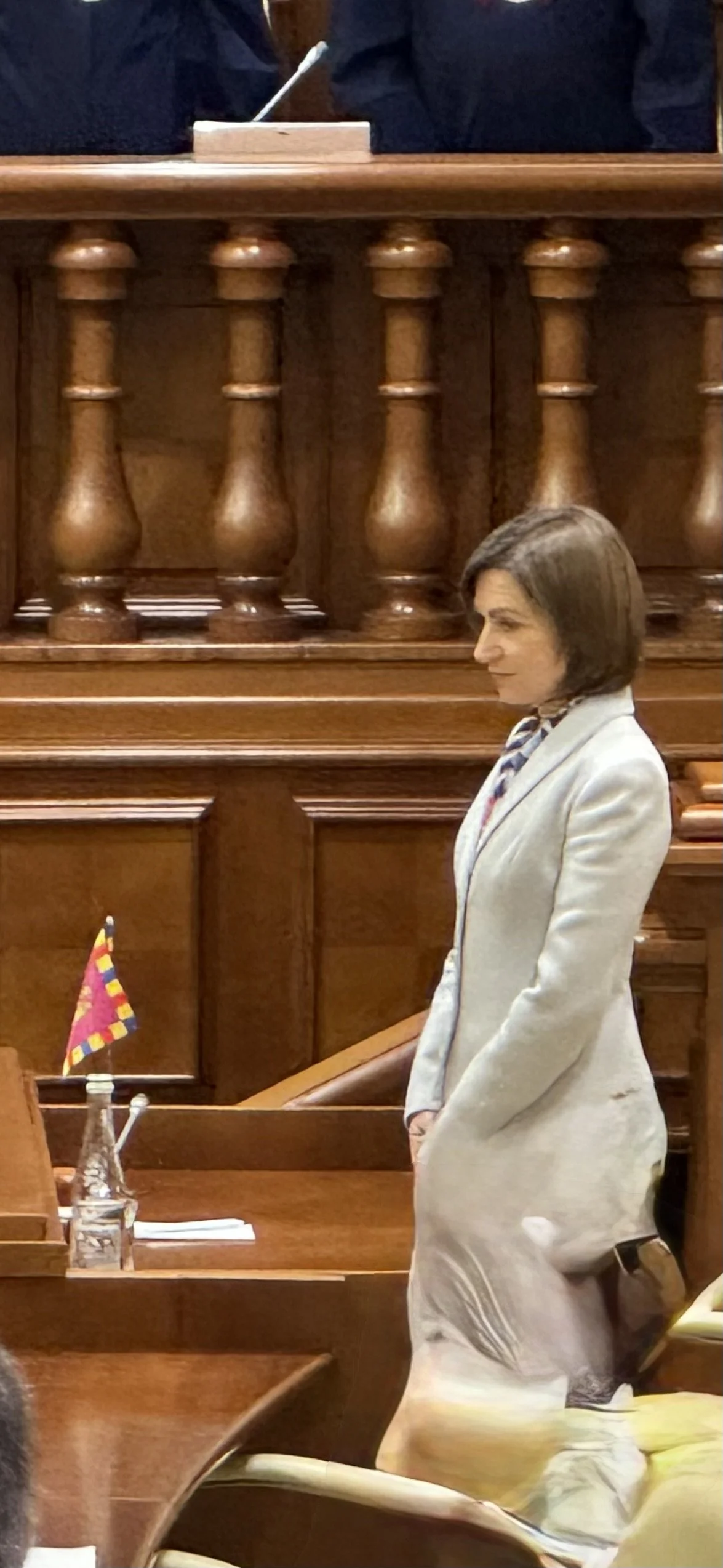
Moldovan President Maia Sandu addresses Parliament, October 22, 2025
Her modest demeanor belied a formidable political leader. After a nail-biting campaign, her party of Action and Solidarity (PAS) had defeated the Moscow-friendly Patriotic Bloc, 50.2% versus 24.2%. The small nation, population 2.4 million, which was once a republic of the USSR, had decided to join the European Union by 2028, a very short deadline.
“A few weeks ago,” she told the assembled lawmakers, “our country went through tense elections, full of trials and challenges. We witnessed a campaign in which truth and lies, hope and fear were all intertwined. Many of these tensions were not accidental — they were fueled from abroad by those who do not want a free and sovereign Moldova. Despite these challenges, Moldovans chose peace, progress, and the European path…We must all recognize that the period we are going through is the most complex since independence, and our responsibility toward the people is immense.”
Located on the southwest border of Ukraine, Moldova is in the crosshairs of Russia, which seeks to keep it at bay from Europe. A nationwide referendum in October 2024 had put Moldova on a European path. According to Sandu’s government, to investigative journalists and to international observers, the Kremlin launched a hybrid campaign (fueled by an estimated $400 million) to undermine this October’s parliamentary elections. Hackers attacked the site of the cCentral eElection cCommission; the Kremlin engaged in vote-buying and disinformation. Kremlin propaganda employed the go-to narratives it has used in other post-Soviet countries: EU membership means Moldova will soon be pulled into the war in neighboring Ukraine; and EU membership will mean an end to Moldova’s “traditional values.”
Liliana Vițu, a former journalist who now is Chair of the government’s Audiovisual Council, the regulatory body for TV and radio, was not surprised. “The European integration process of Moldova,” she told me, “has always been under attack by Russia.”
To join the EU, Moldova must “harmonize” its laws with those of the EU, including a law on equality for women, people with disabilities, people with AIDS, ethnic Roma, and the LGBT community. Using a propaganda technique honed in several other post-Soviet countries, Russian propagandists warned Moldovans that EU membership would put Moldovan traditions in danger.
“Russia said we will not be allowed to slaughter a pig for the Christmas meal,” she explained. “That all the crosses will be removed from cemeteries; that Mom and Dad will be ‘Parent 1 and Parent 2’; that we will all become lesbians and gay; that the gays are queuing at the frontier and they are waiting for you to go there.”
During the 2024 presidential election campaign, attacks were focused directly on Maia Sandu. “They claimed she was schizophrenic, that she had dementia, that she’s not a woman, that she’s gay,” Vițu told me. “They used artificial intelligence to spread all those propaganda narratives on TikTok, on Meta and YouTube. They used pictures, they even used video, as if it’s her, speaking about the fact that once we get to the EU, the gay community will flourish.”
One particular narrative was so off the wall, Vițu said, that she had doubted the Russians would try it. They came up with “this crazy narrative that Maia Sandu got biological material from Elton John and from Ricky Martin.”
“What?!” I asked.
“Yes! That was during the presidential campaign.”
“What does that mean?”
“Sperm,” she replied.
“You mean she’s going to have a baby with Ricky Martin?”
“Yes, or with Elton John.”
The story, Vițu said, didn’t work, so the propagandists performed an “upgrade.” From turning people gay, they claimed Moldovans would be turned into transexuals.
Sandu founded PAS in 2015. She was first elected president in 2020 and was re-elected in 2024. A pro-Russian candidate, Igor Dodon, won the presidency in 2016. His Socialist Party of the Republic of Moldova went on to win a plurality in the 2019 parliamentary election.
Sandu is an economist by education, has a master’s degree in international relations, and another master’s in public policy from Harvard’s Kennedy School. She served as Moldova’s minister of education and as prime minister. Voters, however, do not seem to lump her in with other politicians.
“My explanation for why it [the disinformation attacks] has never worked,” Liliana Vițu told me, “is because Maia Sandu is a person of integrity. And for people, that mattered. For people at that time who wanted an anti-oligarchic regime, who wanted to get rid of all this corruption, the endemic corruption, who were sick and tired of bribes, in hospitals, in kindergartens, whatever, in the public administration. You know, the fact that she is not married, that she doesn’t have kids…even if people were to admit everything that the Russian narratives were saying, the fact that she was a person of integrity prevailed.”
*
Though the streets of the Moldovan capital, Chisinau, are clean and quiet, there is a sense of urgency in government offices. The country intensifies is aligning its legislation with the EU framework so that Moldova can sign the Treaty of Accession to the European Union. It is a monumental challenge. Laws about the judiciary, about trade and commercial markets, public administration, and much more will have to be re-written. Twenty thousand laws need to be passed, 120 pieces of legislation per day, according to one government official – all of it by the target deadline of 2028.
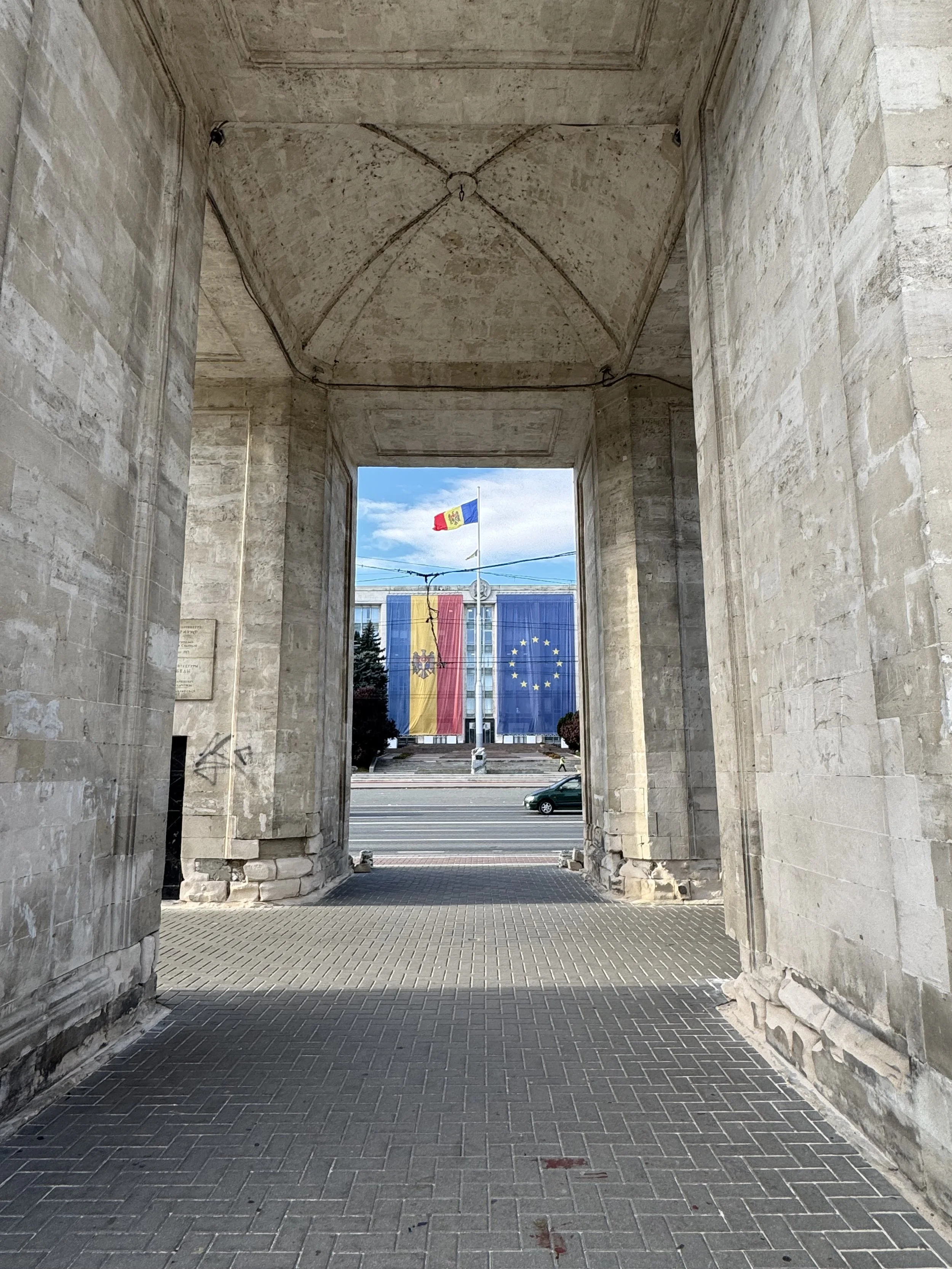
Government buildings in the capital, Chisinau, fly the European Union flag alongside the Moldovan flag.
Vlada Ciobanu agrees Moldova must move quickly to complete the work necessary for the country to join the EU. The 37-year-old civil society activist working with the Center for Policies and Reforms, said her mother and she were “pro-democracy from the beginning.”
“My mom, she was not active socially, but she told me she took me to the protests in the ’90s. I went to the protests in 2002 and 2003, when we were protesting against the communist government. I was very little, you know, just doing my homework in front of the Parliament.”
Now, she says, with Sandu’s government, “I think we feel empowered, because it is right after the elections. But our message is: you can’t rely only on voting. We remember we were protesting with PAS and sometimes joining their political protests or co-organizing protests. Now, we see that they sometimes disregard the opinion of civil society and citizens. They are not doing that as an anti-democratic government, because, of course, they are pro-democracy, but using the excuse that it’s a quick and overwhelming process to integrate into the EU when you have very limited time and a lot of things to do.” Becoming part of Europe, she believes, however, goes deeper than changing laws.
“If you don’t do it right, this integration process, what happens? What happened in Romania, in Bulgaria. All the IT companies are coming, the services, the creative class, they all flourish from investments, from different projects. But the village may be forgotten. Now, we are all, more or less, poor. You already see the differences. But in a few years, this difference will be huge. And what happens? When true populist parties appear – not the ones paid for by Russia and vote-buying, but the ones, like, young people, young men that are left behind who will listen more to this populist, conservative message. I see this as a challenge. The public agenda is still dominated by Russia. And of course it should be, because it is a war there. We still have 100,000 refugees from Ukraine in Moldova. But we shouldn’t act only based on the fact that there is a war.”
*
Even before Russia’s invasion of neighboring Ukraine, Moldova was facing enormous challenges, especially fissures within Moldovan society itself. Roughly half the country supports Sandu’s drive for integration with the EU, but the other half is wary. “Russian speakers have felt a loss of status and a sense of not belonging in the modern Moldova,” says David Smith, editor of the Substack publication Moldova Matters. “This is especially true in minority regions like Gagauzia.” Russian propaganda exacerbates this sense of alienation.
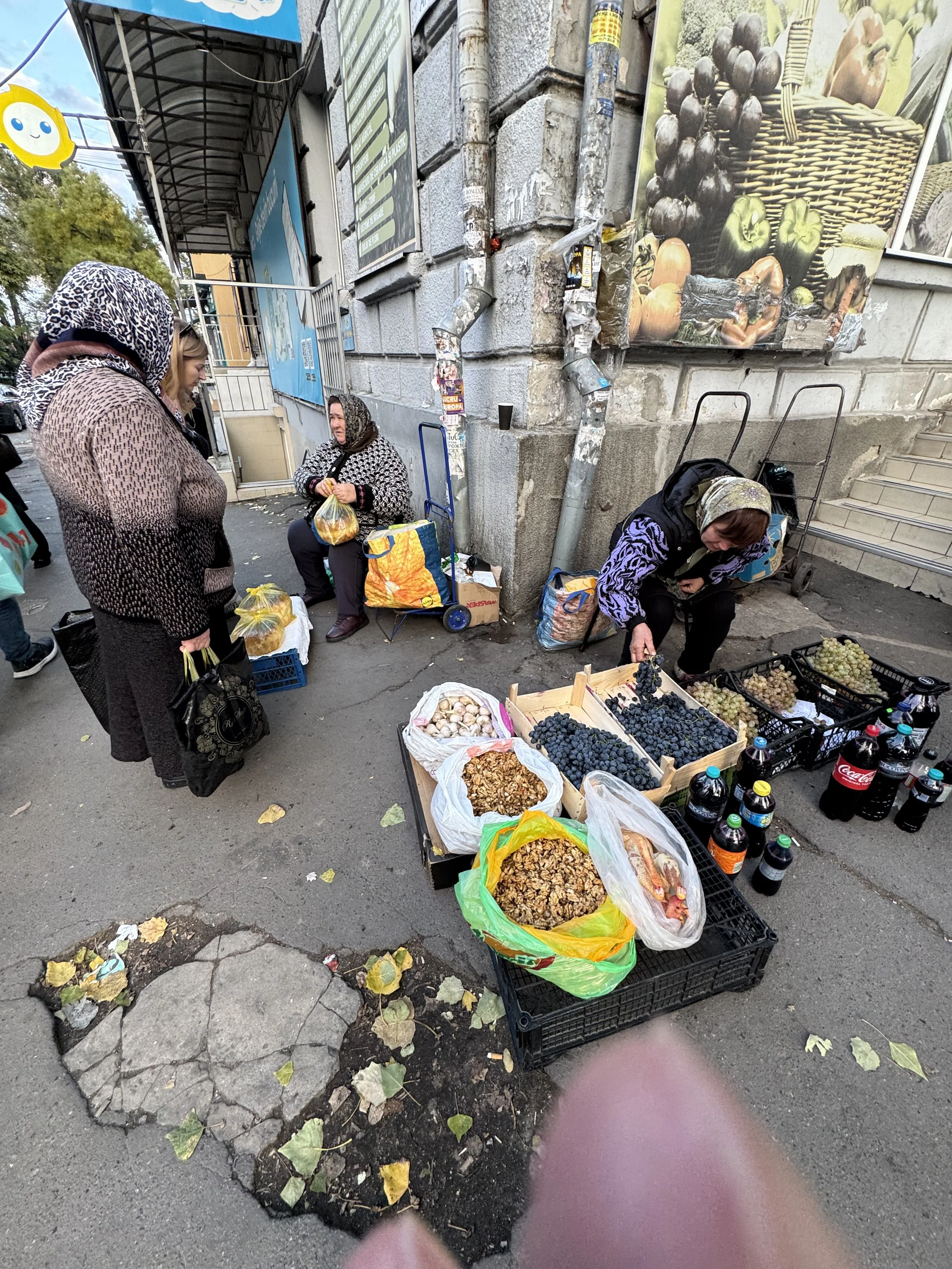
Moldova is considered Europe's poorest country and poverty is visible, even in the capital.
Moldova is considered the poorest country in Europe, with a GDP per capita of less than $20,000. The gulf between poor, conservative rural regions and more prosperous, liberal cities is wide and some politicians have exploited that rift. The Russia-allied Moldovan oligarch/politician, Ilan Shor, for example, funded a series of social-welfare projects, including providing food, repairing roads, building playgrounds – even opening a large amusement park with free access. He was convicted of directing a massive fraud and money laundering operation in 2017 but nevertheless became involved in politics. He eventually fled the country.
Amidst the economic disaster of Moldova’s early independence, more than a million citizens abandoned the country, seeking jobs abroad and migration, leading to population decline, remains a serious threat. More than three decades later, many Moldovans still live abroad and the “diaspora vote” was a crucial factor in Sandu’s election.
Gheorghe Bușilă is 32 years old. He was born just as Moldova was gaining its independence and, like some of his generation, he grew up in Moldova without a mother. “It’s a classic scenario for Moldovan families in the late 1990’s early 2000’s,” he told me over coffee. “There was a big crisis here, so people had to go to other countries to provide for their families, to make money. My mother went to Italy. She had some friends who went there, they thought it was a good idea. She went there to pay for our school. People did this. They hid people in a truck. It was dangerous, yes, but people didn’t know what else to do. That’s why I was separated from my mother. She is still there, 25 years later, my mom and her sister, and my cousin.”
Music, Bușilă told me, is his therapy. A well-known singer, he said he lives in a “very ambiguous tension, so I guess I’m in a place where this tension gets dispersed. The things I sing about, I don’t think I’m the only person who thinks like this. So, I’m helping myself and the people with whom this resonates. I don’t like the war in any nation. My grandmother, during the war, there was famine and she and her family were deported to Siberia for eight years. I grew up hating the Russian culture, hating the system. Now, I feel like things are stable, but I’m on a boat,” he explained. “To me, every day anything can happen. I don’t have plans to move, but time will tell.”
*
There is no greater challenge for Maia Sandu than uniting Moldova. Some Moldovans are lured by what is referred to as “post-Soviet nostalgia:” a longing for the more predictable, more stable, more ostensibly egalitarian society of the old Soviet days, before Moldova officially gained its independence from the USSR in 1991.
I witnessed that nostalgia when I joined a day-long tour to Transnistria, the Russian-leaning breakaway territory located just an hour’s drive from the Moldovan capital. I was surprised to find that you can take a tour with an English-speaking guide.
The region calls itself “Pridnestrovie” (on the bank of the Nistru River), population approximately 465,000. Moldovans call it the “Left Bank” or the “Eastern Regions.” Meeting the guide one morning in Chisinau, we set out in a white van, along with three other tourists. At the “border” we handed over our passports and were given a small slip of paper, a “Migration Card” marked “Transit,” giving us permission to visit until 10:00 pm that night. The capital, Tiraspol, was a few miles down the highway. We headed for a currency exchange point at a local open-air market to change dollars into Transnistrian “rubles.” The dusty pink-colored one-ruble note featured an engraving of the famous czarist-era Russian general, Alexander Suvorov.
We stopped at a bookstore where I bought a poster with depictions of local monuments. At the top was the proud boast: “We make cognac, not war!”
The poster proclaimed Pridnestrovie both “The best country in the world!” and “The country that doesn’t exist.” At least one of those is correct: Transnistria is a self-proclaimed independent country, but no other country in the world - including Russia - recognizes it as such. It was created in 1990, in the waning years of the Soviet Union, as Moldova began to break away from the USSR.
Having experienced other “breakaway” regions of the former Soviet Union, like Russia’s Chechnya or Georgia’s South Ossetia, I envisioned an armed camp, soldiers bristling with weapons but, during my entire day there, even when we drove by their military headquarters in Tiraspol, I never saw a Russian soldier. Officially, there are roughly l,500 of them under Russian command, but I soon learned many of them are local men who receive Russian passports in exchange for their service. The only tank we saw was a World War II-era tank that had been dredged up from a river (we were told) and now sat on a pedestal in a public park. Children happily clambered to the top of it as we snapped pictures.
Tiraspol has a “Sheriff.” It’s the name of the family business owned by Viktor Gushan and his family, an oligarch – reportedly a billionaire – who controls almost everything commercial in town, including supermarkets, gas stations, media and telecoms, a soccer club (FC Sheriff Tiraspol), and other ventures. One might expect, given the pro-Russian status of Transnistria, that the Gushan family would trade primarily with Russia, but their supermarkets, for example, appear to be oriented to Europe. The Kvint wine and brandy distillery, of “we make cognac, not war,” fame, exports internationally.
Tiraspol is a Soviet time warp, with a giant monument to Vladimir Lenin on the main street, heroic statues of historic figures, red banners and, of course, the USSR’s hammer and sickle. You can eat in a retro-Soviet restaurant, gazing at walls plastered with old newspapers with articles about Joseph Stalin, enjoying all the sosiski (sausages) and kasha you want. The atmosphere is almost tongue-in-cheek, but for President Sandu integrating the territory into Moldova is serious business. She highlighted it in a speech to Parliament: “Citizens on the left bank of the Nistru River must be able to access the labor market, move freely, and enjoy the same protection as anyone else in our country. I urge you to stand by them, in parallel with our efforts for a peaceful settlement of the Transnistrian conflict, which must include the definitive withdrawal of Russian troops from the region.”
*
National and ethnic identity also divide Moldovans. Most speak Romanian Moldovan; many speak Russian; and some speak Ukrainian.
Daria Slobodcicova is 33, a journalist and documentary maker. I met with her in Chisinau and our conversation bounced from English to Russian, and back again. She’s 33 and from a Russian-speaking family: “I identify myself as a Russian-speaking citizen of Moldova. I have Russian traditions, but I am Moldovan. I live here; I grew up here. This is my country. But I am different from the majority. That’s OK. I just accept it.”
As a young person, she considered Russia her second “motherland.” “But after Crimea,” she said, “after the first aggression from Russia against Ukraine, I changed my mind. But it was a very long process. First, you listen, trying to understand what’s going on, trying to find some justification for this thing. You think, ‘If Russia does such things, why does she do these things?’ Then, you try to understand the people who are facing this aggression. You try everything, but you don’t want to accept it. So maybe half a year or maybe even a year I needed to start to accept that maybe Russia is the aggressor. It was a very painful process, because it’s your identity, because it’s your history, because it’s your relatives, because a big part of my relatives live in Russia and you choose to not accept, you choose to understand that their country, which became home for them, is doing bad things for my country and for Ukraine.”
Older people, she said, and those who watch Russian TV, began to say: “We don’t need to say anything about war, we need to be neutral, it's Ukraine’s fault, Russia doesn’t attack civilians, or schools, Russia attacks only military targets.”
“I think it’s very, very hard, maybe impossible, to admit and to change identity. I think the best thing we can do is to show that other world, to show how it can be. How people live, in reality, in different circumstances. Last year we went to Romania, to Russian-speaking areas where the Old Believers live. They speak Russian and Romanian. And we tried to show that they can keep their traditions, their values, their language, how the European Union helps to preserve all of this.”
*
Several Moldovans I spoke with described similar “grey zones” of identity, along with having to live with a sense of uncertainty about the future. Some fear more hybrid attacks from Russia, or even invasion, as has been the fate of their neighbor, Ukraine.
Leo Zbancă, a Moldovan living in Chisinau, is a transperson and has lived his life in liminal spaces. “I look young, but I am 39 years old,” Zbancă told me, when we met at the GENDERDOC-M building in a leafy neighborhood in the capital. It’s the biggest, and oldest, non-governmental organization in Moldova dedicated to protecting the rights of the LGBT+ community and I spotted the rainbow flag as my taxi pulled up to the curb.
“I was born in the Soviet Union in 1986, here in Chisinau,” Leo recounted. “My mom is Moldovan, but my father is from Africa, from Guinea Bissau. He was a student here, because in the Soviet Union they gave scholarships for people from communist countries. My father moved away when I was young. So, it’s a long story, but I was raised by my mom and my grandparents here in Moldova. Economically, it was really bad here. When I tell people, in the first years of school I did my homework with a candle, without water, they say “How old are you?” It was in the 90’s, and it was bad, because we were so dependent on Russia for electricity, gas. Everything was cut, and in 1993, 94, 95 I remember those years, we were freezing, we didn’t have heating, we didn’t have electricity. Electricity was maybe one or two hours a day. It was funny, really, cause when I was a kid I wanted to watch TV, but electricity to the TV stations also was rationed so just when we wanted to watch TV there was nothing on TV!”
Zbancă’s mother decided to pursue her PhD in Moscow and took Leo with her to Russia when he was seven. She married an ex-KGB guy, very religious. “So, it was the oddest mix you can imagine!” Leo said with a wry smile.
Leo learned Russian, studied psychology, then filmmaking, became politically active, and came out of the closet. “It wasn’t so easy in Russia to do,” he recalled. But in 2011/2012, during the anti-Putin Bolotnaya protests, he joined the street demonstrations. In 2013, when the first “gay propaganda” law was introduced, he became an activist.
After Russia’s occupation of Crimea in 2014, and Boris Nemtsov was killed in Moscow, Leo made a decision. “I felt that if I stay in this country, I will be killed, because I am too active. I see that people are going to jail for nothing. I left in 2015.” After five years in Europe, in 2021, Leo Zbancă came back home to Moldova.
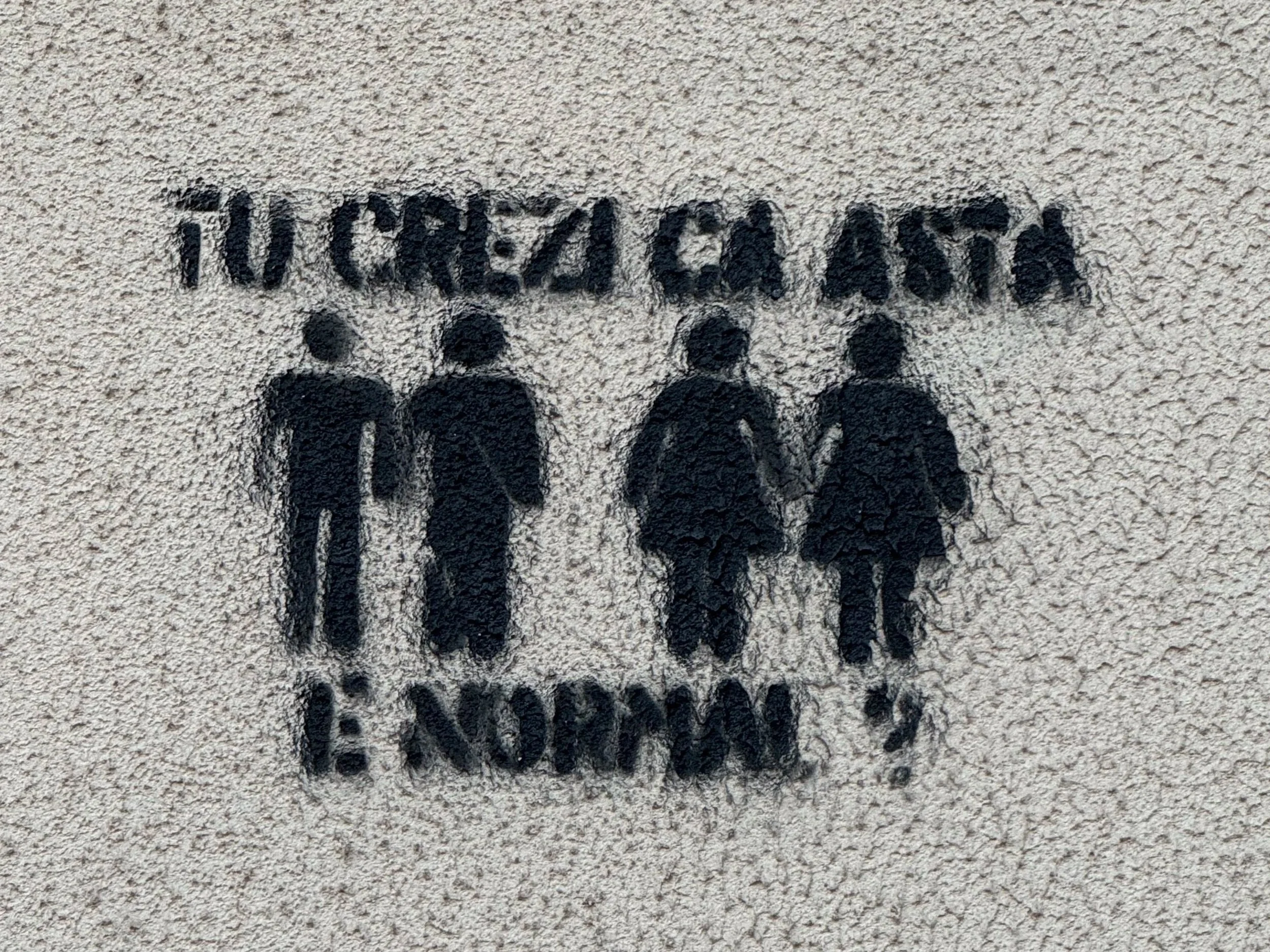
Anti-gay graffiti on a wall in Chisinau: "Do you think this is normal?"
In 1995 homosexuality was decriminalized in Moldova, a requirement of the Council of Europe which the country sought to join. Three years later, GENDERDOC-M was founded. But the communists were re-elected and things changed. Gay rights supporters wanted to hold a Pride march, but that was forbidden. Then, in 2008, a law guaranteeing freedom of assembly was passed. But holding a gay pride march was still dangerous, as Leo explained:
“(Gay rights) supporters were on a bus, surrounded by protesters, about 1,000 of them, with only 38 people inside the bus. They tried to destroy it, set it on fire, Everyone I spoke with said it was the most traumatic moment in their lives. But they resisted and kept fighting. In 2018 it was a full march. And we’ve had several successful marches, peaceful ones. This year there were a thousand people. That’s a lot for Moldova.”
“The interesting thing is,” he continued, “in the 2000’s, if you asked gays and lesbians, many of them were hoping to go to Russia, because Russia was more open than here. So, many went to Russia because they wanted to be free. And now, we know what’s happening with LGBT there. Then, in 2021, this new government arrived with Maia Sandu, our president, and PAS. And for the first time we had a government for four years, and this is the reason why I came back. I realized something is changing in Moldova. Suddenly, I can feel safe here. I told myself I would never go back to an authoritarian country. I don’t want to live in Russia. And I thought it might be interesting to be part of this change and help this country to change.”
During October’s parliamentary election, Leo told me, there was a lot of discussion that “this is the point of no return, that if we get rid of Russian influence, we will be in the European Union.” But, he cautioned, “you don’t know even if the European Union will accept us. It’s an economic entity, it’s not about human values. We see that with (Hungary’s prime minister) Viktor Orban.” For us, I believe, we have to have this change in attitudes, to have more than 50%. There will always be conservatives, there will always be homophobes, but we need just this small number – 60% – who believe in democratic values. I don’t think it will happen in four years, maybe it will happen in eight years, two terms. But, with consistent education, they will do this.”
*
Petru Vinari also left Moldova for Europe in 2013 but, like Leo Zbancă, he returned home. “I was wondering how I can put myself into something useful,” he said, as we talked in Chisinau. Vinari is a 34-year-old environmentalist, head of two NGO’s: “Future Parks,” and “Moldovan Garden.” He envisions a Moldovan countryside the way it used to be centuries ago, before the Soviet Union, even before the Russian Empire.
Moldova is part of the East European forest steppe, a belt of trees and grassland that, for centuries, covered one-third of its territory. Today, in some places, that is down to 2% and it’s a subject so important that President Maia Sandu included it in her address to parliament.
The old Soviet mentality, Vinari said, still holds back the movement to restore Moldova’s forests: “We are still living here with people who are afraid to engage, because they still think the state needs to repair this problem, and even though they are living in a village where they have illegal land use, they still wait for the state to solve it. But after 15, 20, even 50 years, what are we waiting for?”
Vinari and his NGO have created a “seed library,” collecting local seeds in the countryside and organizing corners in libraries where residents can take seeds for planting. They started a “sub-basinal” council for a small river near five villages. “We find areas nearby to reforest and create a kind of bio-diversity” he told me. “It’s voluntary. We buy trees, grow our own trees from acorns, and we have a thousand oaks so far.”
During Soviet times, communist officials created numerous lakes that dried up local rivers. “We are still working on that,” Vinari explained. “We won’t have the water we had in 1953, but this is a very widespread problem. And people understand that. The problem is all over Moldova.”
*
On the road back from Transnistria we stop at the Tighina (Bender) Fortress. It’s a massive circular red-brick and stone fortress built by Stephen the Great, Moldova’s national hero, in the 15th century. It towers over the banks of the Dniester River and was originally built to defend Europe from the Tatar and Ottoman raids. The Ottoman ruler Suleiman the Magnificent seized it in the 16th century and expanded it.
Today, Moldovans think of it as a symbol of their country’s historic role in protecting Europe: a small country that survived, even under control by the Ottoman Empire, the Russian Empire, and the USSR.
President Maia Sandu evoked that history in her address to the assembled members of parliament in October: “Let us join forces with the hardworking and honest people of our country. For them and with them we must work — people who have endured hardship but never lost hope; people who, after decades of uncertainty, deserve to know that they can live in a peaceful, free, just, and prosperous country. European integration is the path through which this dream will become reality. Our solidarity with the refugees from Ukraine, as well as our courage not to be intimidated by threats and to remain a pillar of stability in the region have earned us the respect and gratitude of the entire world.”
Under assault from Russia, still beset by internal challenges, this small nation that once defended Europe now looks to Europe for its own protection.
Jill Dougherty is a Distinguished Fellow at The Wilson Center and Adjunct Professor at the Center for Eurasian, Russian and East European Studies at Georgetown University.