
Vanishing Archives of Russia’s Alternative Futures
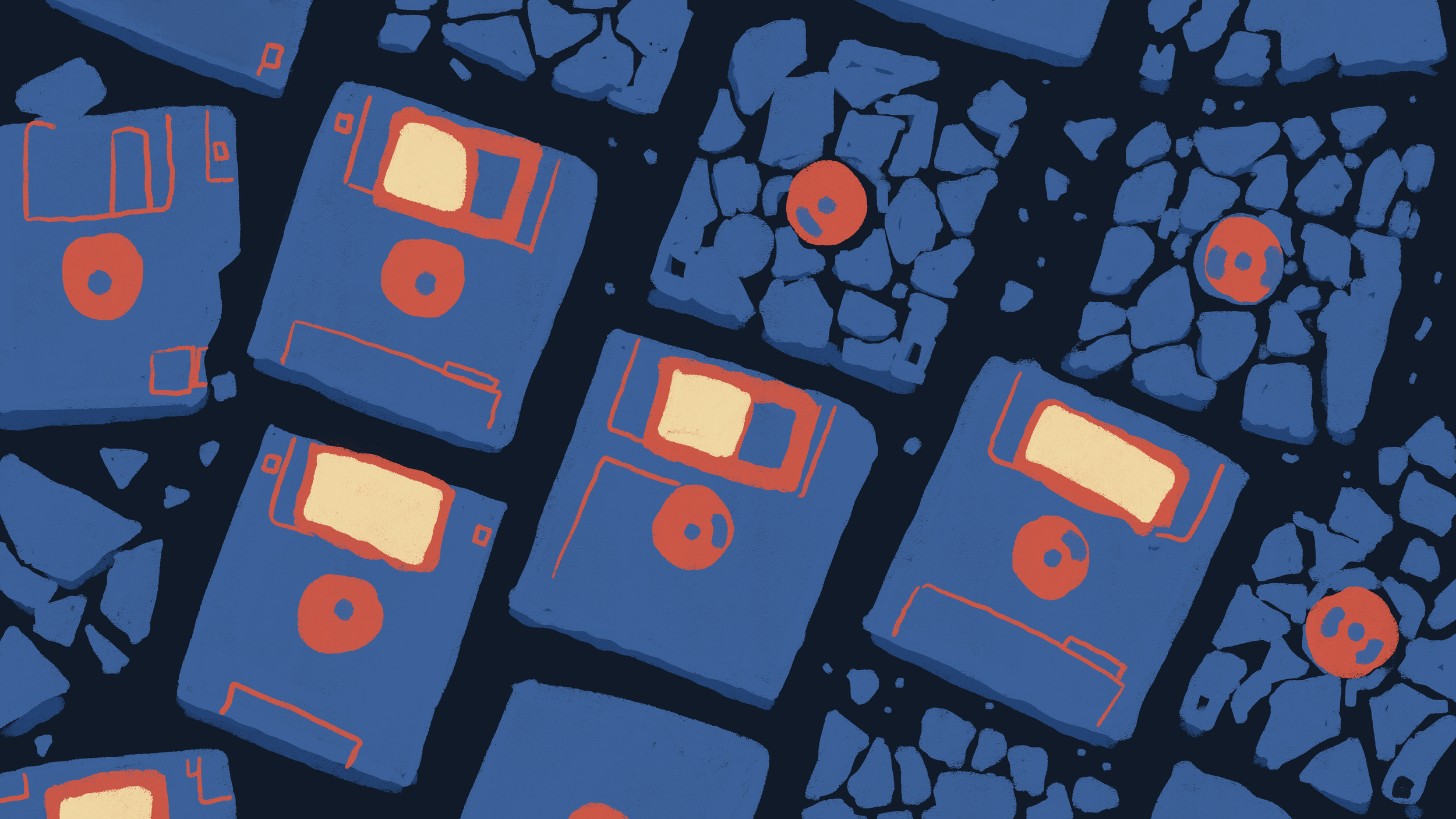
In April 2026, a piece of the Russian internet that had effectively disappeared came back to life. The surviving texts of NTV’s old website had become searchable again. NTV was Russia’s first major privately owned national television network and, in the 1990s and early 2000s, one of the country’s most influential sources of independent news and political reporting. This outlet’s true importance for the pre-social-media Russia is hard to overestimate. It is one of those “you had to be there” things.
Twenty-five years ago, Gazprom-appointed managers and hired security guards seized the broadcaster’s studios, an early milestone in Putin’s destruction of free speech. Now the Russian Independent Media Archive (RIMA) have made profiles, transcripts, news reports, and NTV’s own contemporary account of how the broadcaster was dismantled available to researchers, students, and historians.
As I scrolled through those texts, a memory came back to me, first as a smell, the smell of a damp, sour classroom rag. Then came the squeak of chalk. In April 2001, aged thirteen, in enormous, sprawling letters I wrote “Hands off NTV” across our classroom’s blackboard. I had watched the channel’s news and political programs – the adult world arguing – late into the night and believed that schoolroom chalk might help save it. My first improvised protest action lasted exactly one school break.
*
Twelve years later, I was running TV Rain’s digital newsroom. By then, it had inherited NTV’s former role as Russia’s only independent national television channel; I was working in the studio alongside some of the people I had watched as a child. In early 2014, our turn had come. Using a manufactured pretext, TV Rain was forced off Russia’s major cable networks, just weeks before Russia’s annexation of Crimea.
Co-founded by the New York Times opinion columnist M. Gessen and historian Ilia Venyavkin, RIMA has also turned to preserving some of Lenta.ru’s content. Back in the day, I read the news website Lenta.ru daily, knew some of its journalists, and watched some of the roughly 1,600 short documentaries that Lenta.doc produced in the early 2010s. Honestly, I did not understand their archival value, because they seemed simply to have recorded the political life in which I was once immersed. The record seemed almost excessive.
Well, kudos to Lenta.ru’s formidable editor-in-chief, Galina Timchenko. She always knew better. When she was fired under political pressure, days before the annexation of Crimea – a reader might be starting to notice a pattern here – almost the entire newsroom followed her out the door. Many of those journalists later went on to build Meduza, an independent Russian-language news outlet founded in exile in Riga, Latvia, in 2014. The BBC called it the largest Russian media outlet in exile by audience.
Only 39 Lenta.doc videos remained on the official YouTube channel. RIMA and Meduza have assembled 309, including 242 recovered from Timchenko’s personal drive. Roughly four-fifths of this remarkable chronicle – encompassing the aftermath of Russia’s 2011–12 protests, Alexei Navalny’s rise as a politician, and Ukraine’s 2013 Euromaidan rallies – are still missing from the public record.
When I called RIMA’s head of product, Sascha Molokostova, she explained that the project preserves more than it can safely publish. Contributors may ask for material to be withdrawn; archivists may judge other material too dangerous to make public under Russia’s current laws. RIMA may still give a verified researcher access, but the material remains invisible to search engines and AI systems crawling the live web.
RIMA now reminds me of an early medieval scriptorium. Its archivists, like monks copying the manuscripts that happened to reach them, cannot save all of antiquity; they can only carry forward the fragments. To borrow T.S. Eliot’s image from his poem, “The Waste Land,” they shore fragments against ruin. This particular ruin is barely fifteen years old.
*
Surely, this is not only a Russian problem. Digital decay, sometimes called digital oblivion, is universal. A 2024 Pew Research Center study found that a quarter of the webpages sampled from 2013 to 2023 were no longer accessible. Among pages from 2013, the share was 38 percent. Eighteen percent of sampled tweets disappeared within months. Alexander Pushkin trusted his “monument not built with hands” to escape decay. He never had to pay the hosting bill, update the CMS, or recover a forgotten password.
If pages vanish everywhere, their disappearance carries exceptional political significance in Russia. Increasingly repressive laws, new owners, self-censorship, blocking, newsroom closures, poverty and depression in exile, dying platforms, and personal deletions all push in the same direction. Some are deliberate instruments of control: regulators order deletions, owners sanitize archives, and editors comply. Others are simply ordinary decay. No single Ministry of Truth needs to coordinate them. The state’s account is financed, copied, indexed, and quoted, while alternative accounts may depend on an editor’s budget, a journalist’s laptop, or a forgotten password.
LiveJournal makes the shift personal. I wrote there as vorewig, my LiveJournal handle, from 2006 until 2013, when LiveJournal, an early blogging and social-networking platform was the central forum for Russia’s online political and cultural life. Since December 29, 2025, public posting has been limited to users who meet one of several payment, identity, or status requirements. Its parent company is controlled by Sber, a partly state-owned Russian bank, and promises to preserve old posts. Yet LiveJournal has blocked access before. In January 2013, it did so after Roskomnadzor, Russia’s state agency responsible for regulating and censoring media and the internet, intervened, and there is every reason to assume it could do so again.
Imagine entrusting twenty years of your cherished diaries to a state library where a police officer may enter the reading room at any moment and tear out an old page. The archive survives by permission.
In 2006, Sobaka, an influential St. Petersburg lifestyle magazine, published an issue whose title translates literally as “The End of Homosexualism.” Its editors deliberately used the old Soviet-era term. Their premise was that gay people might soon become ordinary enough for the label itself to become obsolete. By the time Russia’s later anti-LGBT laws came into force, the issue had disappeared from the magazine’s archive. RIMA recovered it through the Wayback Machine, although no one has explained why it was removed.
In another example, a 2009 Vedomosti article naming officials involved in the persecution and death in custody of tax lawyer Sergei Magnitsky — whose case later inspired international sanctions — was altered and eventually deleted. RIMA and students at the University of Arizona found dozens of similar removals involving Navalny, protests, corruption, and the war.
People themselves delete their archives too. A talented journalist friend from St. Petersburg – let’s call him K. – first deleted his LiveJournal and then his Twitter account. They contained years of his life. Had K. kept ten boxes of diaries, destroying them would have required an afternoon, a fire, and some resolve. A digital biography can disappear with a single click.
I chose a different path, exporting my LiveJournal and Facebook posts into a private, AI-searchable archive because I wanted to keep working with those texts. Neither choice can be imposed as a moral rule. But deletion now takes a second and leaves no traces to be discovered later, none at all.
*
Let’s state the obvious. Not every private page belongs to future researchers. People may need to erase confessions, photographs of their children, old beliefs, or evidence that could endanger them. A personal diary and published journalism make different ethical claims on an archive. An archive should preserve testimony without becoming another instrument of surveillance.
What remains of the old independent Runet is a log of Russia’s defeated futures. It does preserve reporting on corruption and repression, but it also preserves assumptions about what Russia could become: that NTV might be defended; that elections might matter; that an opposition leader like Navalny could compete in Moscow’s mayoral election; that LGBTQ+ people might cease to be treated as a suspect category; that public conflicts could be openly discussed and the state might retreat. None of this proves that a democratic Russia was destined, or even likely, to prevail – only that there were so many forks in the road.
We all know the ending: Crimea, the full-scale invasion of Ukraine, political killings, imprisonment, mass emigration, and the destruction of independent media. Being versed in the outcome encourages us to flatten those forks into a single road. For Western observers, the resulting story is especially seductive: Russia was always like this; nobody seriously resisted; 2022 merely revealed the country’s true nature. If argument, resistance, naïveté, humor, and hope disappear from the sources, it becomes easier to present that outcome as a foregone conclusion. The archive can complicate it without absolving Russian society of anything.
In his 1937 poem “Spain,” W. H. Auden wrote: “History to the defeated / May say alas but cannot help nor pardon.” He later repudiated the poem as his political views changed, arguing that these lines wrongly suggested that history’s winners were somehow morally vindicated by their victory. Auden excluded the poem from his authorized collections, but he could not erase it from the historical record. The archival problem here is the reverse. If records are erased, future history may no longer even know whom it is supposed to say “alas” to. Erasure can make it seem as though the defeated were never there.

The Kremlin’s first victory closes a newsroom, jails an activist, silences a blogger, or forces a change of ownership. The second comes years later, as domains expire, video links break, and accounts disappear. Nothing more needs to be done: the official version simply has to outlive the alternatives. First the opposition loses. Then the record of its existence begins to disappear. This imbalance will matter even more as AI becomes the ordinary interface to the past, for casual questions and scholarly research alike. An average reader in 2035 may not open twenty tabs, search the Wayback Machine, or interview retired editors. They will ask an AI agent why Russia became authoritarian, whether Russians always supported the war, and whether alternatives ever existed. The agent will build a fluent explanation from the sources available to it.
A model can turn the surviving fragments into a persuasive story without revealing how much of the record is missing. This is not deliberate “dataset poisoning,” but something quieter. Survivorship bias can be forged into the mainstream narrative.
RIMA holds more than eight million items from over 160 sources. It digitizes print materials, restores websites, and collects vulnerable journalism in real time. Full-text search, dates, authorship, provenance, links between versions, and audiovisual metadata make this record usable by researchers… and machines. RIMA is not only a memorial to independent journalism but an alternative corpus. Through Kronika, RIMA’s international initiative for preserving endangered independent media and their digital archives, this infrastructure is being extended to endangered media beyond Russia, including in Central America. Russia’s archival experience has produced an exportable technology of resistance to digital oblivion, a counter-infrastructure for a future whose understanding of the past will depend on what remains searchable.
The damp school rag erased “Hands off NTV” when the bell rang and the next lesson began. Those words may now survive nowhere but in my memory, like much of the early Runet. What matters is the conviction that the outcome could still be changed. The restored NTV texts preserve a Russia in which the takeover looked like a scandal, not the first iteration of a chronology whose endpoint everyone already knows. The Kremlin need not persuade the future that it was right. Its most complete victory would be to leave no searchable evidence that Russia could have taken another path.
Ilia Klishin is a Russian journalist and media consultant based in Vilnius. He was editor-in-chief of the website of TV Rain (Dozhd), the independent Russian television channel, and later led digital editorial work at RTVI during the channel’s relaunch. His work focuses on Russian digital propaganda, pressure on independent media, Russian politics, exile, public language, and civic infrastructure.
Illustrations by Kennan Institute Creative Director Jude Schroder.