
Making Sense of Senseless Violence
The twentieth-century Georgian philosopher Merab Mamardashvili defined humans as beings who must make sense of themselves and the world. Understanding something or someone, discovering the significance of an event, and making experience meaningful allows human beings to become and remain human.
This is why gratuitous violence is especially difficult to bear. It destroys individuals and with them our ability to give meaning to our lives. Senseless violence demands two equally important responses. Its perpetrators must be brought to justice, and all of us, especially those who are suffering from it, must make sense of the new reality around them. Literature, along with other arts, helps to grasp and to transform the realities that might crush us, even if victory might be wrested from the horror of war.
In 2015, a famous thirteen-year-old lion was killed in Zimbabwe by a wealthy trophy hunter. This was an act of extreme, illogical violence. Olena Stiazhkina’s book, Cecil the Lion Had to Die, tries to make sense of the violence that is just as illogical but more extreme because of its scale: Russia’s invasion of Ukraine. This war began and continues when there is ample knowledge about the dangers of colonialism and the need to preserve our planet. Along with people and natural resources, Russia is destroying humanity's aspirations and ideals.
The African lion did not need to die simply to entertain a wealthy dentist from the United States. Nor did Russia have to begin yet another phase of its colonial expansionism. Now that this war is a fact, we have to work through the new reality in a way that opens up viable futures for ourselves and our children. Stiazhkina’s novel meets this responsibility.
*
Stiazhkina is a professional historian and a native of Donetsk, the largest city and unofficial capital of the Donbas region. She had to leave her city and her job at Donetsk National University, when the region was occupied by Russia in 2014. Along with her scholarly works Stiazhkina has published several novels. Cecil the Lion Had to Die was written after Stiazhkina's forced relocation and gives a glimpse into the chaotic and often feral reality of Eastern Ukraine from 1986 to 2020. The novel's nonlinear plot shifts between more than a dozen characters, following their disrupted and disruptive relationships. The book opens with the births of four of them and takes us through their lives and those of their parents. Dina, the fifth (late and unexpected) child, brings with her the hope for a different, more meaningful life.
Most of the novel's characters have no clear knowledge of their history. Their ignorance lasts until 2013, when the Revolution of Dignity began, or until 2014, when Russia invaded Crimea and the Donbas. The reader, however, needs some historical knowledge of Ukraine's Eastern and Southern regions, and the centuries of Ukrainian resistance to Russian imperial rule. The novel’s Ukrainian audience had acquired this historical knowledge by the time the book was published in 2021 and would understand Stiazhkina's allusions and intimations. For instance, the character who opens the book, Heinrich Fink, comes from an ethnic German family, and a reader familiar with the region’s history would know that a German minority had lived in Donbas for generations. In the twentieth-century, many were deported to Kazakhstan along with other non-Russian ethnicities, because the Soviet authorities in Moscow saw their cultural distinctiveness as a threat.
To grasp historical nuances that are often lost on the novel's characters, an English-speaking reader might want to listen to a series of lectures, “The Making of Modern Ukraine,” delivered in 2022 by the historian Timothy Snyder. The Gates of Europe: A History of Ukraine by the historian Serhii Plokhy, chronicles Russia’s conquest and industrial development of the Donbas, the final years of the Soviet Ukraine, and the turbulent and chaotic first decades since Ukraine’s independence.
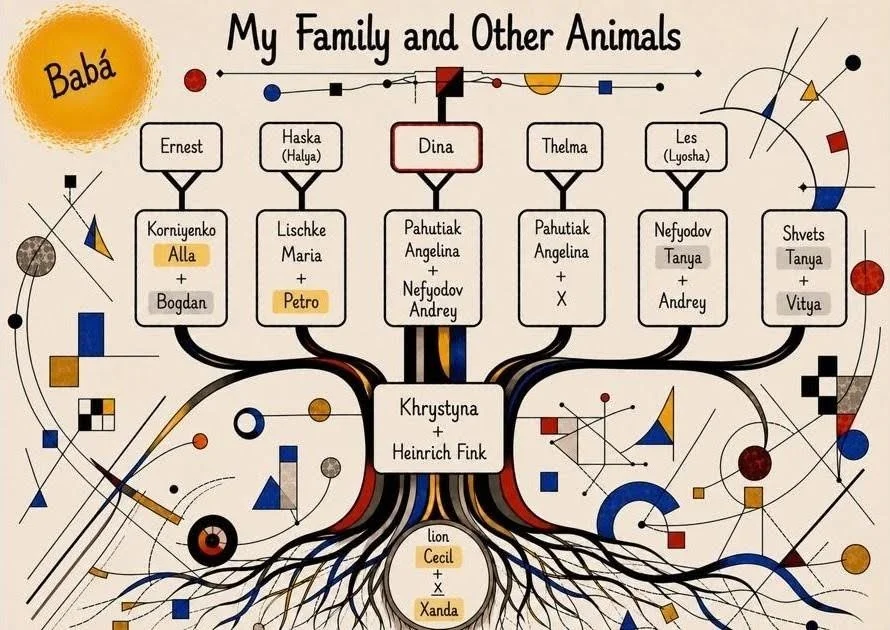
The novel ends with Dina drawing a genealogical tree connecting and grounding of all the characters. She reimagines the image, a photograph, with which the novel begins. My Ukrainian colleague, Andriy Lysenko, has created an image of this tree that could help guide an English-speaking reader through the novel's intricate names and relationships.
An overwhelming majority of Ukrainians are fluent in both Ukrainian and Russian. The novel takes full advantage of this circumstance. By switching between the two languages, Stiazhkina showcases the ease with which many of Ukrainians move or live between languages. She also brings out the transformation—toward greater understanding or away from it—in the lives of her characters, emphasizing the remnants of the Soviet-era mentality that, like mold, keeps reappearing on repainted walls.
The Russian state began taking shape in 1547, when a sixteen-year-old Ivan, the ruler of a modest region around the city of Moscow declared himself “tsar of all Rus’,” referring to Kyivan Rus’, the state that several centuries earlier had ceased to exist. Ivan set out to “gather” the nearby lands populated by other peoples. His first military campaign was launched against the city of Kazan, the capital of a Tatar khanate. Over the course of the following centuries, Muscovy and then the Russian Empire continued its colonial expansion to the south and the east. In 1654, the Russian state entered a military alliance initiated by Ukrainian elites, who sought greater freedom from the Polish-Lithuanian Commonwealth and from the Ottoman Empire. When the Muscovite and Ukrainian delegations met in 1654, they needed interpreters to understand each other.
In the next centuries, the Russian state often tried to erase the differences that separated the Ukrainian language from the Russian and to restrict or extinguish cultural activity in the Ukrainian language. The term “Little Russian” became an official designation for the Ukrainian language and people. In the nineteenth century, printing houses were prohibited from printing books in Ukrainian; stage performances, public recitations, and schooling in Ukrainian was forbidden. With brief intermissions, the Soviet Union continued and intensified these efforts. Stalin tried to silence Ukrainians by starving both the people and their language. An artificial famine of 1932-1933 took millions of Ukrainian lives, and the publication of a new orthography in 1933 eliminated letters and grammatical constructions that distinguished the Ukrainian language from the Russian. Despite the attempts to "Russify” Ukrainian, the lexical distance between the two languages approximates that between Italian and Spanish.
A quick indicator of the colonial relationship between these two languages is that most Ukrainians understand Russian, while most Russian citizens do not understand Ukrainian. As Hegel noted, the master does not feel the need to understand the servant, thus placing limits on his purview and imagination.
*
Stiazhkina wrote her literary and scholarly works in Russian until Russia occupied her hometown in 2014, when she switched to writing only in Ukrainian. Cecil the Lion Had to Die reflects this move from one language to another. Some of the characters switch to speaking Ukrainian. Two of them even start using the Ukrainian versions of their names, and, most importantly, Haska writes a book in Ukrainian. This bi-lingual novel gravitates toward Ukrainian. This is not a clear-cut transition. The Ukrainian language is present from the very beginning, structuring the entire book. All of the chapter headings are in Ukrainian, whereas the novel’s penultimate chapter is in Russian.
Such linguistic “impurity” is an accurate representation of Ukraine’s complex relationship with the two languages. Many of its citizens can move between them with ease, just like the novel’s characters, Fink and Kristina, switch back and forth in a single conversation, and Kristina admits with some pride: “When I fight with my son, it’s always only in Ukrainian. He already knows that if I switch to Ukrainian, it will go poorly for him. I talk to doctors and hairdressers in Russian.”
Writing in two languages allows Stiazhkina to show that a given character consciously chose to move away from the Soviet mentality. This is especially so for the two characters who adopt Ukrainian versions of their names. The storyline begins with Halya, a diminutive of the Russian name Galina, and Lyosha, a Russian diminutive of Aleksei, and transitions to the distinctly Ukrainian diminutives, Haska and Les.
Some chapters are written in Ukrainian, even though their narrator is speaking or writing in Russian. This is the case with “Bohdan. A Letter. December 2015,” an indication that we are reading Haska’s book.
Occasionally, the Russian language breaks through the Ukrainian text, revealing that a character is speaking sovietese. Ideological parasites, having survived the end of the Soviet Union and decades of Ukraine's independence, have lodged themselves in the minds of Kyiv schoolteachers, who are too young to have experienced an authoritarian society and too poorly educated to know better. Angered by a girl’s inability to think in ideological platitudes, Dina’s teacher repeats “Who allowed this!” twice, the first time in Ukrainian and then in Russian. She then uses the words that are unmistakably Soviet: “collectiv” ("staff" in the translation below) and “raiono” ("district department of education"). “‘No’, said the teacher. ‘We’re going to talk right now about what you’re teaching the child. And how you’re teaching her. And who allowed it. You’ll answer for this! Answer to the principal, and maybe to our entire teaching staff and the district!’”
Later, the teacher uses the word obshchestvennoe (communal), a Russian word that Stiazhkina transliterates into Ukrainian, underscoring the comical aspect of the entire scene. The technique of transliterating the Russian words into Ukrainian is frequently used by Ukrainian media when they comment on farcical statements made by the Kremlin elites, revealing the grotesque character of Russia’s violence and making it a little less destructive.
A great deal gets covered over or transformed in translation. The translator Dominique Hoffman and the HURI (Harvard Ukrainian Research Institute) Press tried their best to minimize losses that can be considerable when translating a bilingual book into a single language. Hoffman chose to render the word obshchestvennoe as “an assignment,” which helps us understand the teacher’s reply, though it leaves out the nuance. Mostly, Hoffman does exceptionally well with the novel's many intricate passages, including this one:
“‘Oleksii. Your son,” answered Galya blithely.
‘His name is Aleksei, you stupid fuckface... duckface!’ answered Aunt Tanya. In Ukrainian. The words didn’t even have to be translated. It turns out that, in the new russkiy mir—“Russian world”—of Donetsk, just like in the old world, you couldn’t buy Russian svekla, beets. You couldn’t even buy “svyokla”—if you wanted to try it with a Ukrainian accent. You couldn’t buy them or even to ask the saleswoman for them. If you wanted to buy a beet, you would have to use the Ukrainian word: buryak. Apparently, “duckface” was best said in Ukrainian, too.”
The decision to render Russian text written in white font on black background drives a wedge between the two languages. The original novel is visually more subtle. The transitions between the two languages are less abrupt but just as unmistakable, as Ukrainian has several letters that are not a part of the Russian alphabet. Notably, there is the letter “i” that visually sets apart the Ukrainian portions of the novel without clearly delineating between the languages. The English edition’s edge shows clearly the novel's movement from Russian to Ukrainian. Most of the characters follow the same imperfect but unambiguous trajectory.
Most but not all. Dina, the youngest of the characters, is that incalculable force that might open up a new future for us all. She might be able to do what all other characters, including Haska (and Stiazhkina as well) fail to do, because of the Soviet-era baggage they drag around with them. Dina might be able to make sense of the senseless violence that has crippled or killed so many of us.
In the original Ukrainian, the title of the novel is Smert leva Sesila mala sens, or, literally, Lion Cecil’s Death Had Sense. Of course, the lion's death did not make sense. His death could only make sense when transformed through art. Only recreated by imagination as a work of art can violent death make any sense.
Stiazhkina’s novel tries to make sense of the Russian invasion in 2014, and today we must grapple with an even longer legacy of violence inflicted and inspired by Russia. This is not a trivial task for Stiazhkina and for us, precisely because the violence is meant to be senseless and intended to destroy our ability to make sense of it.
Julia Sushytska is Resident Associate Professor of Comparative Studies in Literature and Culture at Occidental College. She specializes in 20th century European and Eastern European literature and philosophy. Her research focuses on metics—those who place themselves in-between major cultures, languages, or ethnicities.
Illustrations by author and researcher Andriy Lysenko and Kennan Institute Creative Director Jude Schroder