
Dostoevsky Goes Viral
What the White Nights Phenomenon tells us about Reading in 2026
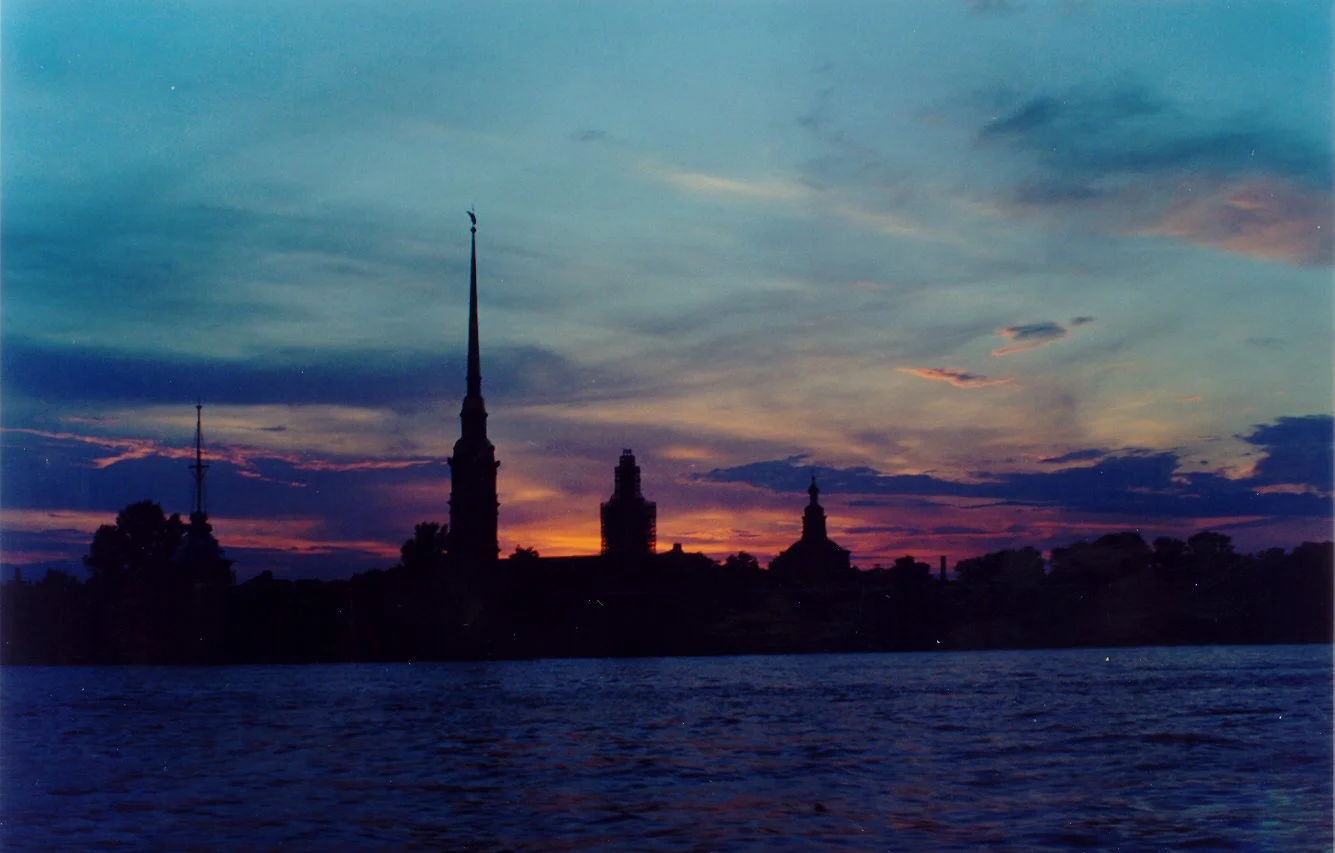
Saint Petersburg, Russia at midnight during White Nights, Photo by Michael Hoffmann (June 20, 1999).
An email titled “Bestsellers of 2026 (so far)” landed in my inbox late this summer and put a somewhat quizzical smile on my face. Snuggled between Yesteryear and Lena Dunham’s new memoir was a little black-and-white edition of Fyodor Dostoevsky’s 1848 novella, White Nights. It was the only nineteenth-century book on the list and other than The Odyssey the only one that could be called a classic. As a Russian literature professor, I was chuffed, but even in my field White Nights is not exactly a household name, not even top-shelf Dostoevsky. Yet according to this email from the Strand bookstore, it was one of the books of the summer.
Why White Nights?
As with most of life’s mysteries, the answer could be found on TikTok. “You think you know love,” begins the short video that spiked sales, “and then you read Dostoevsky’s White Nights.” For a minute and a half, BookTok maven Jack Edwards looks directly into the camera and gushes about “one of the most devastating books about love I’ve ever experienced.” The video racked up over two million views and hundreds of comments. “Ordered it before your video even finished.” “Stop making me buy books!” Others piled on, filling out a #WhiteNights hashtag and spilling over into the broader internet. The 1848 novella had been reborn as a gen-Z favorite.
“I was amazed when I first heard about it,” said Ronald Meyer, the translator of the Penguin Classics edition that inspired the original video. More than a decade earlier, Meyer had translated White Nights as part of a collection of Dostoevsky’s short fiction, hesitating over whether to include this relatively minor early work. Penguin later reissued his translation as a stand-alone volume in its Little Black Classics series. It was this eighty-page version, stripped of footnotes and introduction, that found its way into the earnest hearts and well-groomed hands of social-media influencers.
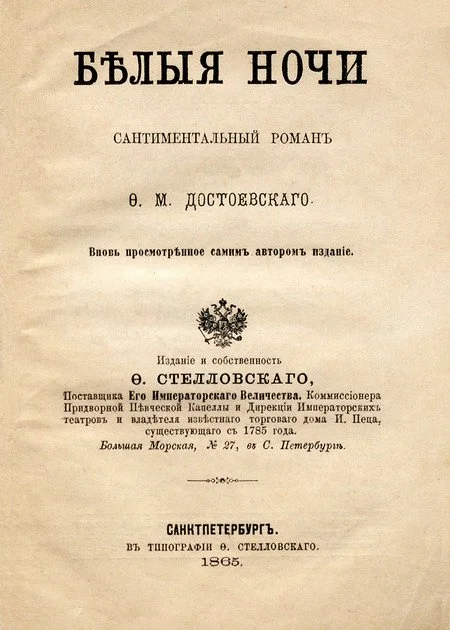
Title page of "White Nights," first edition book published in 1865.
“At first I thought it would be about an incel and unrequited love,” one video starts. “I didn’t expect it to hit me as hard as it did.” The narrator of White Nights would not have thought of himself as an incel, though he might have identified with the incel’s suffering. He lives alone, existing mostly in his own head, unable to make real human connections, especially with the opposite sex. Then one night in midsummer Saint Petersburg he sees a young woman. Clueless about approaching her, our Dreamer sees his chance when an older man accosts her. He confronts her assailant and, after saving the day, strikes up a conversation. The woman, Nastenka, finds conversation with this brainy and awkward young man surprisingly fascinating, even touching. Over the next few long summer nights, when the sun barely dips below the Northern Capital’s horizon, they fall in love; or at least he does with her. The ending, as you’ll hear on TikTok, will “break your heart into teeny tiny little pieces.”
It reads a bit like a male fantasy, and unsurprisingly most of the enthralled BookTokers are young men. Whatever his faults, the book’s narrator connects with a generation that—we are often told—has forgotten how to read. They have bought more than 50,000 copies a year of the book, making it the #4 bestselling translation in the U.K. in 2024. Book stores across the anglophone world have reported huge surges in sales, and other publishers have since released stand-alone editions of White Nights using a different translation, now in the public domain. The book's outsized success suggests that eager young readers relate to the Dreamer's youthful yearning, his social awkwardness, and just as important to his vigorous inner life.
But they are not as naive as you might suspect: they see the book’s ambivalence about the fantasies it might inspire. “Instead of love I would say it’s about obsession and delusion,” one TikTok user commented. “I loved the book btw but I pray no one ever loves me like that. It was messed up and imo intentional on Dostoevsky’s part.” “Original situationship?” another asks. “This is a trauma response,” a third chimes in, not real love. Nastenka, the love interest, “was lucky to get away from him.”
These comments gave me a tingle of recognition. They remind me of the lively and insightful discussions that used to break out in undergraduate literature classrooms across the country and that, we are often told, no longer take place. Allegedly, this generation doesn’t read books. They won’t study anything that does not lead directly to a job. For the record, I have never found this to be true. I have taught energetic, engaged groups of students at various colleges and universities over the last decade. But the size of those groups has dwindled in recent years. Humanities courses enroll fewer students than they did ten or fifteen years ago. Universities are trimming back on literature requirements, and students and parents are less inclined toward majors in the arts and humanities.
Outside academia, something else seems to be happening. Book clubs and mini literature courses are springing up at bookstores across the country. Periodicals offer lectures and clubs to readers who increasingly want to meet over books. The anomie and isolation of the pandemic gave rise to Tolstoy Together, a massive online collective reading of War & Peace. And this summer’s blockbuster adaptation of The Odyssey filled social-media streams with opinions on everything from translation to the nature of guilt, violence, and political power. Outside the university, people flock to literature, often to the classics, to make sense of our world.
We can sometimes see ourselves best through what Barbara Tuchman called the “distant mirror” of other cultures and other times. In her book of that title, Tuchman turned to the late Middle Ages to reflect on the horrors of the twentieth century. When the world seems to be falling apart, she argued, seeing ourselves from a distance, across time and culture can help us navigate a crisis of meaning. We are in another such crisis today. Naked cynicism and corruption have risen to the heights of political power. The world continues warming to apparent public and political indifference, and technologies that flirt with human obsolescence dominate the economy. The future looks bleak, which might be why for the generation just now grappling with early adulthood Dostoevsky is striking a chord.
With granular detail and broad universality, Dostoevsky conveys the alienation and loneliness of modern urban life. The son of a recently impoverished noble family, he came to Petersburg for his education. He found a city so big it made him feel anonymous, a government bureaucracy that cared more for documents and rank than for people, and a newly capitalist economy premised on the exchangeability of all things. All of this belonged to a new world shaped by logic and rationality, a world that was supposed to deliver a brighter and more just future.
Faced with modern life, Dostoevsky’s young men feel above all dispossessed. They are filled with romantic longing and an acute sense of tragedy. Their rich inner lives foster an inflated sense of their own importance and a frustration at their inability to act. Impotent masculinity spills onto the page in long sentences that resemble internet rants, though they are alive with cutting insights and genuine feeling.
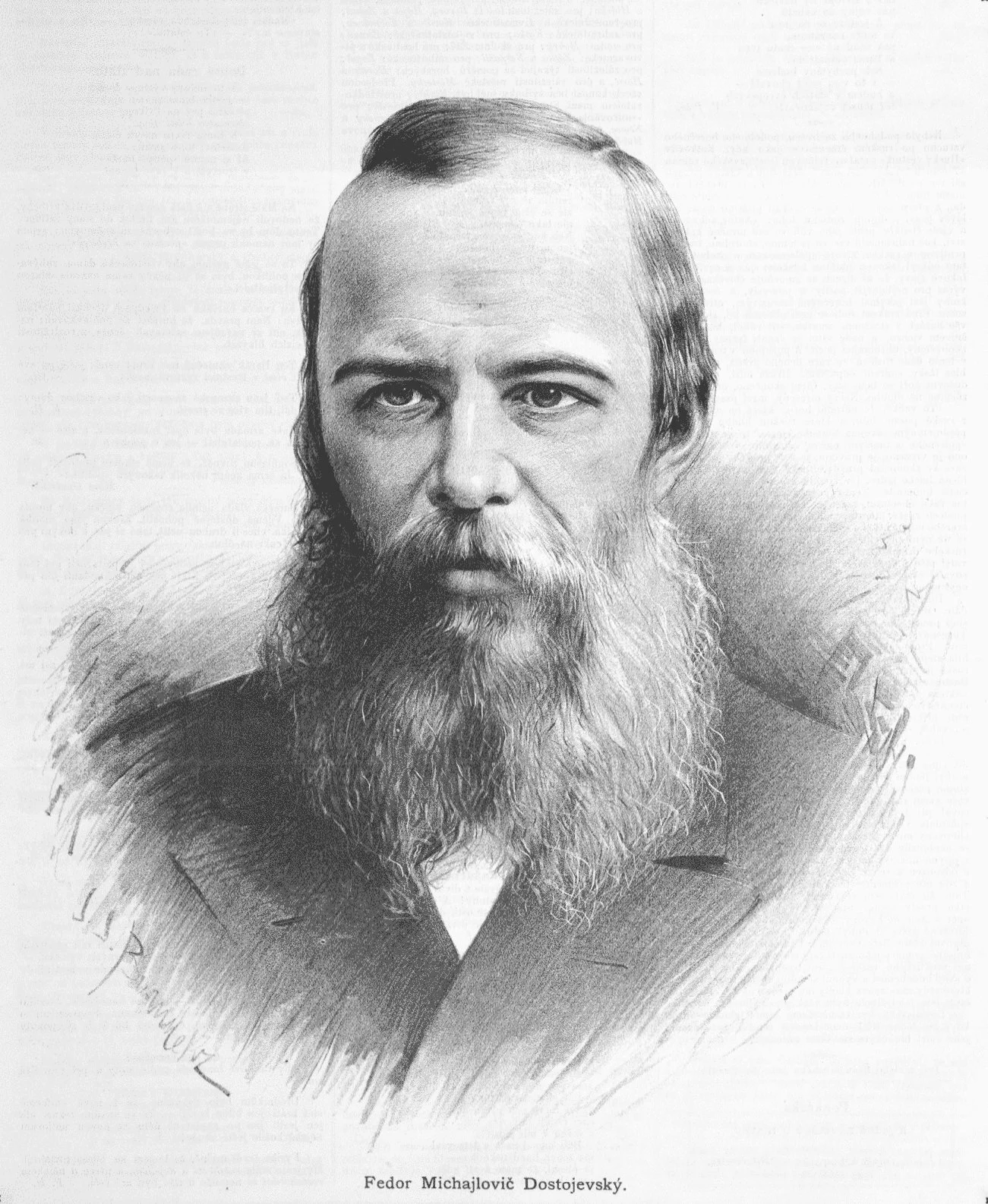

Portrait of Fyodor Dostoevsky by Jan Vilímek, 1889.
Along with Franz Kafka, Dostoevsky was the great poet of modern alienation. He critiqued capitalism, universalism, and the idea of progress, which he saw as threats to human individuality. Through it all, his characters search for meaning. They try on the big ideas of their time, raging against the phony world of their parents. They spin out harebrained theories, straining to make some sense of the world.
In his idealistic youth (he was twenty-six when he wrote White Nights, the same age as the protagonist), Dostoevsky was drawn to utopian socialism. He was arrested as part of a radical reading group, sentenced to death, saved at the last minute and instead sent to Siberia. The experience changed him entirely. After ten years of hard labor and exile, his youthful rage looked not so much romantic as misguided and even dangerous. His greatest works, Crime & Punishment, Demons, and The Brothers Karamazov, were written only after his return.
“It’s almost unbelievable that the same person wrote White Nights and Crime & Punishment,” Meyer, the translator, told me. Denizens of the Dostoevsky subreddit seem to agree. On hearing of the White Nights phenomenon, users have mostly scoffed. “These very same people are going to hate The Brothers Karamazov!” They could never “get through 800 pages or so of a book lmfao.” Dostoevsky's greatest works are certainly more challenging than White Nights, but the big ones are gaining popularity too; sales have more or less tripled in recent years. A viral Facebook post on books that will “change your thinking” had White Nights at the top of the stack and Dostoevsky’s The Idiot (at over 700 pages) not far below.
Crime & Punishment has been climbing Amazon’s bestseller lists too. That novel’s main character, Raskolnikov, is also a loner, suffering through poverty and self-imposed isolation, living inside his own head. He is excessively sensitive to the injustices of the world and all too convinced that his ideas elevate him above the people around him. Raskolnikov looks a lot like White Night’s Dreamer pushed to his breaking point. In this mature work, the romantic fantasy of a thoughtful lonely young man transforms into terrifying meditations on the extremes of isolation, poverty, and intellectual arrogance. The very same readers who are attracted to White Nights might also see themselves in Crime & Punishment, in which Dostoevsky provides fewer easy answers and a deeper search for meaning.
In 2026, Dostoevsky is, to say the least, problematic. A nationalist authoritarian with clear anti-Semitic tendencies, his legacy has been used to justify imperial expansion and violence on behalf of Russia and its supposed messianic role in world history. Some have even connected reading Dostoevsky directly to Russia’s worst atrocities in Ukraine. But despite his political incorrectness—or maybe because of it—he appeals to young readers at a time when many are turning away from the academic humanities. He speaks to something that may have contributed to the almost thirty-point swing among young men towards Trump between 2020 and 2024: a sense of dispossession and impotence in the face of a world that seems to have gone off the rails. If his answers are sometimes pretty “messed up,” in the words of one TikTok commenter, his constant self-doubt opens up debate rather than shutting it down.
If nothing else, the internet debates over White Nights and other literature tell us that Gen Z still knows how to read. They do so earnestly and perceptively, not necessarily reading for critique or for immediate answers. They are already bombarded with insightful analyses on every aspect of real life online. They read instead to find meaning in a world of material abundance in which meaning is painfully elusive. What they need from literature is that distant mirror that allows them—and all of us—to move away from everyday reality. What we need is not an escape, but the art of really reading literature: the art of experiencing what it means to be human and of sensing our own humanity more fully.
Bradley Gorski is associate professor of Slavic Languages with a special focus on late- and post-Soviet literature and culture. He is the author of Cultural Capitalism: Literature and Success after Socialism, and he has published academic work on post-Soviet bestsellers, late-Soviet hipsters, and medieval festivals and conservative aesthetics in today’s Russia.