When Reality Outruns Dystopia
Dmitry Glukhovsky on War, Propaganda, and His Turn to Realism
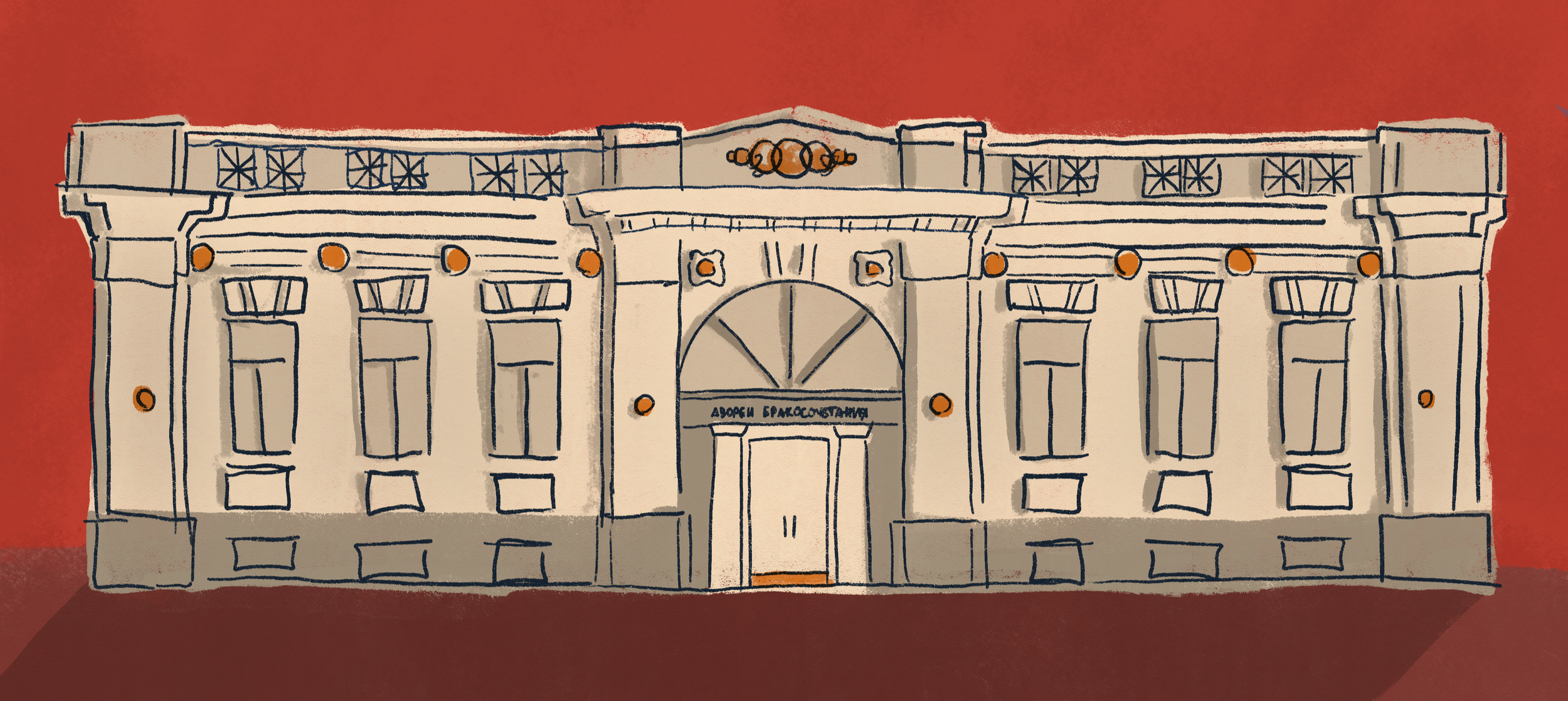
Illustration of Wedding Palace No. 1 (Griboyedovskiy ZAGS), civil status and marriage registration office.
When I was reading Dmitry Glukhovsky’s new novel, Registration, I felt as if I had gone back to my youth, to the late 1980s, when my parents were excited about newly published stories, novels, and poetry that spoke openly about the harsh realities of Soviet life.
Glukhovsky, a Russian writer living in exile, has just published the novel online. It tells the story of people in small-town Russia faced with the temptation of accepting the Kremlin’s contract money to go and fight in Ukraine. It is a study of how this prospect changes the way people think and act. I spoke with Glukhovsky about the novel and his turn from dystopian fiction toward realism.
Glukhovsky is a prolific author whose books have been translated into numerous languages, but I would not have expected him to turn to kitchen-sink realism in depicting today’s Russia. More than two decades ago, he began with the post-apocalyptic fantasy of Metro 2033 and its sequels. The world of Metro is post-nuclear Moscow, where the surface has become uninhabitable and the city’s subway stations have turned into mini states: some fight one another, others organize themselves around competing political ideologies and religions. In Future, Glukhovsky imagined a dystopian world in which humanity has achieved immortality. In the audio novel Post, people are driven mad and die after hearing the “devil’s prayer,” a neurolinguistic weapon created by the authorities in Moscow.
Registration, by contrast, is firmly grounded in reality. Set in 2025, it unfolds in Vologda, a city about 250 miles (400 kilometers) northeast of Moscow, and in Moscow itself. Its main characters are a 27-year-old man who signs a military contract and ends up in the hospital severely wounded, his parents, his fiancée, and her relatives in Moscow. The recruit and his fiancée come from lower-middle-class families in Vologda. At the center of the conflict are the financial incentives the Russian state uses to get people to enlist.
When I ask Glukhovsky about his sudden turn to realism and about the late-Soviet associations that many readers, myself included, have found in his latest novel, he partly disagrees:
The atmosphere may smell of Soviet reality, but I don’t agree that what we are seeing is the late Soviet period. Back then, that reality was already on its way out. Everyone knew they were being lied to on television and would argue with the ideology while standing in line for rotten vegetables.
What is happening now reminds me more of the period when the regime was being established, when people were only beginning to be intimidated and the killing was only beginning. There is fear now that wasn’t there in the late Soviet years. That fear is suffocating freedom of thought. It has already suffocated freedom of speech.
I have a novel called Text, written in 2017, which is ultra-realist. The novel’s central problem is the powerlessness of the individual, the inability to defend one’s human dignity. Anyone who crosses the wrong person can simply be broken and discarded.
To some extent, Registration is the second part of a diptych about the lives of people who go unnoticed in late Putin-era Russia. I took up this story because something similar happened on the periphery of my own family, not in my immediate circle, but to people I have a connection to. I didn’t get this story from the newspapers.
In Russian political circles, this came to be known as “commercial mobilization.” When the authorities saw that people fled the country after mobilization was announced in the fall of 2022, they shifted to contract recruitment. Since then, the budgets devoted to this have only grown. Polling suggests that this has produced an ambivalent attitude toward veterans of the war: those who return are feared rather than regarded as heroes. Whereas people do not necessarily see those who fight as heroes, they understand the value and power of money. In Glukhovsky’s novel, this realization is concentrated in the figure of Ulyana, a thirty-year-old woman who discovers that she is pregnant just as she loses her job, while the father of her unborn child, her fiancé, is away fighting on a military contract.
She may be neutral to war in the beginning but as her personal stake in it grew (the Kremlin’s payout may save her and her child), as she made one moral compromise after another, she became increasingly willing to draw on the arguments that propaganda makes available to anyone living inside Russia’s information environment. You can ignore propaganda as long as the war doesn’t affect you. But once it does, you are told what the rules are and given a framework for understanding what is happening. At that point, you can choose not only to listen to propaganda but to make use of its arguments. And that is precisely what happens to the main character.
Glukhovsky exposes the lies of Kremlin propaganda and attacks state-sponsored, pro-war culture. But there is also literature that is neither pro-war nor anti-war, that seems to stand outside this divide altogether. It is widely read in Russia and draws on fantasy, magical realism, irony, and spiritual quests. Of this Viktor Pelevin is perhaps the most prominent example. Yet for some time now, I have felt that postmodern quotation and irony no longer work the way they once did.
A couple of years ago, Foreign Minister Sergei Lavrov was asked in an interview what he read and said that he read Pelevin and Alexander Tsypkin. I have also heard plenty of people from that milieu say that the world is absurd, that everyone has gone mad: the Americans went mad first, we went mad second, irony piled upon irony. Supplying one “theory that explains everything” after another, Pelevin may have been useful. Glukhovsky’s own trajectory is interesting in this light. He was once part of that broader culture of irony, dystopia, and political ambiguity. In the late 2000s, he published in media associated with the presidential administration, but he gradually moved away from that world. He feels strongly about that break:
I had a book called Stories About the Motherland. It was a collection of fictionalized political jokes, in which I showed different aspects of Russian life, with an emphasis on the subject that particularly interests me—the relationship between the individual and power. And also the relationship between truth and lies, which has preoccupied me all my life.
This was in 2007, 2008, 2009; the book came out in 2010. Some of the stories were published in the magazine Russian Pioneer. Later, for reasons of censorship, they could no longer publish my stories. At the time, it seemed to me that a sardonic tone, allegory cast in the form of a joke, a kind of postmodern mockery of reality, was the best way to talk about what was happening.
But since then, reality has moved into such extremes of brutality that it is no longer possible to joke about it. Joking about it now seems like a weak position to take, a cowardly one. That is also why, I think, Pelevin no longer works. This is a time for speaking directly. What Russia is doing to Ukraine, the unimaginable hell unfolding inside Russia itself: I personally cannot describe these things metaphorically anymore.
Before this became mainstream and reached the Foreign Minister, this was how the entire presidential administration operated, all the campaign managers, political operatives. They explained what was happening to themselves by imagining that they existed inside a Pelevin-like reality, where nothing is quite serious and therefore anything is permissible.
Of course, there is a perspective from which you can say: yes, what absurdity. ‘That’s just the way life is; it’s not us.’ But that amounts, in practice, to shifting your personal moral responsibility onto external circumstances. It is the same as the Russian saying: ‘If you live among wolves, you howl like a wolf.’ These were all formulas and debates that were interesting enough as long as we weren’t talking about the killing of hundreds of thousands of people.
Glukhovsky shows what happens to people from the inside, and how painfully simple the mechanism can be: money can break a person. Yet the reader can understand that person. for all the compromises they make, Ulyana and Tatyana remain understandable to us.
There are no characters in the novel who resist the temptation and then help others do the same. In Russia, though, there are people whose stories are almost impossible to tell through conventional journalism, because much of what they do has to remain hidden. Fiction could help bring these stories to life. There are people who quietly give jobs to those who have been fired for political reasons, help others leave the country or relocate, and lawyers who defend Ukrainians.
There are no good or bad people in my novel. There are simply people trying to cope with temptation. I believe that human beings are fundamentally weak, and I don’t exclude myself from that. If I hadn’t faced similar temptations, fears, and moral choices myself, I wouldn’t have been able to describe any of this. I wouldn’t even have taken up the subject. I have had these conversations with myself, too.
There are no villains here. None of these people is a pathological sadist. None of them is a murderer or a thief. They are people whom the state is trying to implicate, to smear with its own guilt. If there is something evil in Russia, it is the machinery of the state, which has been captured entirely by amoral people, people who are completely on the side of evil, if by evil we mean something devoid of morality, something that consciously acts without moral restraint. The state needs to corrupt and morally degrade the population. And this is a story about how an amoral state corrupts people in order to serve its immediate needs.
There is also the question of how Registration is reaching its readers. Glukhovsky has been living outside Russia since 2022. It is customary for the Russian authorities to try and create as many hurdles as possible for public figures trying reach audiences inside Russia. There is a criminal case against the author over social-media posts critical of Russian forces in Ukraine, and he was placed on Russia’s wanted list. The Justice Ministry has also designated him a “foreign agent.” In August 2023, a Moscow court convicted him in absentia of knowingly spreading “false information” about the Russian military and sentenced him to eight years in a penal colony. He was also barred for four years from administering websites and other online resources.
In September, shortly after Registration appeared online, pro-Kremlin activist Vitaly Borodin, known for filing complaints against public figures, called for the novel to be investigated and designated “extremist material.” Borodin also warned Russian readers against reposting or promoting the book. “They put this filthy Russophobic concoction online, freely available right there on Telegram channels and Western platforms! The calculation is simple and vile: to poison the minds of our young people,” Borodin wrote in his Telegram channel.
Borodin is right in that Glukhovsky did make his novel fully and freely available online – through his Telegram channel. And it is true that he is trying to make sure this work is available and widely read in Russia, not just among émigré circles:
Sixty percent of my readers of my Telegram channel are in Russia [over 110,000 subscribers]. Well, assuming they are telling the truth. I simply asked people in a channel poll, and I think that if someone takes the trouble to participate and says they are in Russia, they probably are. There isn’t much reason to make it up.
In two weeks, 50,000 people subscribed to the channel. The posts containing the files have collectively received around 700,000 views, perhaps more. I think it is reasonable to assume that if 50,000 people subscribed. I would say that by the time we are having this conversation, two weeks after publication, the total number of readers is probably in the hundreds of thousands, and certainly no fewer than 100,000. That includes downloads and people forwarding the files. They can do whatever they want with them. They send them to relatives and friends through WhatsApp, Telegram, and so on. It will also be made available through Boris Akunin’s platform and in a few other places, all of it for free.
If I had gone through an émigré publishing house, there would have been 3,000 printed copies, which over several months would have made their way to a few dozen bookstores around Europe. Some might have been brought into Russia -- dozens of copies, perhaps hundreds. I chose this route because what matters to me is that these subjects are discussed. I think it is important to keep the conversation going inside Russia, with people who are in Russia.
Glukhovsky have done something like this before. He put his first Metro book free on a website. The situation is much different now for Glukhovsky. He has a literary name now and longstanding contacts with publishers. Presumably there is a longer-term plan for distributing the novel commercially, in translations. Strangely enough, despite being rooted so specifically in Russian reality, the novel seems quite translatable.
There will be translations into European languages. I know for certain that there will be German, French, Polish, and Hungarian editions. Altogether, I think seven publishers in seven countries have already confirmed their interest. We’ll see how it develops.
But, again, my first priority was to talk about this with people inside Russia. If my purpose had simply been to give foreign readers a glimpse of what is happening inside the country, there would have been no reason to attract additional attention to myself and take additional risks by publishing it all on Telegram. Vitaly Borodin is already demanding that the novel be declared extremist material, and he says he has submitted a complaint to the Prosecutor General’s Office seeking more serious charges against me. It was obvious that sooner or later it would come to this. In fact, it happened on the third day after publication. Nevertheless, I think the subject is important enough to take that risk.
Maxim Trudolyubov edits The Russia File, the Kennan Institute’s publication, and writes on Russian politics, society, and institutions.