
To Leave or Not to Leave: How Russian Technocrats Undermined Western Efforts to Isolate Russia
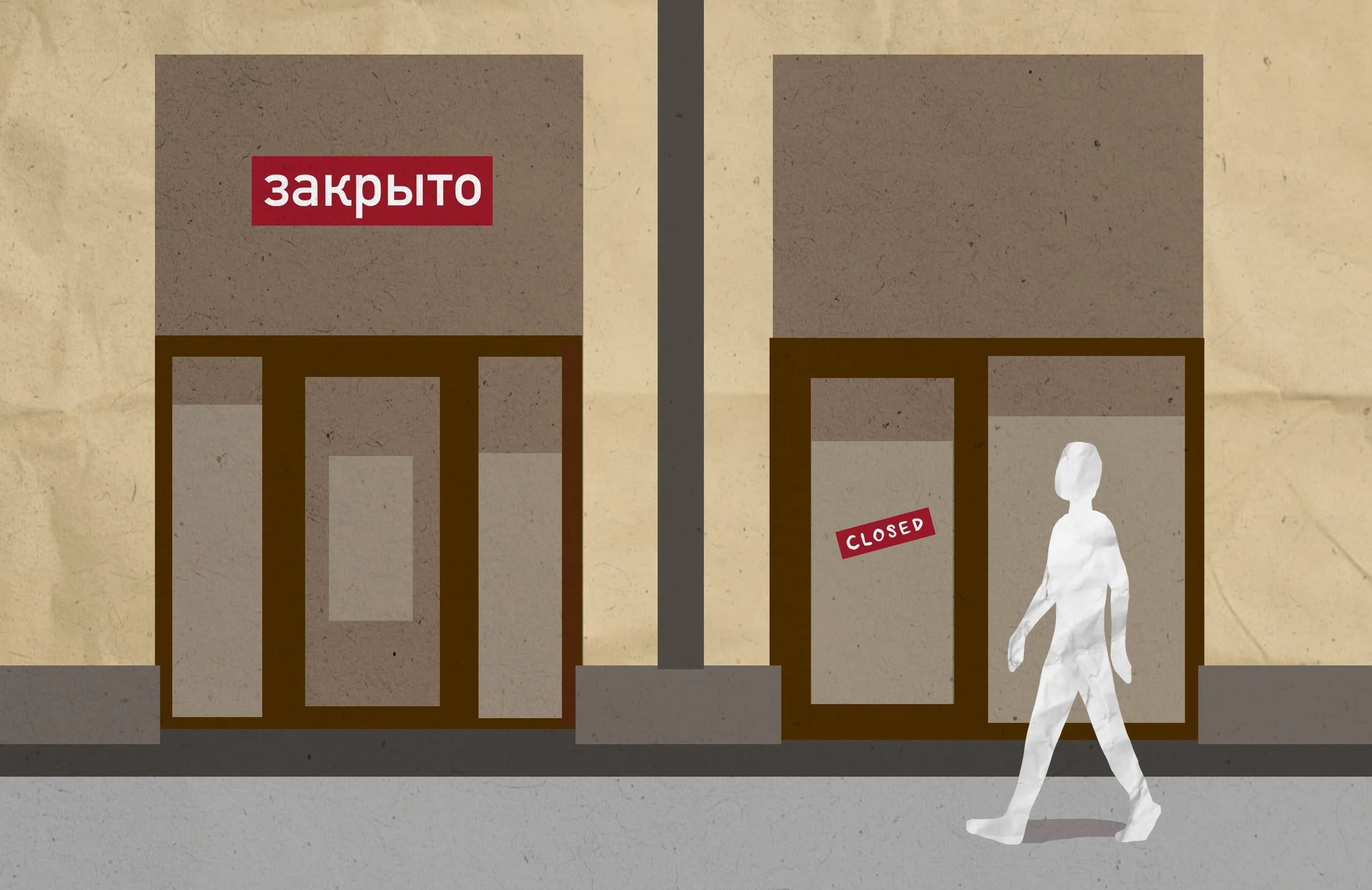
Illustration of closed storefronts in Russia by Jude Schroder, Kennan Institute Creative Director
In 2022, after Russia invaded Ukraine, the West’s concerted policy was to isolate the Russian economy and to ensure that Western companies left the country. In the early months of the war, dozens of global firms including McDonald’s, Shell, BP, and Renault announced their exit. Russia, it seemed, was headed for pariah status. Four years on, a quietly constructed regulatory environment has kept the majority of foreign businesses present in one form or another. Some remained outright, others reconfigured their operations, continuing to work de facto in Russia and generating profits. In practice, a legal exit and an economic exit have proven to be two different things.
A supposedly historic corporate exodus has been illusory. Companies rebranded, restructured ownership, and rerouted revenues through hubs such as Dubai, Almaty, and Yerevan, keeping open the option of return. The result has been a significantly weakened Western economic coercion. Moscow has exploited the gap between formal compliance and actual business activity, expanding networks of intermediaries across Eurasia. Today, more than 11,000 foreign firms still generate profits in Russia, while only about 12 percent (547) of at least 4277 international publicly traded companies that operated in Russia before February 2022 have made a clean break. For those who stayed, the rewards have been substantial: larger market share, consumers willing to pay for quality, and a state inclined to look the other way.
Western governments aimed to cripple Russia’s financial system through G7 bans on transactions with Russian banks and the suspension of correspondent banking. Moscow responded with capital controls, mandatory conversion of foreign-currency earnings, limits on transfers abroad, and the requirement for government approval of cross-border deals with so-called “unfriendly countries.”
A government commission on monitoring foreign investment stands at the center of this regime. This subcommission, which was launched early in the war, became the gatekeeper for major cross-border activity. It imposed punitive terms on exits, including steep discounts, a mandatory “contribution” to the federal budget, and, in some cases, temporary receivership over foreign assets. By the end of 2024, exit deals typically involved around a 60 percent discount plus a 35 percent levy, leaving companies with just 20–40 cents on the dollar of book value. These measures have generated substantial revenues, bringing in roughly $1.5 billion in 2023 and about $4 billion in 2024 and in the first half of 2025.
Financial extraction was only part of the system. Companies seeking subcommission approval were required to disclose ownership structures, supply chains, procurement networks, and their methods for operating in Russia below the radar of Western regulators. Firms seeking to exit handed the Russian state a detailed map of how exactly they had been evading Western scrutiny.
The subcommission functioned simultaneously as an extraction tool, a registry of corporate intelligence, and an instrument of economic control in wartime. Those who resisted faced swift consequences. Carlsberg, which had operated in Russia since the 1990s, attempted an orderly sale of assets valued at around $1 billion. Instead, its local management was arrested, its assets including operations in Azerbaijan and Kazakhstan were placed under temporary state control, and the business was ultimately sold for about $320 million, with an additional 35 percent levy imposed.
The buyer was reportedly linked to Taimuraz Bolloev, a businessman with close ties to the Russian leadership who himself has appeared on EU sanctions lists.
Toyota’s experience is similarly instructive. After halting operations at its Saint Petersburg plant and seeking a managed exit, the company faced a sweeping inspection by Russian prosecutors in November 2022, ostensibly to prevent the removal of equipment from the country. The terms were clear: sell the plant for one euro or risk expropriation. Toyota refused. The following year, the facility was transferred to the Central Scientific Research Automobile and Automotive Engines Institute (NAMI) for a single ruble, roughly one cent.
These expropriations, combined with regulatory changes, fundamentally altered incentives for foreign businesses and discouraged exit. By late 2025, the outflow of foreign companies had largely stalled.
The legal architecture that produced nearly $10 billion for the federal budget has enabled one of the largest redistributions of corporate wealth in modern Russian history. Since 2021, the number of Russian dollar billionaires has not declined. On the contrary, 2024 was the most prolific year for new billionaires since 2011, with nineteen newcomers driven largely by wartime restructuring. In 2025, another fourteen joined the Forbes list, bringing the total to a record 155. The main beneficiaries were business figures close to the Kremlin, often financed by state banks already under Western sanctions.
The rise of Alexei Sagal, owner of the Arnest Group and reportedly close to First Deputy Prime Minister Denis Manturov, illustrates the pattern. Before 2022, his companies generated about $450 million in revenue. After the invasion, Arnest acquired the Russian assets of Heineken, Ball Corporation, and Unilever, backed by roughly $1 billion in financing from sanctioned state banks VTB and Sber. By the end of 2023, these newly acquired assets were generating $1.7 billion in revenue nearly quadrupling the group’s size in under two years, largely at the expense of shareholders in Amsterdam, Cincinnati, and London. Similar purchases appeared across other sectors.
Some foreign companies pursued a middle path, formally exiting in ways that satisfied domestic regulators and reduced reputational risk, while preserving commercial ties that kept the underlying business alive. Russian officials came to regard such arrangements with open contempt, calling them “cosmetic exits” – legal departures with little economic substance.
The case of Schaeffler, the German auto parts supplier, is indicative. When it announced its withdrawal, the deal was presented as a clean sale to Austrian businessman Siegfried Wolf, a member of Schaeffler’s board, who pledged compliance with Western sanctions. But Wolf had also chaired the supervisory board of Russian Machines, controlled by sanctioned oligarch Oleg Deripaska, whose GAZ Group produces military trucks used by Russian forces. Presidential approval was granted not to Wolf directly but to a newly created companyPromAvtoKonsalt managed by Roman Vovk, whom Spiegel described as Wolf’s alleged personal assistant and translator, with a director drawn from Russian Machines’ legal team. Within weeks of the sale, the new owner announced plans to restore Schaeffler components to GAZ’s supply chain, the very connection sanctions were meant to sever.
Alongside coercive measures, the Russian government introduced incentives to blunt Western economic pressure. In September 2022, it allowed companies facing sanctions-related risks to restrict public access to their financial disclosures. As a result, firms such as the German pump manufacturer Wilo effectively stopped publishing disclosures in public registries, turning their Russian operations into a black box.
At the same time, Wilo expanded elsewhere. Its UAE facilities tripled warehouse space and increased production for “emerging markets” by sixty percent by early 2025. For shareholders, the outcome was positive: even as Germany’s economy stagnated, Wilo’s emerging-markets strategy flourished. It was formally compliant yet closely intertwined with the realities of doing business in Russia.
One of the more complex adaptations was the management buyout. Russian executives – often with decades of experience in foreign subsidiaries – formally took over the businesses they had long been running. The arrangement suited all sides: the foreign parent could declare a legal exit; regulators gained a domestically controlled entity; and the new owners, often former employees with deep institutional knowledge and longstanding ties to the parent company, maintained supply chains, licensing agreements, and technical links that kept the business effectively intact.
Viterra, the Canadian grain trader, followed this route in mid-2023 when it announced it would cease Russian grain exports. Its assets were transferred to a newly created entity, Upravlenie Agrobiznesom, owned by members of its local management team, some of whom had overseen operations for over two decades. Continuity was preserved, underpinned by accumulated expertise and established networks.
The French auto-parts supplier Faurecia, a subsidiary of the broader Forvia group, used a similar route when it wrote down its Russian assets in 2022 and announced its departure. By January 2024, its six Russian plants had been transferred to Format Invest, a company whose shareholders included Faurecia Russia’s general director, its operating director, and several operating managers. The deal contained an explicit contractual provision giving Faurecia the option to repurchase the business later on.
The Russian government quickly recognized the pattern. By 2023, its officials demanded the inclusion of domestically connected strategic investors in the deal, a Russian stakeholder who will not quietly sell the assets back once the trade restrictions are lifted. For Western regulators, the exit deal still looked legitimate. Legally the Western company stopped operating in the country, but in reality it had only changed hands.
As scrutiny of management buyouts intensified, a new workaround emerged, exploiting third-country jurisdictions beyond the effective reach of Western regulators. Foreign companies began selling their Russian subsidiaries to intermediaries incorporated in countries with friendly ties to Moscow. This was most often in the UAE but also in Kazakhstan and Armenia. The assets were then passed on to local companies, established by the management of Russia-based assets. The result was a more complex chain of intermediaries spanning multiple jurisdictions, further complicating oversight and enforcement.
Spain’s Inditex, parent of Zara, offers an example. It sold its Russian business to a UAE-based company linked to the Daher family, which already held Inditex franchise rights across much of the Middle East. The new operators reportedly retained staff, suppliers, and product lines, rebranding the stores while maintaining continuity. By late 2024, Zara-branded goods were again reaching Russia through parallel imports schemes.
France’s ADEO, owner of Leroy Merlin, followed a similar route, transferring its business to UAE-based Scenari Holding, which continued operations under a new name with little visible change. In the case of Switzerland’s Sulzer, the financial structure went further: after selling its subsidiary to a UAE entity, the buyer reportedly pledged the shares back to Sulzer as collateral. This pledge means Sulzer retains a secured creditor claim over the very asset it just sold, giving it the ability to reclaim or exert control if the pledge is enforced. Rebranded as Turboservice Rus, the business hired more personnel, grew its revenue to more than 330 million USD, and in 2025 announced a 120 million USD investment in a new production complex in the Urals. Meanwhile, the formal legal separation required by Western regulators remained intact.
The proliferation of these arrangements has created a new Eurasian infrastructure for sanctions mitigation. Its network of intermediary entities, legal structures, and commercial relationships became an alternative architecture for doing business in ways that Western governments cannot easily monitor or disrupt. The Russians invented a new informal and half-ironic name for the UAE’s prime emirate: Dubaisk of the United Arab oblast.
For companies that chose not to disguise their presence, the rewards have been considerable. With competitors gone and market niches freshly vacated, some have shown their strongest results since entering the Russian market.
Between 2022 and 2024, the revenue at the Russian subsidiary of Weatherford International, a Houston-based oilfield services company, grew by nearly thirty percent. Gross profit over the same period increased by sixty-one percent. Its Russian workforce expanded by nine percent, reaching 2382 employees, even as its services remained directly tied to the oil revenues funding the war. The situation attracted enough attention in Washington that fifty members of Congress wrote to the administration demanding stricter enforcement of sanctions on Russia’s oil and gas sector.
Some European companies have made similar choices. Following investigative media reports in spring 2024 that its products had been reportedly used in reconstruction projects in Mariupol, the port city in Ukraine that Russian forces severely damaged during assault, Knauf announced that it would transfer its Russian operations to local management. As of late 2025, the company was still telling reporters that a complex sale process was underway and its head company was not receiving Russian revenues or trading materiel between the EU and Russia. It turned out no one in Russia wanted to buy the assets of one of the world’s most famous manufacturers of building materials. During that same period, revenue at Knauf’s flagship Russian legal entity evidently grew by approximately 20 percent. Its Knauf Insulation subsidiary expanded by around 60 percent. Part of this revenue allegedly comes from high-profile projects, such as the construction of a luxury complex in Sochi that Russian investigative reporters associate with one of President Putin’s residences.
The Trump administration’s efforts to achieve a negotiated settlement to the war has put sanctions relief at the center stage. Some Trump administration officials allegedly believe that a phased economic normalization can get Russia agree on territorial compromises and security guarantees. This assumption is built on a fundamental misreading of the past four years.
Russia’s economy would benefit a lot from the lifting of sanctions. Some of them severely complicated Russia’s ability to produce more or better-quality weapons and generally made the war effort more costly than it could have been. Moreover, inflation is running high in Russia, and Russia’s labor market is distorted by wartime mobilization of human resources and production. Capital is expensive, while access to Western financial markets, technology, and investment is constrained. Easing sanctions would expand the Russian “economic pie” and offer the West a measure of diplomatic leverage.
Whatever Russia’s current economic tribulations, the sprawling cross-border shadow economy built during the war has dramatically reduced Russia’s vulnerability to rapid, disorienting economic pressure from abroad. The network of Gulf-based intermediaries, management buyout schemes, and opaque ownership arrangements in Russian registries has diversified Russia’s economic architecture and helped Western companies to turn a profit. Only those who officially publicly stayed (excluding those who operate via intermediaries) in Russia reportedly increased their profits by 10% or about five billion dollars a year. Concerned about an opacity originally created to aid Western players, the Russian government has proposed a mechanism for the automatic disclosure of hidden information about ownership structure and financial statements. For Western policymakers, the problem is that this network will persist even after sanctions are lifted, making Russia considerably less vulnerable to future economic pressure.
Blindly lifting sanctions would also create moral hazard. Companies that remained in Russia, openly or through intermediaries, have gained a decisive advantage: deeper regulatory familiarity, accumulated local capital, and the trust of Russian partners who noted who stayed and who left. Western officials would face an obvious question from those who complied with political pressure and exited at steep losses: was it worth it?
The Kremlin most likely will not dismantle the regulatory architecture constructed during the war. The ability to condition market access, extract disclosures, and redirect assets toward politically connected actors marks a durable expansion of state capacity. Nor will this experience go unnoticed outside of Russia. The fact that a mid-sized economy under sweeping sanctions, and engaged in the largest European war since 1945, was able to build mechanisms to blunt Western pressure will resonate in capitals such as Beijing and Tehran. As the Russian proverb has it, bad examples spread quickly.
The most consequential legacy of the past four years is the most difficult to quantify. It is the erosion of transparency for Russian economic activity. Exit procedures forced companies to disclose supply chains, ownership structures, and sanctions-evasion methods. This information is now held by the Russian state and will be costly for Western regulators to reconstruct. Allowing firms to withdraw financial disclosures from public registries made the Russian market even more opaque. The growing use of intermediary structures in the UAE, Kazakhstan, and Armenia has further stretched the capacity of Western enforcement, obscuring the true contours of commercial activity.
Several blind spots deserve attention as policymakers consider any future sanctions relief. First, a legal exit should not be mistaken for an economic one. Companies can divest formally while maintaining supply, technology, and licensing ties.
Second, Russia’s approval regime should not be seen as a temporary wartime measure. It has become a durable political filter governing market access. It is likely to persist, adapting its terms to maximize both revenue and political leverage. Foreign participation in the Russian economy is now structurally conditioned on state approval in ways it was not before 2022.
Third, Western leaders can underestimate how deeply the parallel Eurasian infrastructure has embedded itself in global commerce. The Gulf-based intermediary companies, the Central Asian transit networks, the payment systems being developed to bypass SWIFT, the cross-border B2B settlement mechanisms being tested between Russia and Belarus will not disappear postwar. They represent a push towards the structural diversification of global commerce away from Western-dominated financial channels.
Just as Russia is unlikely to go back to its 1991 borders because of a peace deal, the pre-2022 economic relations between Russia and the West will not return. That is why President Trump’s active diplomatic efforts to end the war in Ukraine, if successful, could unintentionally make Russia even more resilient. Though easing sanctions would provide needed macroeconomic help for the Russian economy, it alone would not dismantle the vast network of non-Western ties and intermediaries that reduce economic and political risks for foreign companies.
The Western sanctions regime against Russia was the most ambitious exercise in economic coercion of the post–Cold War era. It mobilized unprecedented G7 coordination, imposed real costs on the Russian economy, and demonstrated that Western governments can act in concert. Yet its politico-economic lessons are disconcerting.
Sanctions tend to work best when the target lacks the institutional capacity to adapt, when the coalition is broad enough to deny viable alternatives and when pressure is applied quickly. None of these conditions have held in Russia’s case. The state developed a capable technocratic apparatus, mobilized a pool of politically aligned domestic capital to absorb assets, and relied on deep ties with non-Western economies that did not join the sanctions or resist benefiting from them.
At home, the same institutions that underpin Russia’s autocracy and resource economy were able to engineer a wartime political economy. The result is a paradox: Russia is less integrated into Western economic governance than in 2021, yet through indirect channels it is in some ways more entangled with Western business practices. It has also been hardened against future pressure. Over time, the shadow economy built under sanctions is poised to become more profitable for those who are able to navigate it.
The twentieth century’s great geopolitical ruptures were resolved by wars that destroyed enough of the old order to make new ones possible. Such ruptures are conceivable today: a grinding war in Ukraine, an intensifying conflict in the Middle East, and China’s bid for untethered global influence. The difference is that while armies fight and leaders threaten, commercial ties persist—and in some cases expand. Whether this entanglement acts as a stabilizing force or whether it feeds on conflict could well be the defining question of the coming decade. It is very much an open question.