
Dagestan’s Divided House: Europe’s Ethnically Most Complex Place
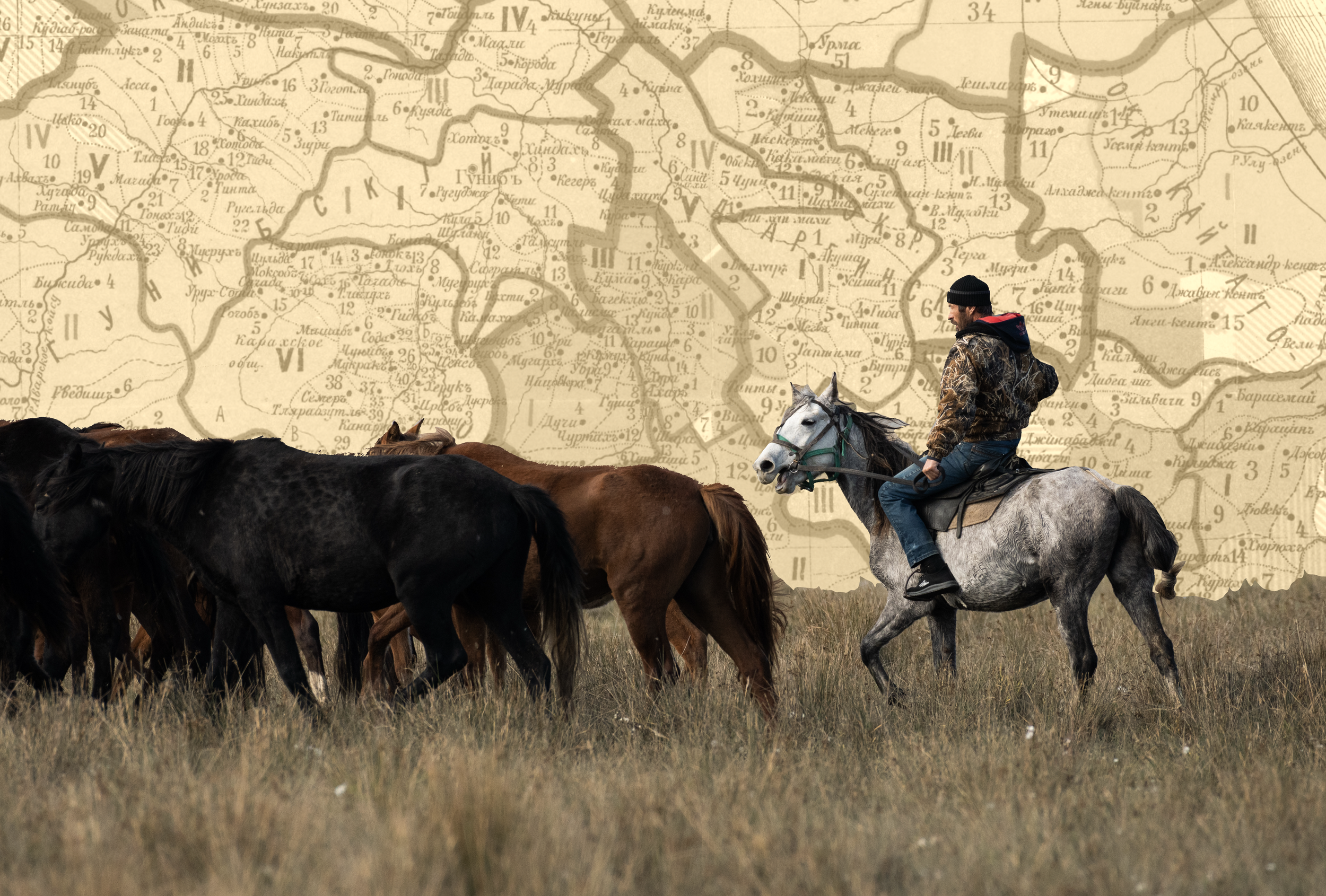
A rider looking after the herd of horses in Dagestan (2022), photo by Marina Gorbunova
Imagine a region where more than thirty distinct ethnic groups share the same administrative borders, speak fourteen mutually unintelligible languages, have coexisted for centuries and yet still struggle to define a common identity. This is Dagestan, a republic on Russia’s southern frontier with Azerbaijan and Georgia, and arguably the most ethnically complex territory in Europe. Whatever it is, it is not a nation. As its Turkic-Persian name suggests, it is simply a “land of mountains,” a geographic designation rather than a polity based on a shared sense of belonging.
The outside world tends to notice Dagestan only when something goes wrong: a terrorist attack, an armed clash, or the anti-Jewish pogrom following the outbreak of war in Gaza in October 2023. But focusing only on crises obscures Dagestan’s true significance. For Russia, Dagestan is a test case for a problem that has never fully been resolved: how to manage extreme diversity without imposing uniformity or allowing fragmentation to turn into conflict.
The name Dagestan captures the republic’s central challenge. Unlike Chechnya, which has a dominant ethnic group bound by a strong shared narrative of conquest, deportation, and resistance, Dagestan has no titular nationality. The Avars are the largest group, at roughly thirty percent of the population, but they have never been able to claim the republic as their own. Dargins, Kumyks, Lezgins, Laks, Tabasarans, and dozens of smaller peoples coexist within the same political unit, each maintaining distinct languages, cultural practices, and political networks.
Instead of dissolving them, Soviet nationality policy deepened these divisions. The policy of korenizatsiya in the 1920s created separate cultural institutions, newspapers, and schools for each recognized group, effectively freezing fluid identities into fixed administrative categories. As the historian Yuri Slezkine observed, the Soviet system resembled a communal apartment in which each group occupied its own room – and in Dagestan, there were more rooms than anywhere else.
If Post-Soviet reforms removed nationality from internal passports in 1997, the underlying social architecture endured. Ethnic quotas in government, designed to ensure proportional representation, meant that political competition continued along ethnic rather than programmatic lines. Until 2006, the republic was governed by a State Council composed of representatives from fourteen ethnic groups instead of a single executive. This system preserved stability, but at the cost of entrenching the very divisions it sought to manage. Analysts at the former Carnegie Moscow Center have argued that Dagestan’s core problem lies not in its clans but in the institutional framework that sustains them.
A paradox lies at the heart of Dagestani identity. The agent that can temporarily override ethnic division is the presence of an outsider. In recent years, Dagestan has become a major tourist destination, drawing visitors with its mountain landscapes, its ancient cities like Derbent, and its reputation for hospitality. What many actually encounter is a society with clearly articulated expectations about behavior, dress, and public space. In 2023, the Ministry of Tourism issued a memo advising visitors against miniskirts, revealing clothing, and public displays of affection. These debates were not just about modesty. They were defining what it means to be “Dagestani.” When Russian tourists arrived in shorts and sundresses at mosques and in mountain villages, the response was strikingly consistent. Avars, Dargins, Kumyks, groups that rarely speak with one voice, suddenly did: “We are Muslims. We have our customs. Respect them.” Shared Islamic identity and regional tradition emerged most clearly through contact with outsiders. As fieldwork interviews suggest, individuals who identify as Avar or Dargin among themselves often adopt the broader label “Dagestani” when addressing an external audience.This dynamic reflects a core insight of ethnicity theory. As Fredrik Barth argued, boundaries are not sustained more in interaction than in isolation. In Dagestan, the figure of the Russian tourist – secular, casually dressed, unfamiliar with local norms – activates a shared “Dagestani” identity that cuts across internal divisions. Islam serves as a common denominator, marking the boundary between “us” and those from outside.
The same mechanism operates more tensely in Moscow and other Russian cities. Dagestani migrants arriving in urban Russia find themselves labelled generically as “Caucasians,” a category that erases the very ethnic distinctions they consider fundamental. In response, many develop a pan-regional identity precisely because Russian society refuses to see the differences they live by at home. The identity that fails to cohere inside Dagestan is constructed outside it.
For Moscow, Dagestan’s ethnic complexity has long posed a distinct governance challenge. The response has been a system of power sharing, quotas, and a carefully maintained balance among competing ethnic elites, one that helped the republic avoid the kind of consolidated ethno-nationalist conflict that devastated Chechnya in the 1990s. Though there has been no Dagestani war, this stability has come at a growing cost. Institutionalized separation has hindered the emergence of a shared civic identity: political appointments, economic opportunities, and social ties continue to flow through ethnic networks. Interethnic marriage remains rare, and even urban neighborhoods in Makhachkala retain visible clustering. The republic coexists; it does not integrate.When formal channels are constrained, the consequences become more apparent. A young man from a smaller ethnic group may find government jobs informally reserved for larger groups, business networks closed, and advancement tied to lineage. For some, this creates a structural dead end. In the 2000s and 2010s, many found an alternative in jihadist networks that rejected ethnic hierarchy in favor of a universal Islamic identity. Dagestan became a key center of the North Caucasus insurgency, with the Caucasus Emirate operating across the region. The risk has not disappeared: following the 2024 Crocus City Hall attack, analysts at the the Soufan Center pointed to the continued vulnerability of North Caucasian youth to extremist recruitment, driven in part by structural exclusion.
Dagestan’s problems do not remain confined within its administrative borders. Three dynamics link its internal fragmentation to broader patterns of instability across the North Caucasus and Russia. The first is the Lezgin question. The Lezgins—around 400,000 in Dagestan and a comparable number across the border in Azerbaijan—are the republic’s most prominent example of a divided people, split by an international frontier that became fixed after the Soviet collapse. Lezgin nationalist movements have periodically called for a unified “Lezgistan” spanning the Russian-Azerbaijani border. As research in Nationalities Papers shows, this irredentist current has influenced not only Dagestani politics but also debates over national identity and minority relations in Azerbaijan. The second dynamic is the spread of radicalization into neighboring regions. The post-Soviet North Caucasus insurgency was never confined to Dagestan: networks extended into Ingushetia, Kabardino-Balkaria, and the Stavropol Krai. The conditions for instability have been contained and reshaped. They have not been eliminated. The third dynamic is dependence on federal subsidies. Dagestan remains Russia’s largest recipient of federal transfers, receiving 73 billion rubles ($940 million) in 2022 alone, more than any other region. Moscow has acknowledged the limits of this model, requiring regional authorities to commit to reducing budget dependence. It has produced a political economy of managed stagnation: federal funds continue to flow regardless of governance quality, while reforms that might improve efficiency threatens the very political stability that justifies Moscow’s investment.
Chechnya and Dagestan offer two different answers to a question Russia has long faced across its multiethnic territory, the question of cohesion. Forged through two wars and consolidated under Ramzan Kadyrov, Chechnya’s answer is vertical unity. A dominant narrative, a single leader, and an institutionalized identity has been built on nationalism, Islam, and personal loyalty to the Kremlin. Chechnya has evolved from the victim of devastating conflict into a blueprint for Putin’s rule of Russia itself. This arrangement has produced a regional actor whose loyalty is conditional and whose influence increasingly stretches beyond the bounds of the federation.Dagestan’s answer is fragmentation by design. Diversity is managed by balancing competing groups, preventing any single one from dominating, and relying on Moscow as the ultimate arbiter. It is stability through multiplication. Amid the profusion of interests, none can mobilize against the center. The outcome is macro-level stability paired with everyday dysfunction. Neither model produces integration or durable legitimacy. Both depend on Moscow as the indispensable external regulator, and both become liabilities if that capacity weakens. After three decades of managing the North Caucasus without resolving its underlying tensions, Russia has produced a set of holding patterns. Dagestan, which is not an exception, may be the clearest expression of this temporizing logic.
Evgeny Romanovskiy holds an MA in Political Science from the University of Vienna and is currently a Ph.D Candidate in Social Geography and Regional Development at Charles University in Prague.