
Part 2: “Foreign Agents”
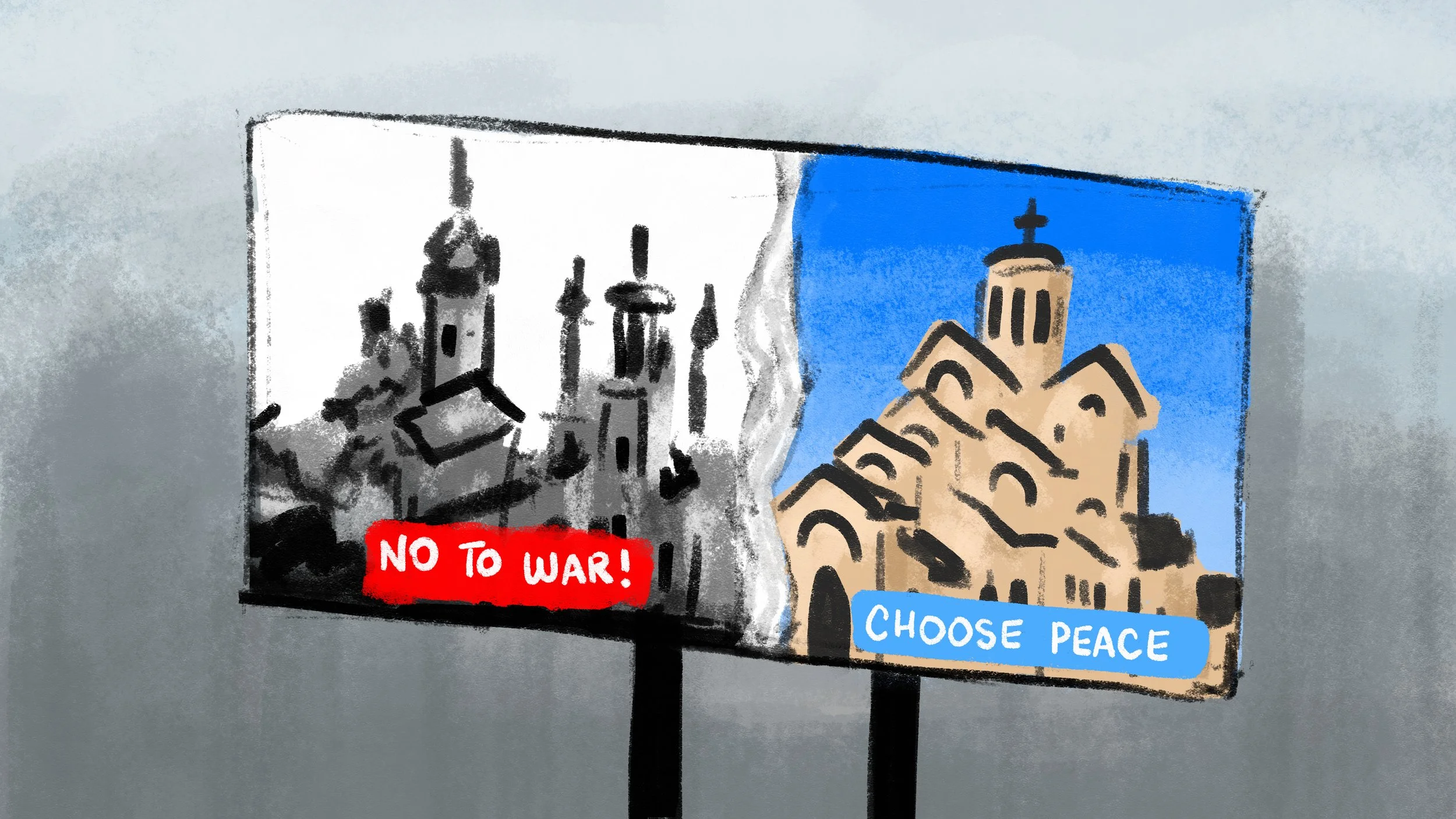
Illustration of a Georgian Dream billboard, which says “No to war!” and “choose peace.”
Georgia’s politicians may be used to politics as a blood sport, but leaders and members of non-governmental organizations inhabit a different world. Many of them are volunteers and are paid little or nothing. And yet, despite mass arrests, police violence, and a series of laws restricting freedom of expression and assembly, civil society continues to function in Georgia.
In an art-filled café, I met four women civic activists and democracy advocates working in a variety of fields, from modern tech education to voter education, to legal aid. All told me they were increasingly under pressure from the government. Two said they had spent time in jail. For their personal security, they asked me not to use their names.
The biggest threat, they said, is the 2024 “foreign agent’s” law that requires NGO’s, media outlets, and other organizations that receive more than twenty percent of their funding from abroad to register as “foreign agents.” The opposition refer to it as the “Russian law.” Many civil society organizations have been “criminalized,” they said. “And it’s not just fines,” one woman, a lawyer, told me. “It can mean going to prison.” The laws are deliberately vague, so even our meeting, they said, could be defined as “sharing expertise,” and could be used as the basis for prosecution.
Some have given up salaries, but even unpaid work can be interpreted as violating the law. All the women said their faces have been used on posters I had seen plastered across the city, labeling them “enemies of the nation.” Some said their families received threatening telephone calls. They cannot defend themselves legally, they said; the courts are controlled by the government. “Under this reality, it simply is not possible to continue to do the work we have done for thirty years,” one told me. And yet, all said they had no intention of stopping their efforts. Some of the most severe restrictions by the government are on education, especially at the university level. The morning after I arrived, I visited Ilia State University, founded in 2006 through a merger of six academic institutes. It has evolved into one of Georgia’s leading comprehensive research universities. It is now in the GD crosshairs.
I was introduced to the university’s rector, Nino Doborjginidze, a linguist and professor whose research focuses on Old Georgian philology and medieval studies. As we sat at a long wooden table in her office, she and two other professors described the government’s seven-point “National Concept of Higher Education Reform,” approved in December of last year. Under the new rules, the government would control what normally are functions of the institutions themselves, from academic programs to student admission quotas. More ominously, the government would authorize only one university in a given city to offer programs in a particular academic field, a throwback to centralized Soviet educational policies.
The tightening of control over academia does not just affect universities, they said. It is part of a wider domestic, and even international political strategy. “Today, Georgian Dream is trying to change and modify the foreign policy orientation of Georgia,” Giorgi Gvalia, Vice-Rector for Academic Affairs and professor of politics and international relations explained. Part of it may be Georgia’s effort to adapt to the effects of the war in Ukraine, he said, but it also could be simply an effort for the GD to stay in power. GD considers independent universities and civil society impediments, he explained, and they must be brought under control.
Ilia State University’s budget has been cut by 97%, they told me. The government has shortened the academic program from four years to three and ended double-degree programs with European universities. “They’re trying to kill the university and silence it forever,” was their conclusion.
The university’s students are inspired by Western values like democracy and human rights, said chancellor Ketevan Darakhvelidze. “So (the government) is thinking, if they kill this sentiment in young people by taking away quality education and opportunities abroad they try to control the emotions of the young people long-term. In their (GD’s) internal discussions, they actually say they delayed all of this. But they’re too late. Young people have protested, and they are so loud!”
In almost every conversation on this visit, the subject of Russia’s war against Ukraine sooner or later surfaced. Several people called it a turning point. Georgia shares a more-than 500-mile-long border with Russia and, shortly after the February 2022 invasion of Ukraine, the country quickly became a key link in Moscow’s efforts to evade Western sanctions. A March-April 2026 report from the Tbilisi-based Economic Policy Research Center analyzed what it called “destination washing” of dual-use goods. It found, for example, that “micro-chip imports to Georgia increased by an extraordinary 33,725% in a single year, rising from just 375 units in 2021 to 130,140 units in 2022.”
The Ukraine war also was a political turning point for Ivanishvili, according to Mariam Rakhviashvili, Georgia’s former ambassador to the Czech Republic, and former Deputy State Minister for European and Euro-Atlantic Integration. Over coffee in Tbilisi, she said, even before the invasion, Ivanishvili had a plan to establish control over Georgia’s domestic politics and foreign policy – without the support of the Georgian people.
“If you look at the situation right now - all these laws - it’s overnight changes, on a daily basis. It’s unpredictable. And it seems he is doing a shortcut, based on the scenario they’ve implemented in Russia and Belarus. They learned the lessons. They know what worked the best.”
Surprisingly, many current members of the opposition once were part of the Georgian Dream coalition. Political scientist and civic activist Levan Tsutskiridze worked with almost all of Georgia’s political parties, including GD, “when it was relatively normal,” he noted. But even before the 2023 “foreign agents” law, he said, there were warning signs.
“The first very vivid example was the dissolution of the coalition, when they kicked out all their democratic partners, and arrested some of them.” The motivation, Tsutskiridze believes, came from Ivanishvili’s “world view,” which, he said, is similar to the Russian view: “the world is the enemy; liberal democracy is decadent; secret organizations rule the world.”
“The (Ukraine) war shifted something drastically in them,” he said. “They wanted to be on the winning side. I think they subscribed to this vision that Putin would be in Kyiv in one week.” But it didn’t happen. “Then there was our very successful pushback against their first attempt to introduce restrictive legislation on NGO’s.” Civil society succeeded in organizing massive resistance and GD was forced to withdraw the legislation. “They didn’t expect that,” he said. “Suddenly there are groups of youngsters marching here and around the country.”
“So, now Ivanishvili thinks he must destroy everybody, destroy civil society, destroy NGO’s, destroy the opposition, free press. I think that he and his small circle really believe that.” Another factor is corruption, what Tsutskiridze calls “sheer banditry.”
I met a young protester, twenty-three-year-old Lucy, who told me she was a student during the anti-“Russian law” protests: “After the full-scale invasion of Ukraine I go more involved in activism, just because I saw all the pro-Russian rhetoric that Georgian Dream was using against Ukraine. It felt deeply personal and I was really up front, speaking at rallies, going on TV shows. But I can say it was pure chaos.”
“We don’t have any ideology among young people,” she told me, “no left or right. We are very susceptible to propaganda. I think a lot of people around me don’t realize how bad it can get.” Young Georgians have grown up with NGO’s, they’ve been able to travel visa-free,” she said. “But we don’t realize it can get much worse,” she said. “It’s not a given that we have these free institutions, and scholarships and international programs. And now we’re close to losing it all. And this is what opposition parties have failed to communicate.”
The young protester, with her informal but fashionable clothes, was indistinguishable from young people one can find in any big European or US city. Tbilisi is a sophisticated capital with a vibrant cultural life along with the stores, cafes, modern hotels and busy traffic common to city of 1.3 million. But Georgia is a relatively small and poor country of 3.7 million with an urban-rural divide. GD tends to have more support in rural areas; among older, more conservative voters, religious voters, and especially among voters dependent on government jobs and subsidies.
I saw how the party pitched its message to such voters when I visited Tbilisi during the October 2024 parliamentary elections. Near my hotel there was a large billboard looming over a traffic intersection. One half had a black and white photo of a bombed-out church in Ukraine. The other half had a color photo of a beautiful Georgian church. Across it was the message “No to war!” and “Choose peace!” It was a graphic illustration of GD’s message that if Georgians voted for the western-oriented opposition that supported Ukraine, the country would be dragged into war. Georgians have suffered through three major wars since independence in 1991.
Georgia, generally speaking, is a conservative country and GD has exploited that to win support. In October 2024 parliament passed the “Family Values and Protection of Minors” law, which mirrors a similarly-named Russian law. It bans same-sex marriage, forbids adoption by gay couples, bans the media from any reference to same-sex relationships or transgender rights.
The Georgian Orthodox Church is tightly aligned with the government and has strong societal influence. It supports the “Family Values” law and its hierarchy have spoken out against alliances with the west that they contend would jeopardize Georgia’s “sovereignty” and “traditional values.”
One evening, I took at cab to the studio of Formula TV, a channel started five years ago with private investment and now a leading critic of the GD government. Its empty, underlit lobby had a forlorn feel to it. I was there to meet Giorgi Targamadze, a journalist, political figure, and media executive. He also served as leader of the Christian-Democratic Movement, and as a member of Parliament, later transitioning to Deputy General Director at Formula TV, as well as anchor and host of a political talk show.
He looked busy; big news was breaking. The Organization for Security and Cooperation in Europe (OSCE), had just released a special report based on a fact-finding mission to Georgia. The Georgian government had rejected the mission and, in response, twenty-four member countries of the OSCE published the report anyway, documenting human rights abuses it said were caused by legislation regarding media, political parties, NGO’s, and other organizations. As we entered the TV control room, I could see live reports flashing across the screens.
His work as a journalist has become increasingly difficult, Targamadze told me. The media are barred from using any words that question the legitimacy of the GD-controlled government. When he included reports about Iran’s alleged growing influence in Georgia, the State Security Services called the people he interviewed in for questioning and launched immediate investigations.
The government has cut almost all financial resources for his channel, Targamadze said. Investors have been pressured to leave the country, all are still under investigation, facing possible imprisonment. Advertisers are warned they could be charged with “collaboration with the enemies of Georgia.”
It’s a “crisis, a fight for survival,” as he put it. Some of their best journalists, salaries cut to almost nothing, have left the channel. Some have changed their professions or even left the country. Meanwhile, government-friendly channels are given generous resources, he explained. (In February, the British government sanctioned the pro-government Imedi TV for spreading “deliberately misleading information concerning Russia’s full-scale invasion of Ukraine… that the Ukrainian Government and President Zelensky are illegitimate, Ukraine is a “puppet” of the West, Ukraine is a corrupt country and that Ukraine and the West are seeking to destabilize Georgia.” The UK also sanctioned another government-friendly channel, POSTV, which, the UK said, “provides support for or promotes a policy or action which destabilizes Ukraine or undermines or threatens the territorial integrity, sovereignty or independence of Ukraine.”
Sitting in his office, ready to go on air, Giorgi Targamadze looked tired and stressed. Organized mobs have attacked Formula TV’s journalists, he explained, seriously injuring one of them. The channel investigated and found that all the attackers were managed by the state security services. Some of them were from criminal groups, he added. “We named them,” he said, but the government did no investigating.
Targamadze said he asks himself frequently why the government does not just shut them down instead of pursuing this “death by a thousand cuts” approach. “I think there’s only one reason: because they’re really afraid of Washington’s reaction, and the Trump’s administration’s reaction. They think that, even with these transactional relations with them, shutting TV’s will close even this very minimal chance to establish new relations.”
“You mean the ‘reset?’ I ask. “Yes,” he replied.
Jill Dougherty is a Distinguished Fellow at The Wilson Center and Affiliated Scholar at the Center for Eurasian, Russian and East European Studies at Georgetown University.
Illustration by Kennan Institute Creative Director Jude Schroder.