
The End of Belarus's Balancing Act
Illustration of a figure balancing on a tightrope as the end unravels.
Aliaksandr Lukashenka has spent three decades in power, leaving some observers with the impression that he still has a real choice between Moscow and the West. Since 2020, that choice has grown far harder to sustain.
Harsh repression followed the presidential election held on August 9th, 2020, an election Lukashenka is widely understood to have lost. Minsk engineered a migration crisis on the border with Poland and Lithuania, and rounds of European Union sanctions have combined to erode the room Lukashenka once had to vacillate between Moscow and the West. Negotiations over political prisoners, resolved within months a decade ago, now drag on far longer, and each time there is less and less goodwill. Calling Lukashenka's position a balancing act today is hardly an accurate description of where he stands.
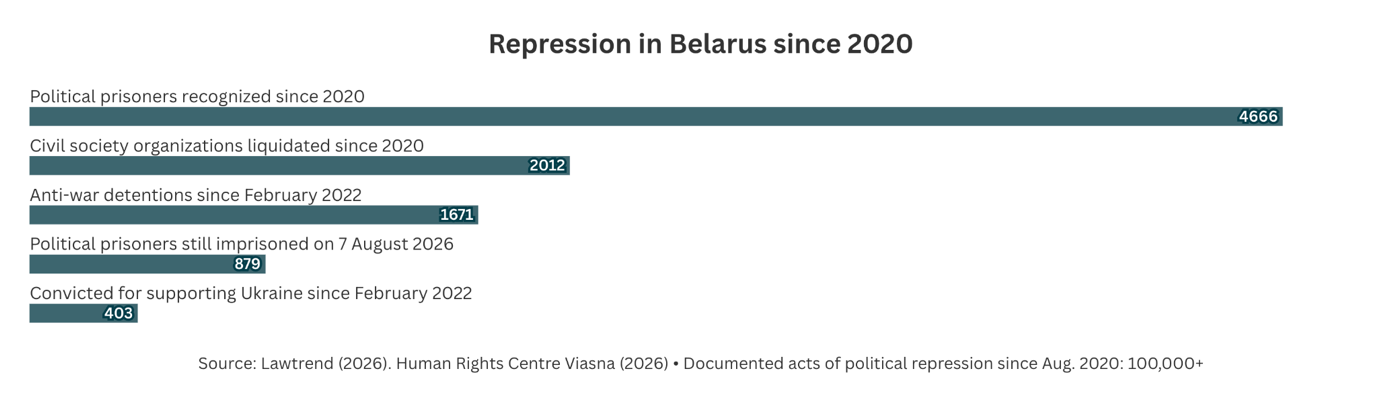
Lukashenka took power in 1994 and has ruled longer than all but a handful of the world’s other sitting dictators. For most of that time, his government has jailed opponents and restricted independent media. But repression intensified sharply after the 2020 election, when mass protests elicited a crackdown severe enough to push much of the opposition and independent media into exile and to fill the country's prisons with political prisoners. There have been tens of thousands of cases of political repression, thousands of recognized political prisoners, and thousands more civil-society organizations forced to close. The war in Ukraine has brought about a further wave of prosecutions.
Over the past three decades, Belarus has received subsidized Russian energy, security guarantees, and diplomatic cover for staying broadly aligned with Moscow, while using its formal independence to negotiate better terms from the Kremlin and occasionally to attract attention from Washington and Brussels.
Lukashenka allowed Belarus’s territory to serve as a staging ground for Russia’s 2022 invasion of Ukraine and has very likely hosted Russian nuclear weapons since 2023. Belarus and Russia have pursued deepening integration under the Union State framework. More than anything Lukashenka claims, Belarus’s independence now rests on what Moscow has not yet asked for rather than on what Lukashenka has now and then refused to do.
Belarusian units have not yet crossed the border into Ukraine. This is the clearest sign of where Moscow's demands currently stop – for now. Elections in Russia this September could test that. Persistent rumors suggest that Putin could announce a new mobilization drive after the elections. Such a move would signal that Russia’s existing manpower pool is no longer sufficient. If the shortage is serious enough to warrant another domestic mobilization, Moscow may also look more closely at what Belarus could still contribute: from logistics and mobilized labor to troops.
Manpower losses and the strain of sustaining offensive operations have pushed Moscow to employ every available resource, including those that Belarus possesses. Demanding more of Lukashenka – a frontline role for Belarusian units, formal mobilization or direct entry into the war – would be easier for the Kremlin now than it was in 2022.
Putin's own interests seem to cut against this step. Belarusian troops sent across the border as combatants or a domestic mobilization drive might destabilize Lukashenka’s regime, not least because no one, including Lukashenka, actually knows how Belarusian units would perform in combat against Ukraine. The army has never been tested that way, and the uncertainty itself is reason enough to avoid finding out. Having governed through autocratic consolidation, he has little reason to believe that a second and larger crisis would end better for him. A resentful or weakened Lukashenka is a worse outcome for the Kremlin than a compliant one supplying territory, training grounds, logistics and political cover.
Behind Russia’s calculations is a narrower, more transactional relationship with Washington. The clearest evidence of Lukashenka’s leverage with the West is the periodic release of political prisoners (timed for attention) alongside occasional informal contact with U.S. officials. These releases are genuine concessions, and they matter greatly to the people freed and to their families; but they are also episodic and mischaracterized by Lukashenka loyalists as actual engagement. In fact, there is no sign of a foreign- or domestic-political reorientation in Minsk.
The overall pattern took shape in 2025. An initial batch of prisoners was freed in February, days after U.S. Deputy Assistant Secretary of State Christopher W. Smith traveled to Minsk. A larger release followed in June after a visit by U.S. Special Envoy Keith Kellogg. It included opposition figure Siarhei Tsikhanouski, husband of exiled leader Sviatlana Tsikhanouskaya. Washington’s response was to ease of restrictions on the state airline, Belavia. Each round since has demonstrated the same logic: a release is met with a rather limited reciprocal gesture.
From Lukashenka, Washington can expect additional prisoner releases, an informal channel and perhaps a marginal check on how far Belarus is drawn into the war. The moderating of sanctions on potash shows that Washington is prepared to put meaningful incentives on the table, but even these moves will not pull Minsk out of Moscow's orbit. They can generate concessions and slow things down. They cannot reverse the direction of Belarusian foreign policy.
The European Union’s stance has been more coherent and more fixed. Brussels has not recognized the legitimacy of the 2020 election. It maintains a sanctions regime targeting Lukashenka's inner circle, and Brussels continues to fund Belarusian civil society and independent media in exile. Ordinary Belarusians face tighter visa rules and banking restrictions, a side effect analysts increasingly cite as a weakness in the sanctions strategy. Unlike Washington's episodic engagement, the EU’s approach gives Lukashenka no public room for maneuver.
Moscow and Washington approach Lukashenka from very different angles. Moscow can offer or withhold the subsidies and security guarantees that keep his government solvent and armed. Washington can offer sanctions relief and attention, while Brussels can do even less for Lukashenka.
Belarus looks more flexible from the outside than it is from within. The country is still formally independent, still able to extract a few concessions from Washington and to claim some distance from the Kremlin. That is the narrative Minsk prefers to emphasize, and it is not wholly false.
Every step toward integration with Russia narrows the space for future hedging, regardless of the narratives Minsk that might prefer. The country’s space for independent action, which has been integral to Lukashenka’s reputation over the past three decades, is smaller today than at any point since the 2020 protests. The war next door gives Belarus fewer reasons to test the boundaries of its unfreedom, and Moscow fewer reasons to let it.
Alesia Rudnik, PhD in political science, is a postdoctoral researcher at Södetrörn University and Maastricht University.
Illustration by Kennan Institute Creative Director Jude Schroder.