
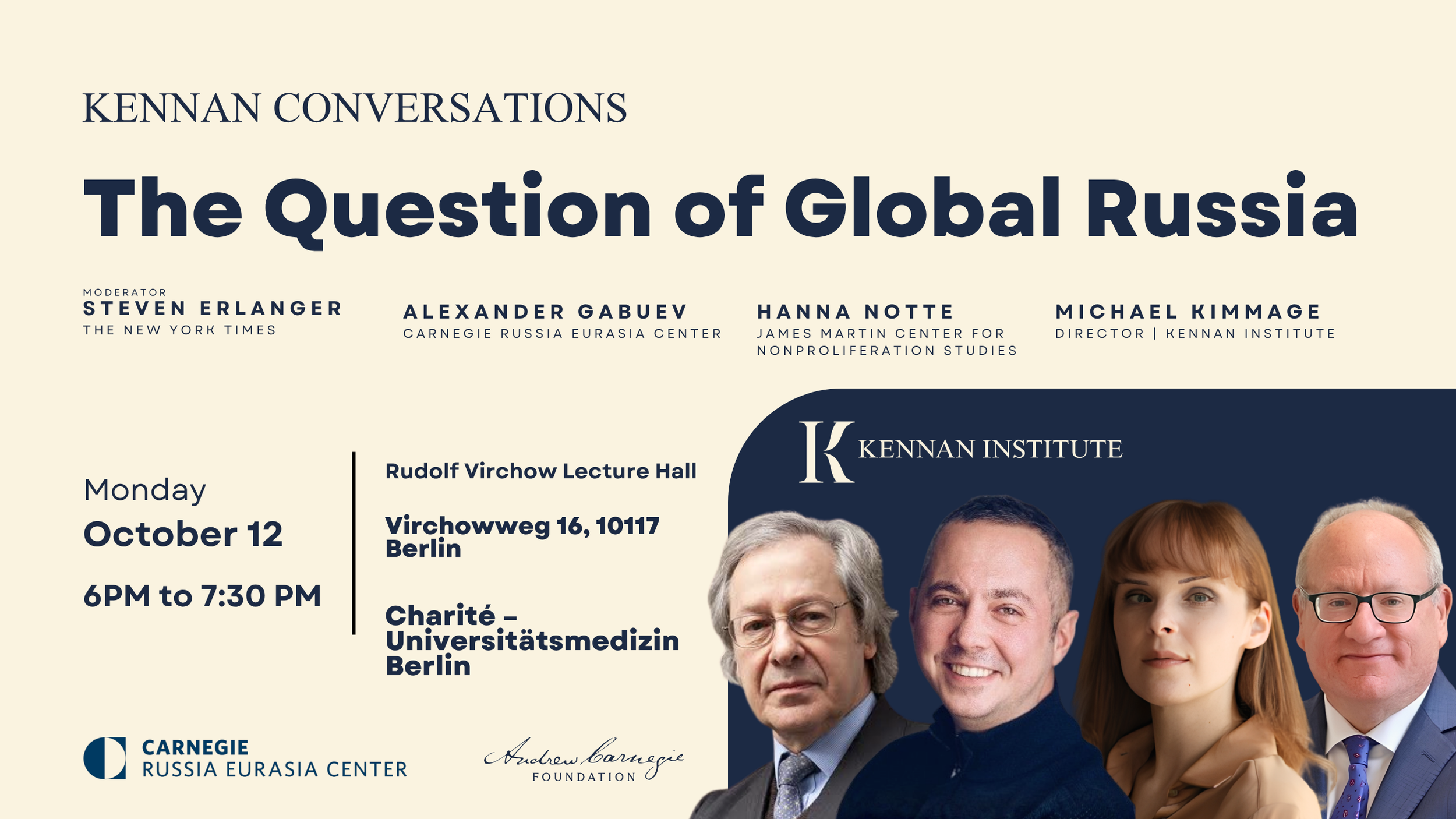
The Question of Global Russia
How is Russia’s foreign policy reshaping European security and the international order? Russia’s war against Ukraine has raised fundamental questions about the Kremlin’s geopolitical ambitions, the future of European security, and the evolving relationship between Russia and NATO. Recorded live in Berlin, this edition of Kennan Conversations brings together Alexander Gabuev, Hanna Notte, and Michael Kimmage for a discussion of Russia’s geopolitical strategy and its implications for Europe and the wider international community. The conversation explores Russia’s use of hybrid tactics, NATO’s evolving approach to deterrence, and the challenges facing European nations as they respond to Moscow’s actions. It also considers how Russia’s confrontation with the West is shaping international security and the broader geopolitical order. Featuring:
Alexander Gabuev, Carnegie Russia Eurasia Center
Hanna Notte, Non-Resident Fellow, Kennan Institute
Michael Kimmage, Director, Kennan Institute
Moderated by Steven Erlanger, Chief Diplomatic Correspondent, The New York Times. This conversation was recorded live in Berlin as part of the Kennan Institute’s Kennan Conversations series. Please note: This recording contains audio only. Kennan Conversations is made possible by the generous support of the Carnegie Russia Eurasia Center and the Andrew Carnegie Foundation.
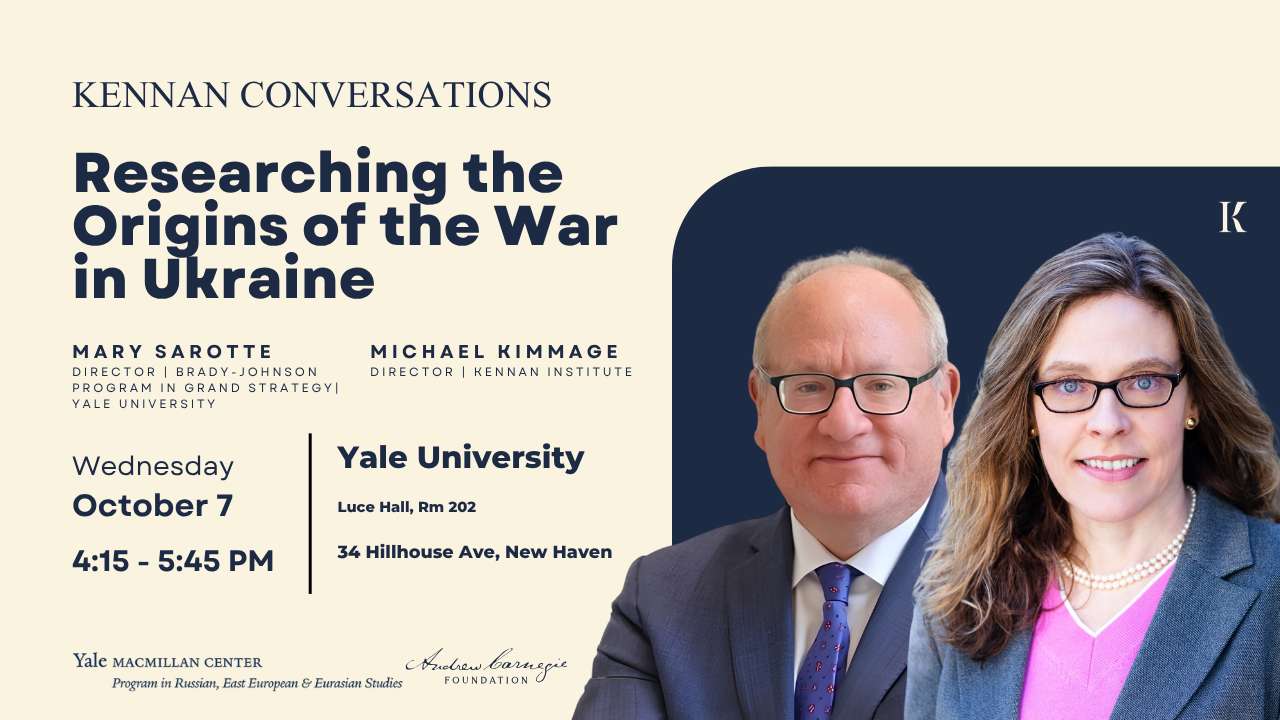
Yale University

Kennan Conversations is made possible through the generosity of the Carnegie Foundation.

Russia's Invasion of Ukraine: The Conundrum of Chronology

Kennan Conversations is made possible through the generosity of the Carnegie Foundation.

Origins of the War: A Question of Chronology
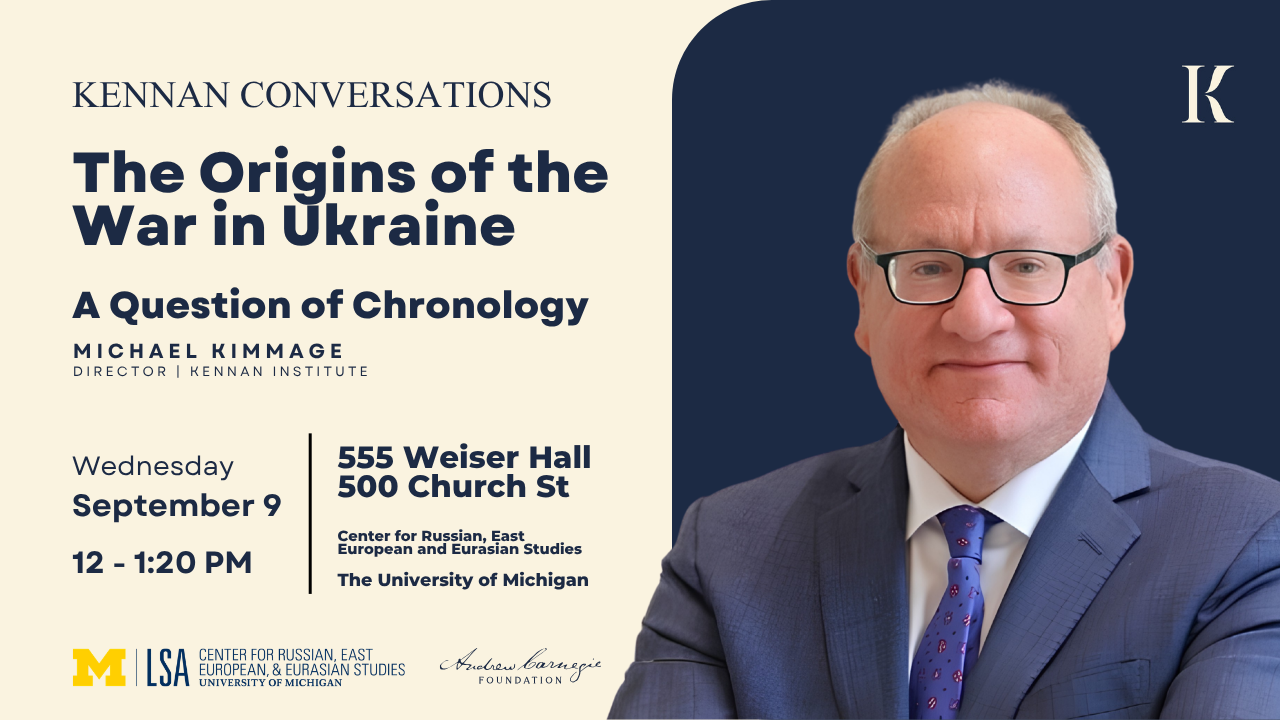
When did the war in Ukraine begin: 1654, 1991, or 2021?
On September 9, Kennan Institute Director Michael Kimmage joined the Center for Russian, East European and Eurasian Studies at the University of Michigan for The Origins of the War in Ukraine: A Question of Chronology.
Kimmage considers three possible points of origin for the war and examine how the chronology we choose shapes our explanations of it. The lecture also explores the difficulty of conducting chronological analysis without solid empirical evidence, a challenge extending from academic research on Russia to intelligence analysis and policymaking.
Kennan Conversations is made possible through the generosity of the Carnegie Foundation.

Maduro's Fall and Russia's Response: A Conversation
Hanna Notte, Kennan Institute Non-Resident Fellow, and Stephen Wertheim, Senior Fellow at the Carnegie Endowment for International Peace, address the implications of the recent U.S. intervention in Venezuela, focusing on what they may be for Russia's global foreign policy and for Russia's approach to the war in Ukraine. What are these new notions of global order being ushered in by the Trump administration, and what opportunities and challenges will Russia derive from these new (or not-so-new) notions?

Kennan Conversations: The Russian Press and Putin
A conversation with two journalists, Andrei Soldatov and Irina Bologan, taking a close look at their recent book, Our Dear Friends in Moscow: The Inside Story of a Broken Generation, which explores the evolution of the news media in Putin’s Russia and the increasingly repressive relationship between state and media after 2011.

Kennan Conversations: Distant Friends and Intimate Enemies
A book talk with Ivan Kurilla and Victoria Zhuravleva about their new book, co-authored with David Foglesong, Distant Friends and Intimate Enemies, a sweeping history of U.S.-Russian relations across the centuries.
Artwork by Kazimir Malevich and Wassily Kandinsky