
The Tale of Two Filmmakers in Putin’s Russia (Draft for Review)
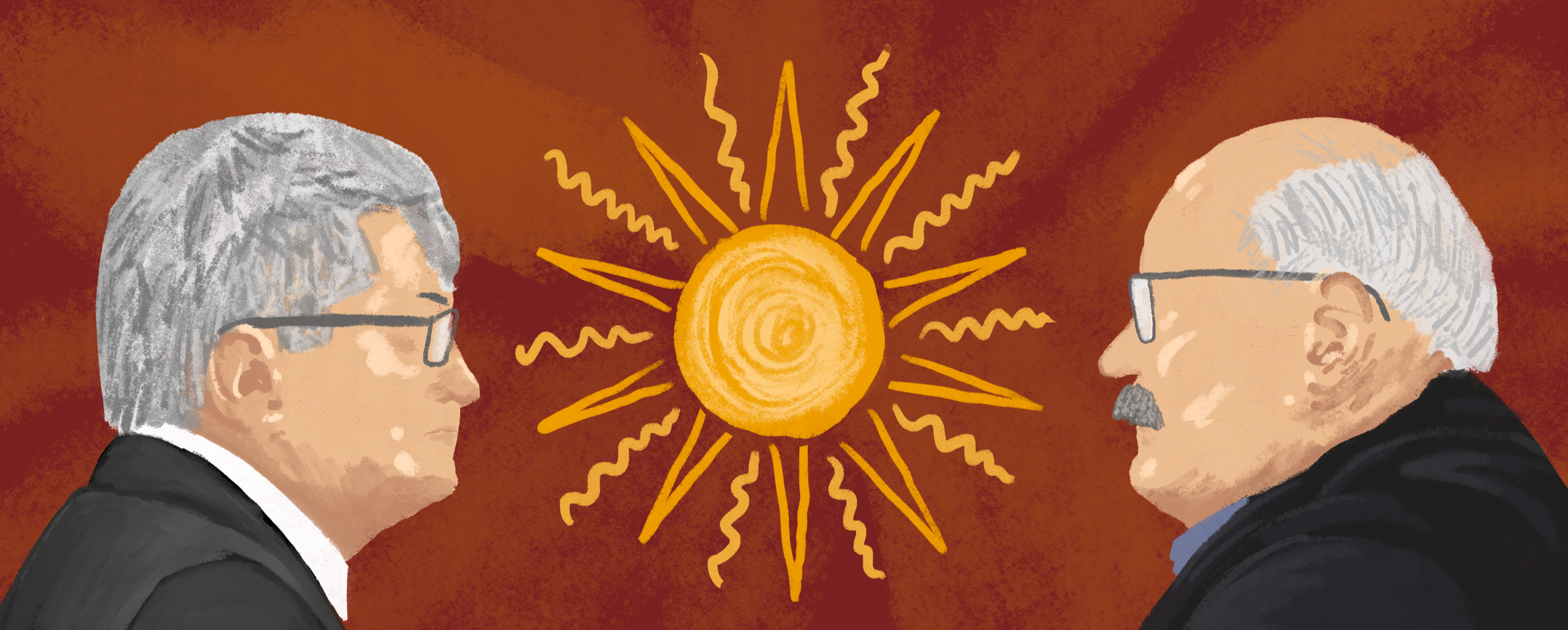
In Russia under Vladimir Putin, there are two towering cultural figures who seem to embody radically opposing responses to power. Both are internationally acclaimed film directors. Both are larger-than-life public personalities constantly present in the news, and both have maintained unusually long and personal relationships with Putin. Yet their roles could hardly be more different. Nikita Mikhalkov has spent decades praising and mythologizing the ruler, while Alexander Sokurov has stubbornly persisted in trying to speak truth to power.
Nikita Mikhalkov has supported Vladimir Putin through virtually all of his major political campaigns since 2000. Alexander Sokurov, by contrast, has long been associated with human-rights advocacy and moral dissent. In his meetings with the president, he has repeatedly raised uncomfortable ethical questions and voiced concerns that few others in Russia’s cultural establishment would dare to express.
*
In 1999, the Cannes Film Festival opened with The Barber of Siberia, an epic historical drama directed by Nikita Mikhalkov, who also appeared briefly in the film as Tsar Alexander III. Russia that year was awaiting a transfer of power. The inner circle of the country’s first president, Boris Yeltsin, was searching for a successor. Rumors circulated that the lavish financing behind The Barber of Siberia was compensation for Mikhalkov’s role in Yeltsin’s 1996 reelection campaign.Although Nikita Mikhalkov had served as a public surrogate for Boris Yeltsin during the 1996 presidential election campaign, his relationship with Russia’s first post-Soviet president never truly developed. The rise to power of former KGB officer Vladimir Putin, by contrast, was greeted by the Mikhalkov family as a historic vindication. One of Putin’s earliest symbolic acts as president was to restore the Soviet national anthem’s melody as Russia’s official anthem. The lyrics carried special significance for the family. The original 1943 version had been written by Nikita Mikhalkov’s father, Sergey Mikhalkov, a celebrated children’s poet and influential Soviet literary functionary. The text had been edited personally by Joseph Stalin.After Stalin’s cult of personality was denounced in the Khrushchev era, Sergey Mikhalkov produced a revised version removing Stalin’s name. Decades later, following the collapse of the Soviet Union, he wrote yet another version for Putin’s restored anthem. When criticized for his apparent adaptability and willingness to serve any political regime, Sergey Mikhalkov reportedly replied with a terse aphorism: “The Volga flows under every government.”
In 2007, Nikita Mikhalkov released a prime-time television tribute titled 55 and dedicated to Vladimir Putin on his birthday. In Mikhalkov‘s interpretation, the power that seemingly fell into Putin’s hands in 2000 was providential not accidental.
Questions of providence, sacrifice, and state power also permeate Mikhalkov’s cinematic magnum opus, Burnt by the Sun and its later sequel. The original 1994 film won the Grand Prix at the Cannes Film Festival and remains the only post-Soviet Russian film ever to receive the Academy Awards for Best Foreign Language Film. At the time, Burnt by the Sun was interpreted as a clear condemnation of Stalinist terror. Set during a single summer day in 1936, it follows the celebrated Red Army commander Sergei Kotov, played by Mikhalkov himself, a Soviet hero who is ultimately arrested by the NKVD, the Soviet secret police. The film ends with titles informing viewers of Kotov’s death.
In 2010, Nikita Mikhalkov “resurrected” Kotov in Burnt by the Sun 2. In the 1994 original, Stalin remained an ominous off-screen presence, visible only through a gigantic portrait floating above the final scenes on a dirigible. In the sequel, however, the leader appears on screen almost immediately, filling the film with moral ambiguity. Stalin’s power is terrifying, the film suggests, yet because he rules Russia, that power also possesses has a kind of divine dimension.In Mikhalkov’s worldview, the Soviet role in World War II ultimately absolves and redeems everything: wartime atrocities, repression, even the crimes of the Soviet state. The sacrifice made by the people becomes an act of atonement for the 1917 revolution and for Russia’s abandonment of its Orthodox faith. In many ways, Mikhalkov anticipated in 2010 nearly all the central tropes of Russia’s wartime propaganda in the 2020s. It is no surprise that the country’s most prominent state-aligned director has not made a film about the war in Ukraine. He had said everything fifteen years earlier.Since 2011, Mikhalkov has hosted the television program Besogon TV, whose title roughly translates as “Exorcist” or “Demon-Chaser.” After 2022, the show evolved into one of the major platforms of Russian wartime propaganda. Mikhalkov has used it to denounce antiwar voices as traitors, to glorify the war effort and to promote an aggressively nationalist worldview.
Instead of art, the relationship between Mikhalkov and Putin appears to revolve around politics, historical narratives, business interests, and putting pressure on dissenting cultural figures. Mikhalkov and Putin have never had a public disagreement. In Putin’s Russia, the role of the director willing to challenge the president has belonged to someone else.
*
In September 2011, the top prize at the Venice Film Festival, the Golden Lion, was awarded to Faust by Alexander Sokurov. The film completed Sokurov’s so-called “tetralogy of power,” which had begun in 1999 with Moloch, portraying several days in the life of Adolf Hitler. It was followed by Taurus, focused on the gravely ill Lenin during his final days at Gorki, and then The Sun, depicting Emperor Hirohito as he signs Japan’s surrender and renounces the divine nature of his authority.Faust stands apart from the earlier film. Goethe’s tragedy contains no dictators. Yet for Sokurov, the film was not more than the philosophical culmination than merely the conclusion to his tetralogy. Rather than examining the physical and psychological limits of individual rulers, Faust becomes an allegory of power itself. Mephistopheles tempts Faust, but in the end Faust kills the devil with stones and presses “further, further, further” onward. In Sokurov’s interpretation, a human being corrupted by power becomes even more terrifying than the devil, because he loses any genuinely human sense of good and evil.
In Putin-era Russia, Alexander Sokurov remains virtually the only public figure who, even after the outbreak of the Russo-Ukrainian war, can still openly disagree and argue with Vladimir Putin. Nearly all other prominent critics of Putin were pushed out of the political mainstream during the 2000s and the 2010s, their voices separated from official public life.
Alexander Sokurov attended court hearings for political prisoners and has repeatedly used the stages of film festivals and award ceremonies to speak in their defense. His last major address before Russia’s Presidential Human Rights Council in 2025 touched, among other things, on the discrimination faced by opposition figures branded as “foreign agents.”In 2021, Sokurov publicly challenged Vladimir Putin over whether Chechnya should remain part of the Russian Federation, going so far as to interrupt the president during the exchange. For the first time in many years, audiences saw Putin display something close to spontaneous anger rather than his usual carefully managed composure. By the end of his response, the president had softened his tone: “Come see me, we haven’t met in a long time. You know how much I value our meetings and discussions. I’d be glad to debate this with you. But before saying such things publicly, one must think very carefully. Please don’t be offended, but these are very serious matters.”
For many years, Alexander Sokurov and Vladimir Putin have publicly acted out a kind of recurring drama of “the director and the tsar.” Part of the explanation may lie in Sokurov’s earlier relationship with Boris Yeltsin. Sokurov was one of Yeltsin’s most important intellectual interlocutors and made two documentary films about him. Sokurov later recalled that the two men even rehearsed Yeltsin’s dramatic 1990 resignation from the Communist Party in Yeltsin’s Moscow apartment. The director carefully recreated the stage layout from the Congress Palace, counted the number of steps to the exit, and coached Yeltsin on where to walk, what to say, and even what to do if someone grabbed him by the arm. Sokurov remembered being struck by how seriously Yeltsin understood the personal and political risks he was taking.Sokurov remained close to Yeltsin until the former president’s death, and one might say that together with the Russian state Putin inherited this unusual relationship. For Putin, the stature of the interlocutor matters. Many mocked his famous 2007 remark that after the death of Mahatma Gandhi he no longer had anyone to talk to. Yet figures such as Aleksandr Solzhenitsyn and Sokurov, despite holding views very different from Putin’s, allow him to inhabit his preferred historical role: that of a ruler engaged in conversation with figures of perceived moral and intellectual magnitude, whose very presence helps confirm the scale of his own place in history.
But why does Alexander Sokurov continue this painful dialogue with Putin? Unlike Mikhalkov, who benefits from extensive state patronage, Sokurov has paid a price for his conversations with the Kremlin. His films have struggled to obtain distribution licenses. Retrospectives on his work and public appearances have been canceled.
Yet for Sokurov, perhaps Russia’s foremost cinematic explorer of power, these encounters with Putin may hold artistic as well as civic significance. This exploration culminates in Fairytale, where Stalin, Churchill, Hitler, and Mussolini converse with endless doubles of themselves. Echoing, in some ways, the ideas of the medieval historian Ernst Kantorowicz, whose The King's Two Bodies argued that a ruler possesses both a mortal physical body and an enduring political one, Sokurov multiplies the ruler’s body into second, third, and tenth incarnations, like voices reverberating through an echo chamber. The political body becomes a sequence of images, a presence extending far beyond the biological limits of a single human life.
By making two films about Boris Yeltsin, Alexander Sokurov captured the transformation of an ordinary human being by political power. Few, if any, documentary works have examined the nature of power so intimately. Sokurov continues this exploration through his encounters with Vladimir Putin, documenting how over time the burden of power reshapes the individual.These exchanges are not merely acts of dissent, though their importance in that regard should not be underestimated. They also function as a kind of living documentary adaptation of the enduring Russian tale of “the director and the tsar,” exposing the mechanisms, psychology, and language through which artists and political power relate to one another.
Konstantin Shavlovsky is a poet, cinema critic, publisher, curator, and the founder/executive manager of the Saint Petersburg bookstore Word Order. He has worked as an editor for Seance magazine, published extensively on Russian cinema, and curated multiple interdisciplinary cinema projects. He is the author of two books of poetry and resides in Tbilisi, Georgia.
Illustration by Kennan Institute Creative Director Jude Schroder.