
The Nouveaux Riches of “Novorossiya”
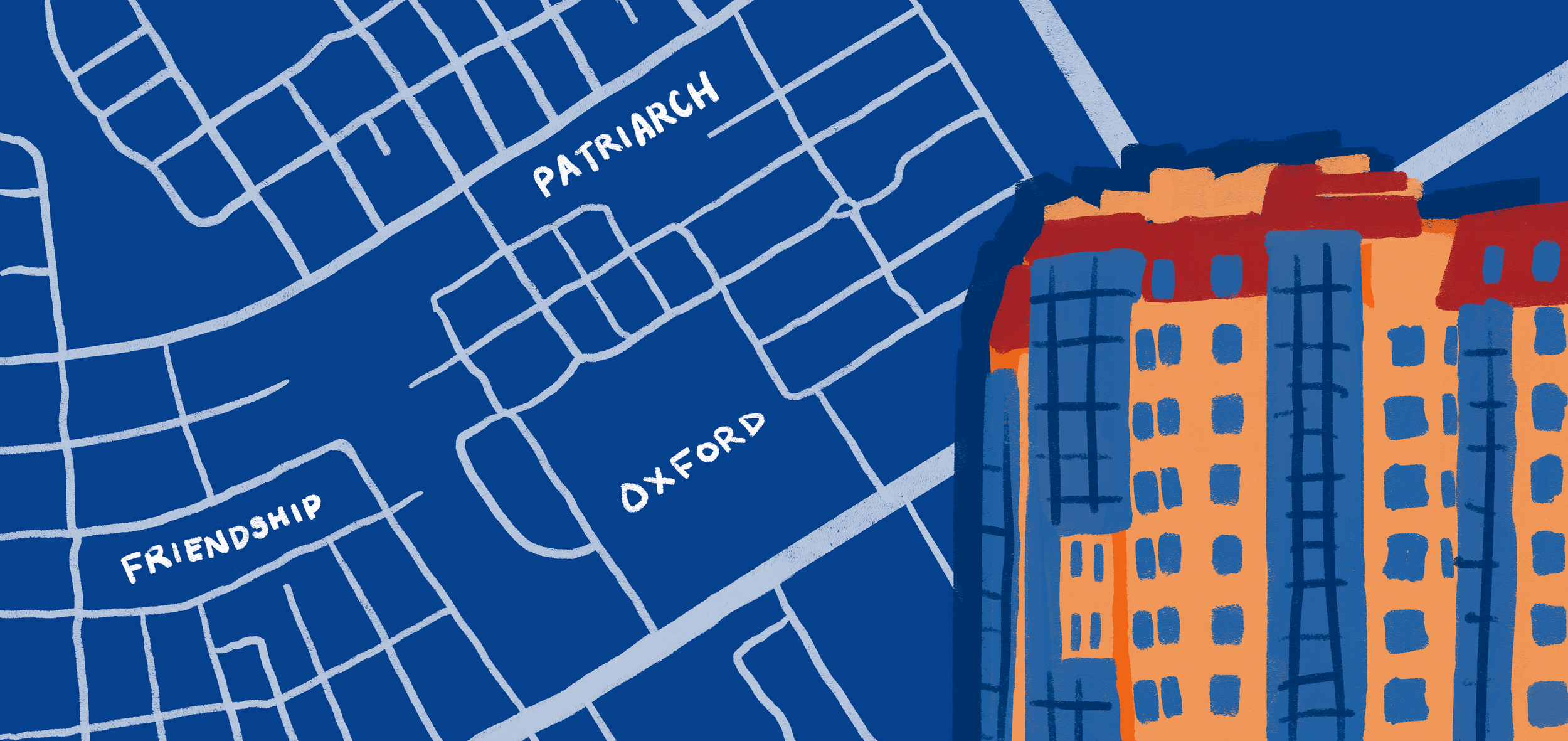
Artistic interpretation of new housing developments built in occupied Luhansk under free-economic-zone rules.
In the center of Mariupol, at 28 Engels Street, one can find the opulent gaucherie of the RICH restaurant. It was built on the ground floor of a destroyed block of flats, a shiny pedestal on a gruesome grave. According to locals violently displaced by the eatery’s clientele, the owner is himself from Mariupol. His family established the restaurant to serve the incoming occupiers. RICH began operating almost as soon as the siege ended, alongside the Mega supermarket chain, which this family also owns.
The restaurant has been designed for a “gilded youth” of Russian military parvenus and collaborator families. On offer are a “refined cuisine,” a banquet hall, “aromatic smoky hookahs,” An implausibly varied range spans Russian traditional dishes, pizza, sushi and French delicacies. It is hard to imagine a cook who could excel at all of this and harder still in occupied Mariupol, where energy outages and chronic shortages limit fresh supplies. Some difficulties surface on the restaurant’s own Telegram channel. If its 2024 posts were hedonistic and buoyant, the feed now pleas for guests to forget “all problems,” if only for a while.
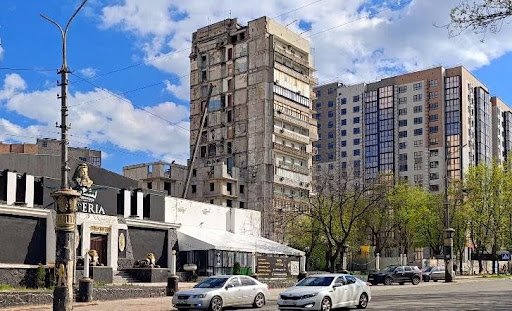
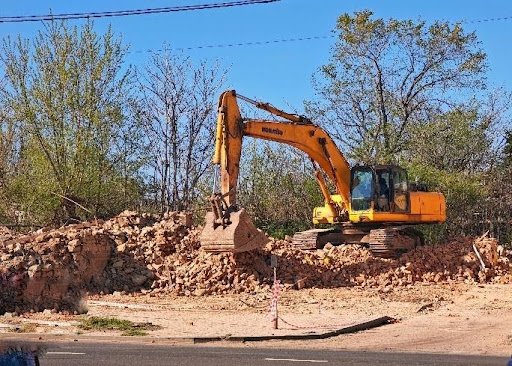
Seven blocks away, an equally extraordinary competitor to RICH is rendered in stone. The Imperia restaurant announces itself in Egyptian pastiche, a gilded pharaoh’s head above the door, sphinxes couchant on either side, a black polished facade, a summer marquee advertising banquets, corporate parties, weddings and a children’s menu. Directly behind it stands a gutted Soviet tower, its windows blown out, a crane picking at the upper floors. To the right rises a finished high-rise in fresh brick. Three structures compress the regional economy into a single frame: the tacky venue for the new clientele, the ruined home being cleared, the mortgage block going up on the cleared ground.
These two venues are the shopfront of the occupation. They display a highly specific consumer economy — restaurants, “elite” apartment complexes, leisure and property services — that has taken shape across the occupied territories. Like Imperia and the flashy subsidised tower-blocks raised on the footprints of demolished homes, this unrooted economy is now beginning to struggle. Some of its patrons have fled from Ukraine’s sustained middle bombing campaign in the occupied territories. Apparently, they did not imagine that moving into someone else’s home, when that someone is armed and would like it back, might be unwise. The restaurants’ changing fortunes unwittingly chronicle the luxury economy of the occupied territories, pointing to a layered structure of beneficiaries. Awkwardly united by political and personal loyalty, these figures are buoyed by subsidies, by redistribution and by the outright theft of other people’s property.
“Novorossiya,” New Russia, was Catherine the Second’s eighteenth-century coinage for the southern steppe her armies took from the Ottomans and the Crimean Khanate. She dressed the conquest in classical Greek names — Kherson, Sevastopol, Mariupol among them — territorial expansion in the guise of civilizationism, a restoration of Hellenic-Byzantine inheritance and an anticipated “Greek” turn for the Russian Empire. In 2014, the Kremlin revived the label for the territories it now covets in Ukraine, although since 2022 “Novorossiya” largely refers to the occupied territories outside the Donbas. The sentiment is unchanged: that Russia has a civilisational entitlement to this territory. The facades of RICH and Imperiya are new paint on an old project, conquest presented as a venture between normalcy and glamour.
*
The new rich of the occupied south and east fall into two categories. The first are local collaborators who have turned political loyalty to their commercial advantage. Ukrainians who have fled occupation describe these collaborators as the regions’ also-rans, people who had been passed over in the pre-occupation past and were now seizing the moment. Bloggers became deputy governors; provincial managers of pyramid schemes became regional heads.
Ensconced in occupation officialdom, these locals have steered contracts, property and licences toward their own families. Yevgenyi Balitsky, the head of the Zaporizhzhia occupation administration and a native of Melitopol, has used his position to build a family business empire: a real-estate firm, LLC Omega, which carried out contracts for Balitsky’s own administration, winning roughly fifty-three million rubles in orders in 2025 alone as a sole supplier; a cluster of affiliated firms in hospitality, food production and auto parts; and a Sevastopol restaurant chain through LLC “7Ya.” Businesses are frequently transferred from their previous owners to figures close to the administration through newly created clone companies. The transactions are laundered by decrees and orders from the military-civil administration.
The second category of profiteers comes from Russia. At the top sit administrators: the Zaporizhzhia government, and then Mariupol, headed by Anton Koltsov, previously a senior official in Vologda oblast; the Kherson administration’s Andrey Alekseenko, a former mayor of Krasnodar; prosecutorial and security posts filled from Khabarovsk, Tambov and elsewhere. Reconstruction is managed through the federal contractor PPK Yediny Zakazchik and a roster of Russia-based development firms. Many nominally local construction companies are actually Russian.
Through the 'Zemsky' schemes — federal programs that pay doctors, teachers and cultural workers to relocate to understaffed rural areas, now extended to the occupied territories — settlers receive a premium of around two million rubles, roughly double the sum offered for moving to a Russian village, on five-year contracts. Working on five-year contracts, these newcomers are subsidised, though they are not growing rich. Embodying a demographic project, they have been brought in to supply the occupation with a loyal professional class and to de-Ukrainianize the regions. Importing settlers to hold newly taken ground is an old imperial method. Catherine's Novorossiya was populated the same way, with Serbs, Greeks and Germans drawn in by land grants, tax exemptions and religious toleration to secure the conquered steppe. The inducements have changed, cash premiums rather than free land, but the logic has not: settle loyal newcomers on seized ground and let self-interest do the work of empire.
Most apartments in Mariupol’s new-builds are bought not by locals but by arrivals from Russia — from Moscow, St Petersburg and Siberia, together with military personnel drawing wartime pay — drawn by a two-percent state mortgage open to any Russian citizen. One-room apartments in the city sell for 2.5 to 3 million rubles and cottages for as much as 200 million, while job boards in Mariupol advertise salaries averaging around 40,000 rubles a month. This is a market over which local residents exert little influence and to which they have scant access.
The new rich are defined less by a common social origin than by a common relationship to the occupation. They are those who administer it, those who have relocated to staff it, and those who are permitted to profit from it.
*
The names of the new developments are intended for outsiders, something they do very little to hide. Across occupied Luhansk, blocks thrown up under free-economic-zone rules carry names that reach conspicuously beyond their surroundings. One complex is simply called Oxford. Then there is Yasnaya Polyana, named after Tolstoy's country estate and marketed as an ‘eco-village’ of glued-timber houses, or Patriarch an apartment block designed for ‘new people who never lived here before.’ Other developments include Aviator, Trefoil, Aura, and, with no apparent irony, Friendship. Each is advertised in the same grammar of aspiration: closed guarded territory, barrier-gate entry, CCTV, underground parking, ‘comfort-class.’ The names borrow the allure of unfamiliar and faraway places, imported prestige for imported populations.
The state embellishes this new settler class with its very own vocabulary. Veterans and loyal newcomers are, in Putin’s repeated phrase, ‘the new elite of Russia,’ and entire seized districts are marketed as ‘elite’ to match. The branding spins a subsidised land grab into a project of national renewal. Beneficiaries of the occupation get transformed into a deserving vanguard with a stake in Russia’s permanence on seized land.
*
The wealth of the occupation’s new rich derives from at least three overlapping sources. The first is direct state expenditure and preference. New construction proceeds under subsidised mortgages set at two percent, tax holidays, and free-economic-zone status designed to attract investors. Loyal sectors receive targeted support, such as the 6.5 billion rubles directed to Crimean and Sevastopol winemakers over a decade. Apartments in new complexes sell at 100,000 to 150,000 rubles per square meter. In Sevastopol no newly built units remain below five million rubles, with price levels sustained by federal financing rather than by the local economy.
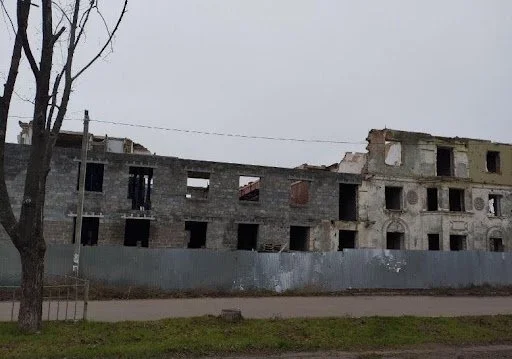
A second source of wealth is the redistribution of existing property. The occupation authorities have stolen pre-war Ukrainian assets and placed them in the Russian official register, where property receives a value for taxation, sale, lease, withdrawal and development. A 2025 Russian law recognises only pre-annexation Ukrainian title documents, requiring owners to appear in person with Russian passports; they have no guarantee that they will not be arrested and disappeared. When most owners declined to take the risk, their properties were designated “ownerless” and transferred to the state. New residential complexes are frequently built not on renovated sites but on the outlines of buildings that have been demolished.
The third mechanism for wealth creation is outright fraud. A Sevastopol developer has been detained for taking some 52 million rubles from sixteen buyers, who received only unfinished shells. There is also the Melitopol building on which the local occupation authorities wasted more than 400 million rubles after evicting its proper owners. The boundaries between subsidised enterprise, administrative reallocation and fraud are indistinct. All of them feed into the same consumer economy.
*
The money that fills the RICH banquet hall may originate in Mariupol, but it is not owned by Mariupol. The consumer surface of the occupied cities rests on a vertical extraction economy. The higher you climb, the more familiar the names become: the sons of the Russian security elite, a Chechen strongman's relatives, the family of the disgraced former president Yanukovych.
Between 2024 and mid-2025, more than 400,000 tonnes of grain left the occupied south through Berdiansk, some $110 million worth carried on at least twenty ships sailing on falsified papers. The route is a laundering operation: the grain is taken to the port of Kavkaz, blended with Russian wheat, and re-stamped as Russian in origin before it sails on to Turkey, Egypt, Syria and Bangladesh. Leaked correspondence shows a Russian certification firm logging the cargoes as domestic “cabotage” (domestic coastal trade between two Russian ports), a bookkeeping fiction that erases the fact they were ever loaded on occupied Ukrainian soil.
Someone had to grow that grain. In occupied Zaporizhzhia, an occupation body grandly titled the “State Grain Operator” fixes prices and takes its cut from a “nationalized” fund of some 250,000 hectares, most of it lying fallow with only a quarter sown in 2025. Farmers describe being made to surrender their harvest at roughly fifteen percent of its worth and shut out of the guarded chain that carries it away. The proceeds do not stay local: exports from the occupied south were coordinated through the Russian Ministry of Agriculture under Dmitry Patrushev, son of Security Council secretary Nikolai Patrushev. Meanwhile, the Grain Operator that Balitsky runs posted a loss of some 1.1 billion rubles in 2024 and has repeatedly filed for bankruptcy. The enterprise runs at a loss because before the money reaches the ledger it is skimmed.
Heavy industry follows the same logic. At Mariupol’s Ilyich steelworks, one of the plants that has defined the city, figures around the Chechen leader Ramzan Kadyrov seized control via relatives of a Kadyrov-allied senator. They proceeded to asset-strip the steelworks, hauling off equipment and scrap for resale in Russia and as far afield as Uzbekistan, even looting an entire production line worth around $220 million. Kadyrov’s people went on to “supervise” the Mariupol port, the grain trade and local business, elbowing aside the collaborators who had naively expected to inherit the city.
Coal tells a third version of the story. Anthracite from the Donbas moves to Turkey through intermediaries and a company, Energoresurs, tied to Oleksandr Yanukovych, son of the former president. It is reported to have exported nearly 500,000 tonnes of coal in 2023–24 via Uspenskaya station in Rostov, a crossing so opaque it is known colloquially as the “Bermuda Triangle.” Less evocatively, it is where occupied-Donbas cargo vanishes and re-emerges as Russian. The seaport for this cargo has itself been carved up by the security services and structures around Deputy Prime Minister Marat Khusnullin.
Behind the shopfronts is the rapacity of this elite. The developers, restaurateurs and (not so) beau monde who embellish Mariupol’s sushi and hookah lounges sit at its retail end. Above them extend the federal officials, security networks and rehabilitated oligarchs who hold the grain, the steel and the ports. Position is granted by loyalty and kept by protection, and those who forget it are disciplined. Balitsky, who resisted outside investors at Berdiansk port and stalled the sell-off of the Kirillivka resort coast, saw his region’s federal funding get cut. The consumerist lives on display in Mariupol are a dividend for those strong enough to survive in the brutal vertical of occupation.
*
Many people cannot and have not survived this vertical. The Russian occupiers have disappeared, summarily executed, tortured, driven insane, deported, and forced out anyone who has dared to challenge them. Of the millions of locals who remain, many live in a fear and penury that gives a surreal cast to the Instagram posts about parties and caviar. In occupied Kherson, where 2,000 civilians are trapped in a humanitarian catastrophe in Oleshky, the installed “governor” Volodymyr Saldo has been marketing proposed yacht marinas, landscaped embankments, “art spaces” and food courts, an “Eco-Folk Henichesk” promenade, resort clusters at Skadovsk and Henichesk, and cottage villages at Novooleksiivka.
Since Russian forces destroyed the Kakhovka dam, most of the region is experiencing drastic water shortages and ruined harvests, while families ration tanker deliveries and haul water home by hand.
Scarcity is hardly isolated to places like Oleshky and Holyi Prystan. Much of the population in occupied Ukraine has been deprived of even the most basic services. Water supply across occupied Donetsk oblast has substantially failed. Reservoirs that served Donetsk, Makiivka and Khartsyzk have run dry, and water reaches households by tanker on a schedule or from barrels placed in courtyards. Residents report going without running water for months at a stretch. Electricity is also intermittent. A single strike on thermal-power infrastructure in November 2025 cut supply to roughly 65 percent of the “DPR” and shut down dozens of boiler houses. As of June 2026, Mariupol’s municipal system operates in a permanent emergency mode dependent on unstable water supply, tired networks and the manual redistribution of resources between districts.
Households that can afford storage tanks, pumps or private wells secure a supply, while others carry water by hand or pay some 2,000 rubles per tanker delivery, generating friction between neighbours. Local entrepreneurs promote water delivery as a growth business.
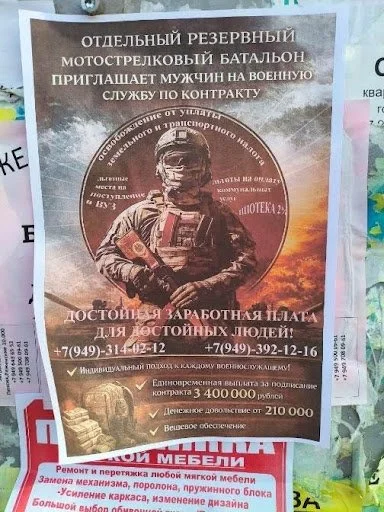
The labour market offers limited mobility across this divide. Large-scale construction has not created a full-fledged labour market for the city, because the main salary and contract flows return to the Russian regions; employers can use shift workers, labour migrants, ex-convicts and locals willing to accept lower wages. Miners in the Donbas and factory workers in occupied Zaporizhzhia face recurrent wage arrears, which are picked up even by Russian media. For younger residents, military service with the occupation forces functions as almost the only realistic source of high income.
Russia is not consolidating its hold here. It is attempting a transplant. New people, new structures, new names are all grafted onto the territory and bound to Moscow and its idea of what this land should be. The idea is a fabrication, an invented historical inheritance, and the graft shows. The imported bureaucrats squat on ground they do not know; the gilded facades insult the ruins over which they were built; a crass imperialism is being imposed on a sullen Ukrainian reality. Everywhere the new order is juxtaposed with the destruction that was required to clear the space for it, and the juxtaposition always grates. The plastic pharaohs of Imperia contain both the look and the logic of occupation, a pre-fabricated fantasy of empire next to a gutted Soviet tower in a devastated Ukrainian city.
Dr. Jade McGlynn is a Leverhulme Early Career Research Fellow the Department of War Studies, King’s College London and Senior Research Fellow at the Centre for Statecraft and National Security.
Photos by Petro Andriushchenko, TOT Insights Hub.
Illustration by Kennan Institute Creative Director Jude Schroder.