
Who Has the Right to Speak?
Curating, Leaving Ukraine, and Cultural Legitimacy in Wartime
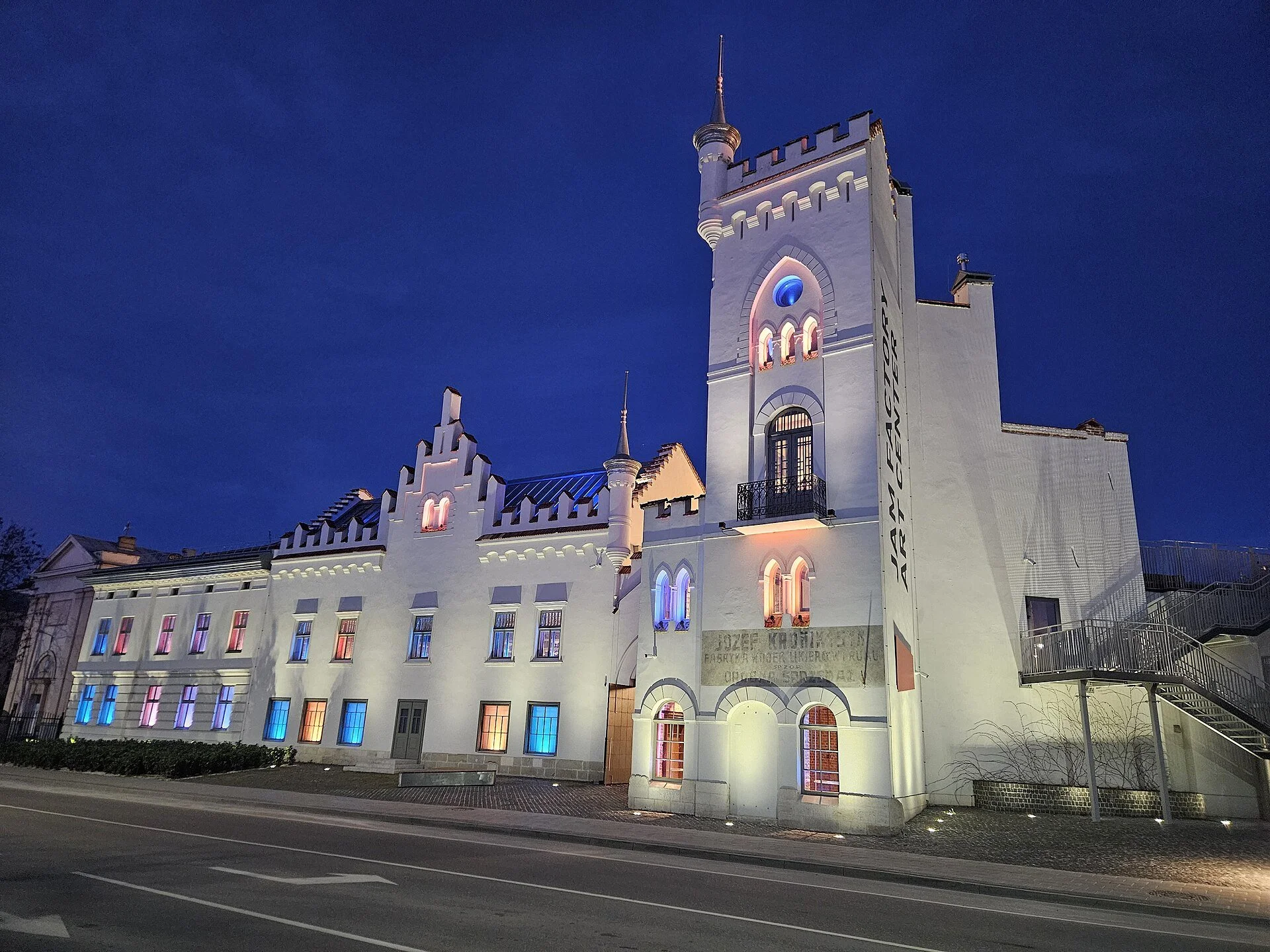
Jam Factory Arts Center in Lviv (April 12, 2025). Photo by Alex Rosenthal.
This summer, the Jam Factory Art Center in Lviv opened an exhibition with an almost prophetic title: THIS IS FINE)). Running from June to August 2026, it has examined self-organized artistic initiatives in Ukraine from 2014 to the present. Twenty-six initiatives are represented, and the exhibition was curated by Nastia Khlestova, Anton Tkachenko, Anastasia Shergina, and Ihor Tymoshchuk. The curators describe self-organization as a mode of "existence, survival, and collective action amid war and ongoing instability," a way to continue working even when everything around you is on fire.
Not long after opening, the exhibition itself became part of the instability it sought to describe. One of its curators, Anton Tkachenko, had left Ukraine approximately two years earlier with official permission granted to cultural figures traveling abroad, and he had not returned. He continued working within the Ukrainian cultural field and became a curator of an exhibition devoted to communities surviving and working in wartime Ukraine. His living abroad provoked controversy. Denys Pankratov, a representative of the Lviv self-organized initiative Mizhkimnatnyi Prostir [Interroom Space] and a serving member of the Ukrainian military, withdrew the initiative from the exhibition. He questioned whether someone who had used the exceptional mobility available to cultural figures and then remained abroad should be granted the institutional authority to represent communities working in wartime Ukraine.
It would be easy to reduce this to an increasingly bitter Ukrainian argument. There are those who stayed versus those who left, soldiers versus civilians, people inside Ukraine versus Ukrainians abroad. But this would miss the more difficult question exposed by the exhibition. Who has the authority to frame, interpret and represent Ukrainian experience during a war in which access to safety, mobility, professional development and even time itself has become radically unequal?
*
The contemporary art world can have a romantic image of the curator. The curator is someone who conducts research, discovers artists, fosters dialogues among works, and helps audiences to see connections that might otherwise remain invisible. All of this is true, but curating is as much an exercise of power as of creativity. Curators choose some artists and exclude others. They establish contexts, create categories, allocate space, and determine which voices will be amplified. The artist and curator do not occupy symmetrical positions. Artists speak, but curators set the conditions under which their speech becomes audible and intelligible.
This point is central to Yosh Pshyk's intervention in the controversy. Writing in Hromadske an online portal, Pyshk, the pseudonymous name for a feminist cultural critic,she argues that "curating is the power to choose others," and that Pankratov's refusal should not be treated merely as another artistic statement or as testimony to his military experience. Pshyk challenges the legitimacy of the arrangement through which some people have the authority to represent others: it is the war that makes this asymmetry particularly visible. Some Ukrainian cultural figures continue their international careers, attend biennials and residencies and travel to conferences. Others cannot legally leave Ukraine. Some have abandoned their professions to serve in the armed forces. Others combine military service with cultural work, and still others have been killed. They may formally belong to the same cultural domain, but they no longer inhabit the same social reality. The question "who is speaking?" leads inevitably to the question of "from where are they speaking?"
Before 2022, mobility was an obvious form of professional capital for Ukrainian artists. A residency in Berlin, Vienna, Warsaw, or Amsterdam enhanced a career. Curators capable of moving between countries and institutions were regarded as successful cultural intermediaries. Rather than destroying this system, the Russian invasion radically changed its moral economy. What was once simply freedom of movement has become a privilege.
This does not mean that Ukrainians abroad lose the right to speak about Ukraine, especially since they too are suffering. Legal circumstances, family situations, health, citizenship, and migration histories differ. Ukrainian culture cannot establish a tribunal to decide who has suffered sufficiently to be allowed to make art. The issue lies elsewhere Does a person's symbolic authority remain unaltered when their material relationship to the community they represent has been transformed?
Speaking in one's own name requires no institutional permission, but curating is much less free. Institutions provide curators with resources, visibility, space, money, and the authority to determine who will publicly represent a cultural phenomenon. Curatorial authority is delegated, making the controversy over Anton Tkachenko less about censorship than legitimacy. Pshyk focuses on the material basis of this asymmetry. Pankratov's intervention, she argues, reminds civilian cultural life of a fact it can easily repress: that exhibitions in Lviv remain possible because people far from Lviv are physically enabling them. This uncomfortable fact introduces material dependence into a cultural field accustomed to discussing symbolic representation. The exhibition is not outside the war. Its very existence is made possible by wartime conditions.
Imagine two artists from the same generation. Before February 2022, they might have participated in the same exhibitions and applied for the same residencies. After the invasion, one moves to Berlin and continues a career, while the other enters the Ukrainian armed forces. Four years later, their cultural capital will differ greatly, because the first can apply for grants, maintain networks, produce new work, attend exhibitions and residencies, and meet curators, while the second may spend months without the physical or psychological capacity to make art at all.
Rather than a moral judgment, this is a structural inequality. War creates a disturbing paradox. Those who experience the historical events most directly may gradually lose the ability to represent them culturally, while those who experience war from a safe distance have the resources required to interpret it.
This is why some authoritative statements made from abroad are received differently and at times more critically within Ukraine. It would be easy to dismiss negative reactions as nationalism, envy, or resentment, which certainly exist; but a crisis of trust can manifest itself in the speaker's position. War has given weight to the location of thinking and of discourse (and of experience), a principle that becomes dangerous if converted into a universal moral law. Suffering does not automatically generate wisdom, and military service does not translate directly into artistic expertise. A person under missile attacks may not be a better curator than someone enjoying the security of Berlin and similar such cities. Yet the opposite assumption—that the speaker's position is entirely irrelevant—is untenable.
*
Borys Filonenko, a Ukrainian curator and art critic, offers a reading of THIS IS FINE)) that complicates Pshyk's argument. Filonenko does not dismiss Pankratov's objection. To the contrary, he notes how extensively Jam Factory incorporated it into the exhibition. The following statement appeared in printed materials and exhibition captions, replacing an absent video interview, and was publicly read by the curator Anastasia Shergina: “I, Denys P., do not see myself participating in this exhibition because I consider it wrong to delegate the power to choose and represent artistic spaces and communities in Ukraine to a man who crossed the border two years ago, using the privilege of a cultural figure, and did not return.”
This text appeared in the exhibition several times. It was in handouts with a description and a map of the project, in captions for the missing video interview with curators of Interroom Space, and on four screens where fragments of the video mightcould have been broadcast (but were not). For Filonenko, the question is what happens to dissent once an institution incorporates it. Does Pankratov "light a spark," or does his protest enter a space of "controlled fire"? The answer depends on whether an actual discussion develops around the conflict, introducing a productive set of problems. Pshyk is primarily asking about who has power and who accepts responsibility for the distribution of art. Filonenko asks what an institution does with the conflict its exhibitions inspire.
Incorporating controversy and criticism can be an admirable gesture of openness. Instead of hiding disagreement, Jam Factory makes it visible. But incorporation can also neutralize dissent. Even the statement "I refuse to participate in your exhibition" can become material for an exhibition. Critique gets displayed, contextualized, and then curated. Filonenko does not automatically conclude that this happened: his question is unresolved. Can an exhibition preserve the antagonism produced by Pankratov's refusal, or does it transform that antagonism into another element of institutional self-representation? This is a distinction that matters.
Filonenko shifts this discussion from individual biography to institutional power. THIS IS FINE)) is ostensibly about self-organized communities. Yet once such communities appear in a major art center, they encounter disparities in resources, visibility and symbolic capital. Filonenko is critical of attempts to describe established institutions and self-organized initiatives inwith the same vocabularylanguage. If everybody is precarious, exhausted, self-organizing and resilient, language can no longer reflect the radically varied amounts of power available to different actors. His comparison with another exhibition clarifies this danger. Precarity can cease to be a condition for which a powerful institution might try to compensate. Instead, precarity can become an aesthetic or curatorial technique. Rather than providing space, an institution can romanticize its absence. Rather than correcting inequality, it can celebrate "freedom" under the aegis of inequality.
Pshyk and Filonenko, who approach the controversy from different directions, meet at an important point. Pshyk emphasizes that democratic procedures alone – such as open calls, juries and collective curating – do not eliminate the need to think through and possibility to confront the distribution of power. She argues that democratic procedure has the potential to dilute responsibility, making it harder to identify who is accountable when a conflict emerges. Filonenko emphasizes nuance and differentiation, indicating that the language of solidarity should not obscure distinctions in institutional power. Together, their arguments suggest that "giving everyone a voice" is not enough. We must ask who controls the frame for these voices and who can make these voices resonate.


Gunshow (Strip #648, "On Fire"). KC Green.
Filonenko, drawing on philosopher Michael Marder, offers a useful metaphor for this dilemma. Marder distinguishes between the light and heat fire produces. Light makes things visible: heat makes for proximity, sensation, and solidarity. But cultural warmth has an ambivalent character, since the desire to remain together can be stronger than the desire for critical engagement. For Filonenko, THIS IS FINE)) is better at producing heat than it is at shedding light. This may be the fairest way to assess the exhibition and its aftermath. The capacity to maintain cultural communities during war is far from trivial, and Filonenko praises the exhibition for restoring connections among those in the artistic field willing to explore marginal spaces.
Networks extending beyond Ukraine belong to this complicated ecology of encounter. Ukrainian artists and curators abroad have communicated Ukrainian experiences internationally. They have raised funds, challenged Russian narratives and sustained international attention. Their contribution cannot be reduced to their distance from the war, though warmth and solidarity are not all-encompassing. Being part of the same Ukrainian cultural field does not mean occupying equivalent positions within it.
This inequality will matter long after the war ends. Cultural careers depend on continuity, and producing work, traveling, publishing, maintaining networks, accepting invitations and remaining visible are vital to the creative process. War disrupts this continuity unevenly and unfairly. When the war ends, those least able to participate in cultural production run the risk of being the least visible. Soldiers may return to a professional field that moved on without them, while those with greater mobility possess stronger CVs, broader networks, and greater authority to explain what “Ukrainian culture during the war” was.
The people closest to the experience of war could become marginal to its translation into art and into cultural memory. Pshyk's response is to insist that cultural figures directly connected to the war need more than symbolic acknowledgment. The question is whether they will participate in decision-making itself, deciding who will sit on juries, distribute resources and define institutional agendas. Filonenko outlines another warning. If everything gets absorbed into a bland consensual language of community and resilience, inclusion alone is inadequate.
*
The central question should not be whether a person who left Ukraine can make or judge or curate Ukrainian art. That question too easily leads to moral policing. A better question concerns changes in the weight of cultural authority since 2022, when everyone had a voice. Representation requires attention to people’s positions in life, and institutional power demands accountability. Ukrainian culture must defend two propositions simultaneously: experience does not equal authority; and authority cannot pretend to be independent of experience.
The controversies surrounding THIS IS FINE)) is valuable precisely because they are so difficult to disentangle. They reveal a cultural field trying to operate according to pre-war principles of mobility, professional autonomy and international exchange on the one hand and on the other to the wartime realities of military service, restricted movement, physical danger and radically unequal degrees of sacrifice.
The soldier who refuses an exhibition and the curator who works from abroad do not inhabit mutually exclusive moral universes. One person's sacrifice does not invalidate another's professional competence, but it is not censorship to contemplate and account for the asymmetry at work. It is the beginning of an ethics proportional to wartime. The task of Ukrainian cultural institutions is not to decide once and for all who is entitled to speak. It is to illuminate the conditions under which some voices acquire cultural sway while others lose it and to ensure that solidarity does not erase difference. An unacceptable outcome of this war would be a cultural order in which those who had the greatest opportunity to distance themselves from Ukraine gradually acquired the greatest authority to commemorate and to define Ukraine’s wartime experience.
Bohdan Shumylovych is an Associate Professor in the Department of Cultural Studies at the Ukrainian Catholic University in Lviv, Ukraine and was previously a researcher at the Lviv Center for Urban History. The main focus of his work is media history in East Central Europe and the Soviet Union, as well as media arts, visual studies, urban spatial practices, and urban creativity.