
Weapons of the Weak: What Today’s Russian Humor Reveals

Jokes, songs, rumors and small acts of sabotage do not directly threaten power, but they reinforce distrust of the “strong.” The prevalence of satiric and critical discourse is an indicator of social tension and therefore something that deserves close attention. Gossip and jokes, the anthropologist James C. Scott argued, form a space that furnishes direct access to people’s expectations and desires.
Before the internet era, hidden messages, these “weapons of the weak,” as Scott called them, circulated in a kind of gray zone. They thrived, for example, in Soviet smoking rooms or in the restrooms of Italian factories: spaces that were no longer private like the home, yet not fully public.
In today’s Russia, as elsewhere, this kind of discourse naturally finds its outlet in social media. Some platforms serve it better than others, and many users find it easier to speak than to write. With its emphasis on live visuals, Instagram has absorbed much of the small-business activity. Videos that are quickly recorded and shared create a sense of direct, personal communication.
Instagram has retained this advantage despite being banned in Russia. Shortly after Russia launched its invasion of Ukraine, the Kremlin restricted access to several major platforms and later designated Meta, Facebook and Instagram’s parent company, an “extremist organization.” WhatsApp, also owned by Meta but widely used in Russia, was exempted and then banned. Despite the ban, a significant number of users and businesses continue to access Instagram through circumvention tools such as VPNs and mirror services.
Russian law enforcement agencies exercise near total control over VKontakte, Russia’s largest social media platform, comparable to Facebook, which readily provides user data upon request. Its parent company, VK, is effectively controlled by state-run companies including Gazprom, and its CEO, Vladimir Kiriyenko, is the son of Sergei Kiriyenko, the Kremlin’s chief of domestic policy and first deputy head of the presidential administration.
Aided by keyword search, the authorities operate with relative ease in Telegram channels. They are far less effective when it comes to Instagram reels. Because word search does not work with them, content has to be tracked down manually.
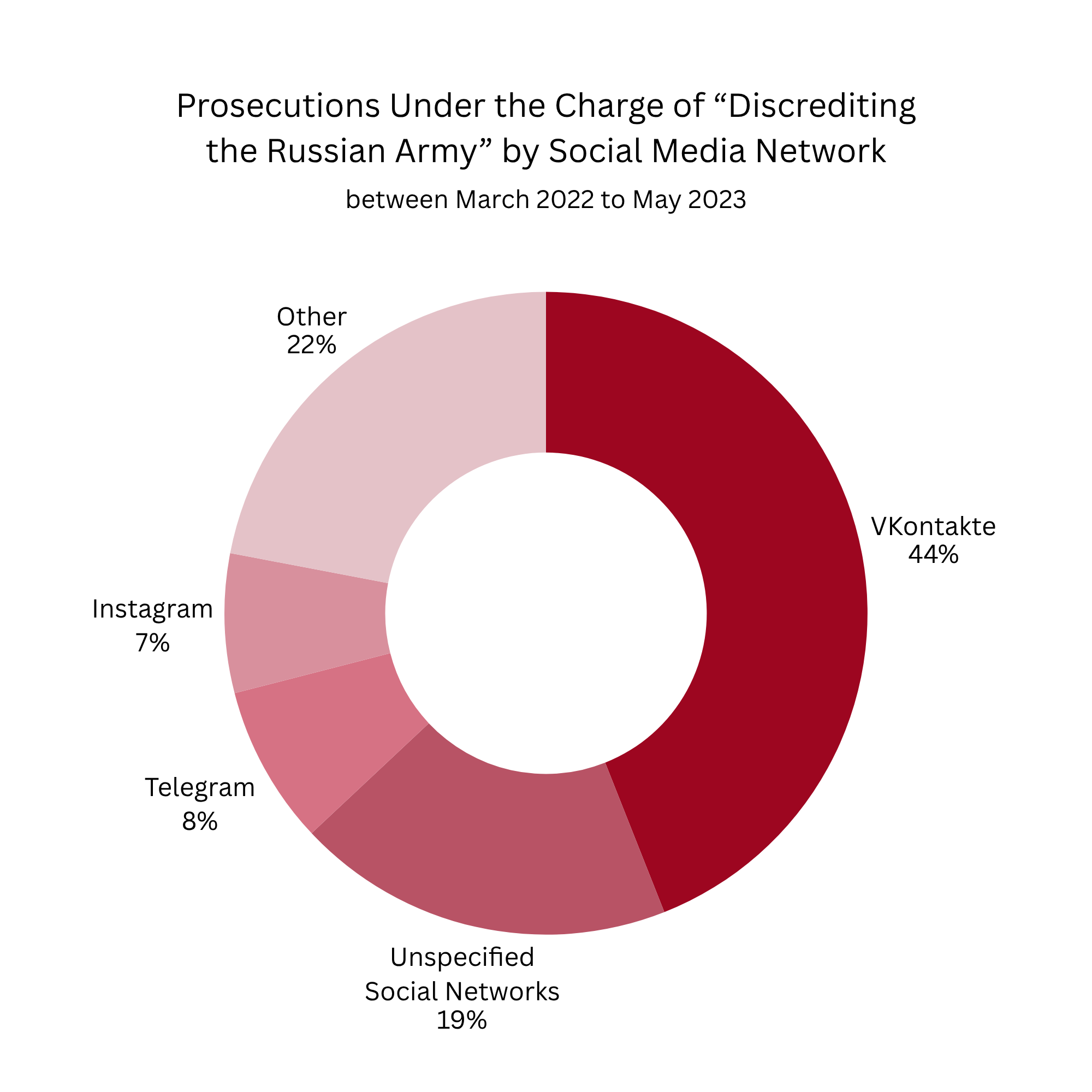
From March 2022 to May 2023, together with volunteer lawyers, I compiled a database of prosecutions under the charge of “discrediting the Russian army” (Article 20.3.3 of the Code of Administrative Offenses). Of the 1,447 known cases of prosecution for antiwar statements, forty-four percent were linked to VKontakte, nineteen percent to “unspecified social networks,” and the rest were distributed relatively evenly. Telegram accounted for eight percent of cases, and Instagram for seven percent. Notably, almost all fines related to Instagram were based on the analysis of text in Stories rather than video content.
A blocked Instagram has become precisely the kind of gray zone that Scott described. The ability to make a personal statement on the one hand, and the difficulty of automated monitoring on the other, have inspired many humorous and anxiety-laden reels, which are shared in the thousands and tens of thousands.
In February and March 2026, Instagram users have been spreading what might be called “performative jokes.” Different users pick up a familiar, recurring motif – varying in detail but essentially the same – and present it as a miniature performance from their own perspective. This shows that folklore is alive, and jokes today have simply taken on a new form.
Many jokes deal with Max, a state-backed messaging app developed by VK and promoted as a native alternative to platforms like WhatsApp and Telegram. For example, a user calls the FSB and says: “You’re monitoring me through Max anyway, right? Remind me what my wife asked me to buy / where I’m supposed to meet someone / which apartment number I’m looking for, I’ve forgotten.” The FSB officer responds, and then, depending on the variation, adds that the wife is seeing a lover or that the apartment listing is fake. The sketch typically ends with the “Comrade Major” addressing the user: “Stand up straight!” a reminder that the Federal Security Service not only listens but sees everything. Watch the reels here, here, and here.
A second popular performative joke follows a different pattern. A user calls his wife on the Max messenger: “Hey, come over, I’ll order pizza and sushi.” A second later, he receives a notification from the bailiffs: “Eating well, Dmitry but you could have paid off your loan debt instead.”
In both cases, the Federal Security Service imposes its “care,” suggesting that it will look after the narrator better than he can himself. This paternalism is taken even further in a series of jokes about the near future, where a person wakes up to a call via the Max messenger and is required to report to an FSB officer on their plans for the day, the content of their dreams, and what the family is saving money for.
Reels that mock a shared predicament – restrictions, and bans – promote their creators. It is precisely these narratives that people choose when making videos they hope will go viral.
As of March 2026, a new law requires that all information intended for consumers be presented in Russian. Foreign-language text may remain untranslated only if it forms part of a registered trademark, service mark, or official company name. The law has drawn objections from a wide range of professions, including psychotherapists, who have highlighted the awkward, archaic-sounding Russian equivalents for “schizophrenia” and “depression.” Stylists, hairdressers, and beauty salon owners have also been mocking the new rule, posting videos “translating” words like stylist, barber, and lashmaker into Russian.
Though nail salon workers are not exactly the group one would expect to protest, they have been particularly active in this performative genre. In their videos, they imagine that, once messaging apps are blocked, they will notify clients via the intercom or by shouting up at the client’s windows.
Manicurists show how they will work under the new restrictions. Music cannot be played in the salon without a paid license, and clients cannot be addressed by name without written consent. If the Shazam app is found on a client’s phone, the client is treated as a spy. A fitness trainer from Novosibirsk compares news about livestock culling in Siberia on YouTube (plenty of information) and on VK Video (none).
People are not just making jokes. They are discussing what to do. Some are considering moving to Belarus. Zoomers are posting videos about “abusive relationships” with the motherland, comparing it to Dolores Umbridge from Harry Potter. Millennials, meanwhile, are sharing a video built around the line “There’s nowhere to run, Mr. Anderson,” a reference to The Matrix.
Russian humor today is often gallows humor. The storytellers are not laughing at others but at themselves. This collective “I,” which long saw itself as apolitical, protected its everyday life, and did not believe the state would intrude into it, has now become the object of self-irony. That is why these videos are so easily and naturally performed in the first person.
At first glance, this kind of humor may like letting off steam. It is more than that. By staging the same humorous scenarios, users are collectively negotiating a shared understanding of what is going on. A horizontal network of interpretations emerges, in which the authorities consistently appear as absurd, intrusive, and excessive.
Hundreds of thousands of views turn a private joke into a collective experience. A shared awareness, encoded in humor, demonstrates that what is happening is not normal. The modern weapons of the weak are not direct resistance. They are the mass production of an attitude that avoids direct confrontation with authority, while steadily eroding trust in the powers that be.
This piece has been translated from the original Russian and adapted for context and clarity, and is republished here with permission from the publisher, Важные истории.
Alexandra Arkhipova is a social anthropologist and Visiting Professor at the École Normale Supérieure, Paris.