
Part 3: A Dream Contested
On several visits to Georgia over the past three years, I have attempted to interview members of the Georgian Dream (GD), but have found little willingness to meet with an American who has worked as both a journalist and an academic. Two years ago, with the help of an American journalist colleague, I was able to get in touch with one young official who spoke excellent English and appeared to be the “designated hitter” for GD’s conversations with Western journalists. He assured me Georgia was intent on joining the European Union, but the government’s subsequent November 2024 decision to suspend efforts to open EU accession negotiations until the end of 2028 belies that. The EU has warned that Georgia’s “foreign agents” law and democratic backsliding impede the country’s attempts to join Europe but increasingly the GD seems intent on pushing Europe away, claiming it must protect the country’s “sovereignty.”
Shortly before this trip, I had the opportunity to meet a delegation of Georgian parliamentarians visiting Washington, DC. I was eager for the chance to talk with them, hoping they could explain the rationale for GD actions that have been criticized both by political opponents and by many western governments. On the delegation’s agenda were meetings with members of Congress, the executive branch, think tanks, and a conference of the Alliance of Sovereign Nations, organized by the honorary chairwoman, Florida’s Republican Congress member Anna Paulina Luna.
In our meeting, they said they were in town to “rebuild relations” with the White House, to “make Georgian-American relations great again.” The Trump administration, they explained, has a “much better understanding of our position” than the Biden administration did.
In an address to the conference, the head of the delegation, Chairman of the Georgian parliament’s Foreign Relations Committee, Nikoloz Samkharadze, told the audience that Georgia is a “partially occupied country – 20% of our territories are occupied by the Russian Federation.” “We have been victims of foreign interference in our elections and internal affairs,” he continued. “When I speak about foreign interference, I do not mean only the Russian Federation; I also refer to non-governmental organizations funded from the United States and Europe that were effectively working to undermine the legitimacy of a democratically elected government, as well as to encourage unrest, violence, and ultimately the violent overthrow of the government.”
When I raised that viewpoint in Tbilisi with several members of NGO organizations, they scoffed. “It’s fake conservatism,” they said, “one of the fallacious arguments they make in order to try to appeal to the MAGA movement in the United States.””
When I asked the delegation about the Hudson Institute report about alleged growing Iranian influence, they denied it was happening.
In January 2025, Representative Joe Wilson, a Republican from South Carolina, introduced the “Megobari Act” (Mobilizing and Enhancing Georgia’s Options for Building Accountability, Resilience, and Independence Act)in the U.S. House of Representatives. (The word in Georgian means “friend”). The bill requires the President to impose sanctions on foreign persons he determines are involved with “actions or policies to undermine Georgia's security or stability.”
In May, the bill passed the House with overwhelming bipartisan support. Calling the GD party a “tyrannical mafia cabal,” Congressman Wilson said the vote demonstrated U.S. support “for the freedom-loving Georgian people and rejection of the illegitimate, America-hating Georgian Dream regime.”
Since then, the Megobari Act has languished on Capitol Hill. Then-Senator Markwayne Mullin, Republican from Oklahoma (as of March 2026 U.S. Secretary of Homeland Security), who previously criticized GD for its close ties to America’s “hostile rivals and enemies,” changed his mind and blocked the bill, warning the legislation would harm U.S. ties with Tbilisi. “I want to be able to work with them before we throw sanctions on them,” he told thehill.com.
In May, a U.S. State Department delegation visited Tbilisi, meeting with Prime Minister Irakli Kobakhidze and other government officials. In a statement issued after that discussion, the GD government struck an optimistic note, along with its customary reference to Georgian sovereignty, announcing the focus was on “the importance of resetting USA-Georgia relations and establishing a strategic partnership based on a concrete roadmap.” Georgia was ready “to renew bilateral relations from a clean slate, based on mutual respect.”
The U.S. statement, while positive, struck a more cautionary note: “A sustainable partnership will require continued progress in ensuring the conditions that make Georgia a credible partner, including a business environment favorable to American business and a stable domestic political climate that facilitates opposition engagement.”
The U.S. delegation met with several opposition leaders, noting “a functional democracy requires a political opposition that engages with state institutions to represent the interests of citizens who voted for it.” The careful phrasing could be interpreted in two ways: urging the government to allow the opposition to function; or urging the opposition to participate in a parliament many of them do not recognize as legitimate and which some have boycotted.
Like most of the opposition leaders, Zurab Japaridze dismissed the GD’s willingness to work with the opposition: “Bringing this country and America closer is not in their interests. This is a fairy tale,” he told the independent news site Civil Georgia: “American companies will not be able to enter this country as long as there is no independent judiciary and no rule of law.”
At least one business deal does seem to be in the officing. On May 11, President Trump’s son Eric announced on X plans for a seventy-story luxury apartment complex, to be branded “Trump Tower Tbilisi.” If completed, it would be the tallest building in Georgia. “I am so excited to share the official rendering of Trump Tower Tbilisi,” he wrote. “With a prime location, in the heart of Tbilisi, this tower will quickly become a landmark as the tallest building in Georgia. This marks our first project in the region and we are so excited to bring it to life!”
According to the Trump Organization website, it’s the first “Trump branded project” in the region, to be constructed in cooperation with several Georgian investment and real estate companies. It has already has attracted controversy. The development would be built on land that originally was sold to Ivanishvili. He later divided the territory and donated a significant part of it – a barren former racetrack - to the city of Tbilisi. The rest is a verdant tree-covered park used a public recreational area, one of the few in the rapidly urbanized capital. The current ownership is complex and obscure.
A year and a half ago, Saba Buadze, former member of parliament and former leader of the opposition in the Tbilisi City Council, along with some associates, sued the city requesting to annul the project. Since then, only one court hearing has been held. “And I’m not surprised why,” he told me in a telephone conversation. “The Georgian investors who are in a close relationship with the ruling party are going to pay a significant amount of money to the Trump Organization in order for them to acquire the Trump name.”
Buadze charges the project would cause significant harm to the city: “They’re going to destroy one of the last and very important green spaces in the city…now, it could be an opportunity for the ruling party and Ivanishvili to develop some kind of relationship with the Trump family and the Trump Organization.”
Before leaving, I had lunch with the most well-known modern singers in Georgia, Nino Katamadze, whom I first heard twenty years ago in Moscow. I’ve been a fan ever since. Her friend and colleague, Nikolas Rachveli, joined us. He is a composer, conductor, arranger and pianist, as well as the General Music Director of the Georgian Philharmonic Orchestra. They were just back from another concert tour in Ukraine. Ignoring the dangers of the war, they bring Nino’s jazz-inflected music to civilians on the front lines, in hospitals and in that concert halls that still manage to function. Ironically, we spoke in Russian, since I cannot speak Georgian and their command of English was limited.
“It’s unbelievably hard to see people who want to applaud, but they have lost arms or hands,” Nikolas recounted. “But we can’t allow ourselves to cry or show our sadness. We can just be artists who love their music and are happy to play. They’re so happy to see Nino and hear her music! They can turn off from all the psychological and physical trauma they are going through. When they leave, and go home, then we can feel it. But you never get used to it.”
Back home in Tbilisi, Nino regularly joins anti-government protests. Laws have been tightened to gut any protest against GD. Even standing on a sidewalk as a pedestrian can be a criminal, not an administrative offense with a sentence of fifteen days in jail. For repeat offenses, it means one year in jail.
And yet, she and her friend gather near Parliament almost nightly. Georgians living in the countryside have no chance to protest, she told me. “They are poor. For them, politics is something unattainable; they vote for whoever they are told to vote for,” she said. “Life is difficult. But things are changing, she believes. People have shown they are ready to see politics as part of life, not something separate. The wave of protests is big.”
Ukraine, Georgia, even Moldova, they are like a “mini-world,” she told me: “The memory of the Soviet Union is the same. The old system is the same, emotions are the same. It’s the same problem, a spiritual problem. But Ukrainians have shown they are trying to preserve their spiritual values. These problems that Nikolas and I are talking about (here in Georgia), they’re not really problems,” she explains. “It’s a process you have to go through because, if you don’t resist, and if you don’t think that, really, this is absolutely not normal, to live next to people who are arresting young people, when young guys have gone out and expressed their absolutely healthy ideas about their motherland. All we are demanding is that they won’t steal any more money, rob the government, so that grandmothers and grandfathers won’t go hungry, so that they can afford the medicine they need, nothing more.”
In June, the House of Representatives passed a bill requiring the Trump administration to conduct a detailed assessment and issue a report on Russian and Chinese intelligence activities in Georgia. It passed with bipartisan support. It also requires the administration to define its strategy on Georgia. The sponsors said the goal of the bill was to let the Georgian people know the American people support them in their quest for democracy and strengthen ties with the Euro-Atlantic community. The bill must be approved by the Senate and be signed by President Trump.
In the early days of the country’s independence, after the breakup of the USSR, Georgia often was called the “poster child” of the transformation. It embarked on fiscal reform and drew close to the west. Although it was not a member of NATO, it deployed 11,000 troops to Afghanistan as party of the International Security Assistance Force (ISAF). Thirty-two of them died. Its soldier supported the NATO operation in Kosovo from 1999 to 2008.
But that was before Bidzina Ivanishvili and the Georgian Dream came to power. Now, Georgia’s neighbors in the Caucasus region, Armenia and Azerbaijan, are slowly rejecting Russia and moving closer to the west. Georgia sits alone, increasingly isolated and influenced by Russia. Its EU accession process is stalled and any hope that it might join NATO is almost extinguished.
The overwhelming majority of Georgians, however, want a closer relationship with the west. There is growing discontent, even among Georgian Dream supporters, with the Georgia deteriorating economy. A recent EU-funded survey shows that almost three quarters of Georgians support joining the EU.
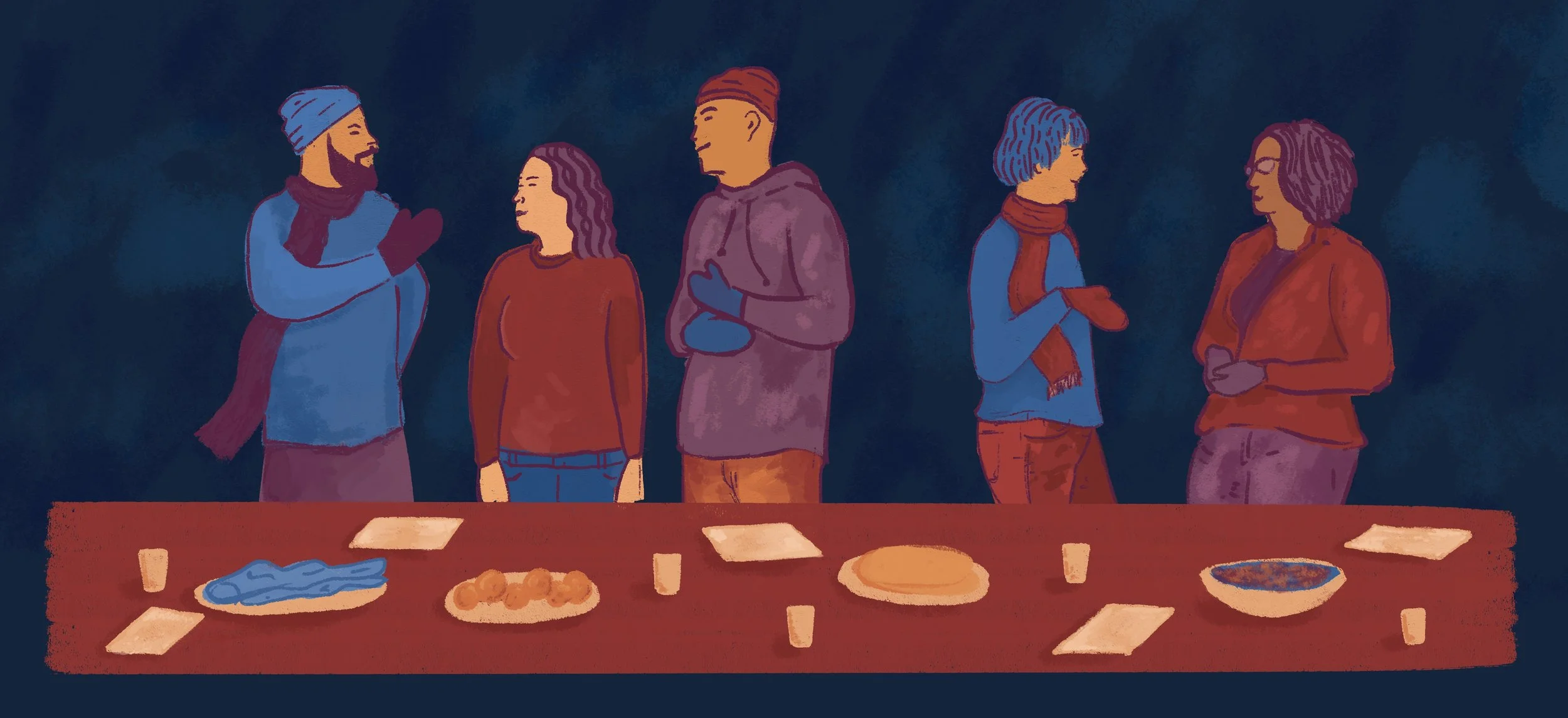
This past March, on my last night in Tbilisi, I took a walk on the main boulevard, Rustaveli Avenue, remembering how I spent New Year’s Eve 2025 along with tens of thousands of Georgians at a massive “supra,” Georgia’s traditional ceremonial feast. Down the middle of the street, as far as the eye could see, stretched a giant symbolic supra table constructed of scores of smaller tables set up end-to-end, covered with a bright red cloth and groaning with array of every delicious Georgia dish imaginable, along with bottle after bottle of Georgian wine. It was a New Year’s Eve party, complete with fireworks, but it also was a protest against GD, against arrests and violence, and the direction in which many Georgians feared the country was headed.
This cold and still night, more than a year later, I saw a small group of about one hundred protesters gathered in front of the Parliament building, holding the Georgian flag, along with the flags of the European Union and Ukraine. Seeking a better location to take some pictures, I crossed the street through an underpass, emerging in front of parliament. I was stunned to see my favorite singer, Nino Katamadze, standing there, chatting warmly with some friends. We embraced and she introduced me to two of her friends, middle aged men who looked as if they had seen a lot in their lives. Nino told me they came there every night.
The men smiled and shook my hand. One of them wearing the Georgian flag like a cape, holding a paper cup of hot coffee in the cold night air, raised his right hand and flashed a two-fingered victory sign. Nino clasped her hands together, as if in prayer.
Supporters of Georgia are hoping those prayers are not in vain.
Jill Dougherty is a Distinguished Fellow at The Wilson Center and Affiliated Scholar at the Center for Eurasian, Russian and East European Studies at Georgetown University.
Illustration by Kennan Institute Creative Director Jude Schroder.